11 markeasy
A molecule contains carbon, hydrogen and oxygen. For every carbon atom there are twice as many hydrogen atoms but the same number of oxygen atoms.
What is the formula of the molecule?
Choose your answer
C2H6O
C2H4O2
C4H8O2
C2H2O2
17 questions · 17 marks · ≈ 17 min
A molecule contains carbon, hydrogen and oxygen. For every carbon atom there are twice as many hydrogen atoms but the same number of oxygen atoms.
What is the formula of the molecule?
Choose your answer
C2H6O
C2H4O2
C4H8O2
C2H2O2
Theobromine is a stimulant found in chocolate and in tea leaves and is closely related to caffeine, the stimulant found in coffee.
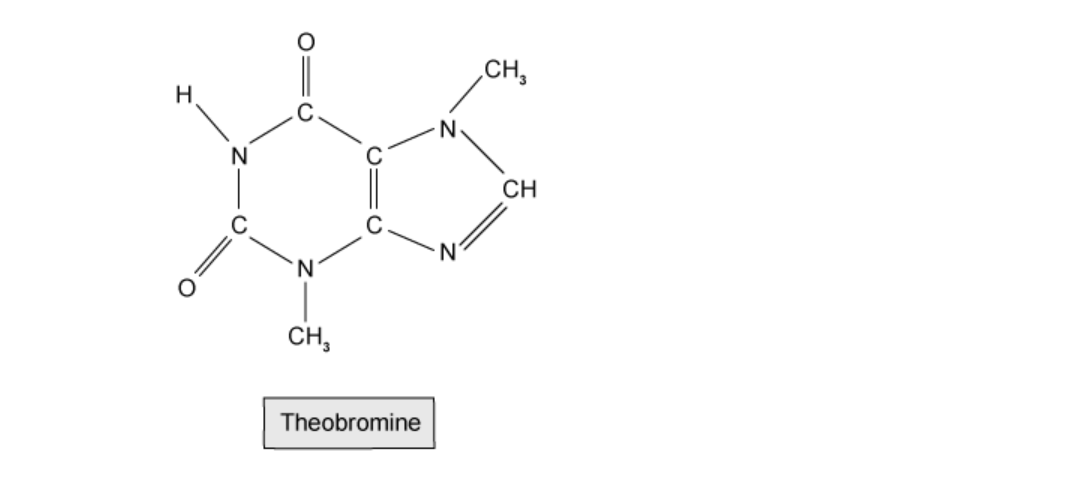
What is the formula of theobromine?
Choose your answer
C6H5N4O2
C7H8N4O2
C7H8N3O2
C7H7N4O2
Extended tier only
Hydrogen reacts with elements from Group VII to produce compounds called hydrogen halides. An example is when a molecule of hydrogen reacts with a molecule of fluorine to produce hydrogen fluoride.
What is the correct equation for the reaction?
Choose your answer
2 H + 2 F → 2 HF
H2 + F2 → H2F2
2 H + 2 F → H2F2
H2 + F2 → 2 HF
Leucine is an essential amino acid used in the synthesis of proteins in the body.
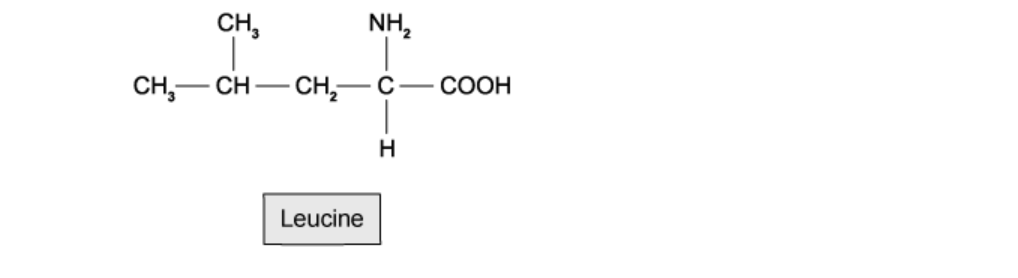
What is the relative molecular mass of leucine?
Choose your answer
144 g
86 g
125 g
131 g
When magnesium carbonate is heated, the products are magnesium oxide and carbon dioxide.
MgCO3 (s) → MgO (s) + CO2 (g)
What mass of magnesium oxide is formed when 21 g of magnesium carbonate thermally decomposes?
(Ar = Mg = 24, C = 12, O = 16)
Choose your answer
10
11
20
22
Extended tier only
What is the balanced equation for the reaction of methane and oxygen?
Choose your answer
CH4(g) + 2 O2(g) → CO2(g) + H2O(g)
CH4(g) + O2(g) → CO2(g) + 2 H2O(g)
2 CH4(g) + 4 O2(g) → 2 CO2(g) + H2O(g)
CH4(g) + 2 O2(g) → CO2(g) + 2 H2O(g)
Extended tier only
A compound contains two atoms of oxygen and one atom of calcium. It also contains hydrogen in sufficient amounts so that the overall charge of the molecule is neutral.
What is the molecular formula for the compound?
Choose your answer
Ca(OH)4
Ca(OH)2
H4CaO2
CaO2H2
Extended tier only
Dilute sulfuric acid and barium chloride solution react to produce barium sulfate and hydrochloric acid, as shown in the reaction below:
H2SO4 + BaCl2 → BaSO4 + 2 HCl
Which row represents the correct state symbols for the reaction?
| H2SO4 | BaCl2 | BaSO4 | HCl | |
|---|---|---|---|---|
| A | (aq) | (l) | (s) | (aq) |
| B | (l) | (aq) | (aq) | (l) |
| C | (aq) | (aq) | (s) | (aq) |
| D | (l) | (aq) | (l) | (aq) |
Choose your answer
6 g of hydrogen react with 48 g of oxygen to form water. A chemist performs the same reaction using 2 g of hydrogen.
What mass of oxygen is required to combine with the hydrogen?
Choose your answer
24 g
12 g
16 g
72 g
Extended tier only
The formula and charge for positive and negative ions are shown.
| cation | anion |
|---|---|
| Al3+, Mg2+, Cu2+, Fe2+, Li+ | F-, CO32-, NO3-, S2-, SO42- |
The table shows the name and formula of common ionic compounds formed from the ions. Which row is not correct?
| name | formula | |
|---|---|---|
| A | lithium sulfide | Li2S |
| B | iron(II) fluoride | Fe2F3 |
| C | aluminium sulfate | Al2(SO4)3 |
| D | magnesium nitrate | Mg(NO3)2 |
Choose your answer
The displayed formula of propene is drawn below.
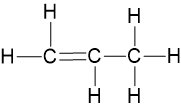
Calculate the relative molecular mass, Mr, of propene
(Ar: C=12, H=1)
Choose your answer
30
34
42
50
Iron(III) chloride is an ionic compound.
What is the formula of iron(III) chloride?
Choose your answer
FeCl
FeCl2
FeCl3
Fe3Cl
Ammonia is manufactured by the reaction of hydrogen and nitrogen in the Haber process, as shown in the equation below:
N2 + 3 H2 → 2 NH3
16.8 tonnes of ammonia can be produced from 14 tonnes of nitrogen.
How much nitrogen is needed to produce 51 tonnes of ammonia?
Choose your answer
42.5
34
17
24.5
Extended tier only
The left hand side for the reaction between ammonia and copper(II) oxide is shown. What are the products of the balanced equation?
3 CuO + 2 NH3 →
Choose your answer
3 Cu + 2 N + 3 H2O
3 Cu + 3 HNO3
3 Cu + N2 + H2O
3 Cu + N2 + 3 H2O
Extended tier only
What is the balanced equation for the reaction between aqueous NaOH and Fe2(SO4)3?
Choose your answer
Fe2(SO4)3 (aq) + 6 NaOH (aq) → 2 Fe(OH)3 (s) + 3 Na2SO4 (aq)
Fe2(SO4)3 (aq) + 2 NaOH (aq) → Fe(OH)3 (s) + Na2SO4 (aq)
2 Fe2(SO4)3 (aq) + 4 NaOH (aq) → Fe(OH)3 (s) + Na2SO4 (aq)
3 Fe2(SO4)3 (aq) + 6 NaOH (aq) → 3 Fe(OH)3 (s) + 2 Na2SO4 (aq)
Extended tier only
Magnesium nitrate and sodium carbonate react as shown.
Mg(NO3)2(aq) + Na2CO3(aq) → MgCO3(s) + 2 NaNO3(aq)
Which row describes the spectator ions and the net ionic equation for the reaction?
| spectator ions | net ionic equation | |
|---|---|---|
| A | Mg2+ and CO32- | Mg2+(aq) + CO32-(aq) → MgCO3(s) |
| B | NO3- and Na+ | NO3-(aq) + Na+(aq) → NaNO3(aq) |
| C | Mg2+ and CO32- | NO3-(aq) + Na+(aq) → NaNO3(aq) |
| D | NO3- and Na+ | Mg2+(aq) + CO32-(aq) → MgCO3(s) |
Choose your answer
Extended tier only
Nitric acid and potassium hydroxide react in a neutralisation reaction to produce salt and water, as shown by the equation below:
HNO3(aq) + KOH(aq) → KNO3(aq) + H2O(l)
Which row describes the spectator ions and the net ionic equation for the reaction?
| spectator ions | net ionic equation | |
|---|---|---|
| A | NO3- and K+ | NO3-(aq) + K+(aq) → KNO3(aq) |
| B | H+ and OH- | NO3-(aq) + K+(aq) → KNO3(aq) |
| C | NO3- and K+ | H+(aq) + OH-(aq) → H2O(l) |
| D | H+ and OH- | H+(aq) + OH-(aq) → H2O(l) |
Choose your answer