Public & Private Worship in Muslim Communities (Cambridge International IGCSE Religious Studies)
What is the adhan?
-
Adhan literally means “announcement” in Arabic
-
The adhan is the Islamic call to prayer
- In some countries, this takes place five times a day
blockquote “Believers! When the call to prayer is made on the day of congregation, hurry towards the reminder of God and leave off your trading” (Qur’an 62:9)
- The muezzin is the official who calls the people to prayer, sometimes from a minaret at the mosque
The performance of wudu and its significance
-
Muslims must prepare themselves for prayer by spending a few moments reflecting on their niyyah (intentions)
-
They must also spiritually cleanse themselves before prayer
-
This is achieved by a ritual washing called wudu, following special instructions so they do it in the right order
-
The ritual involves washing faces, hands and feet under running water
-
Mosques have special rooms for this
-
In the desert, a dry wash of sand and dust can be used
- This is called tayammum
-
It allows Muslims to fully concentrate on prayer
-
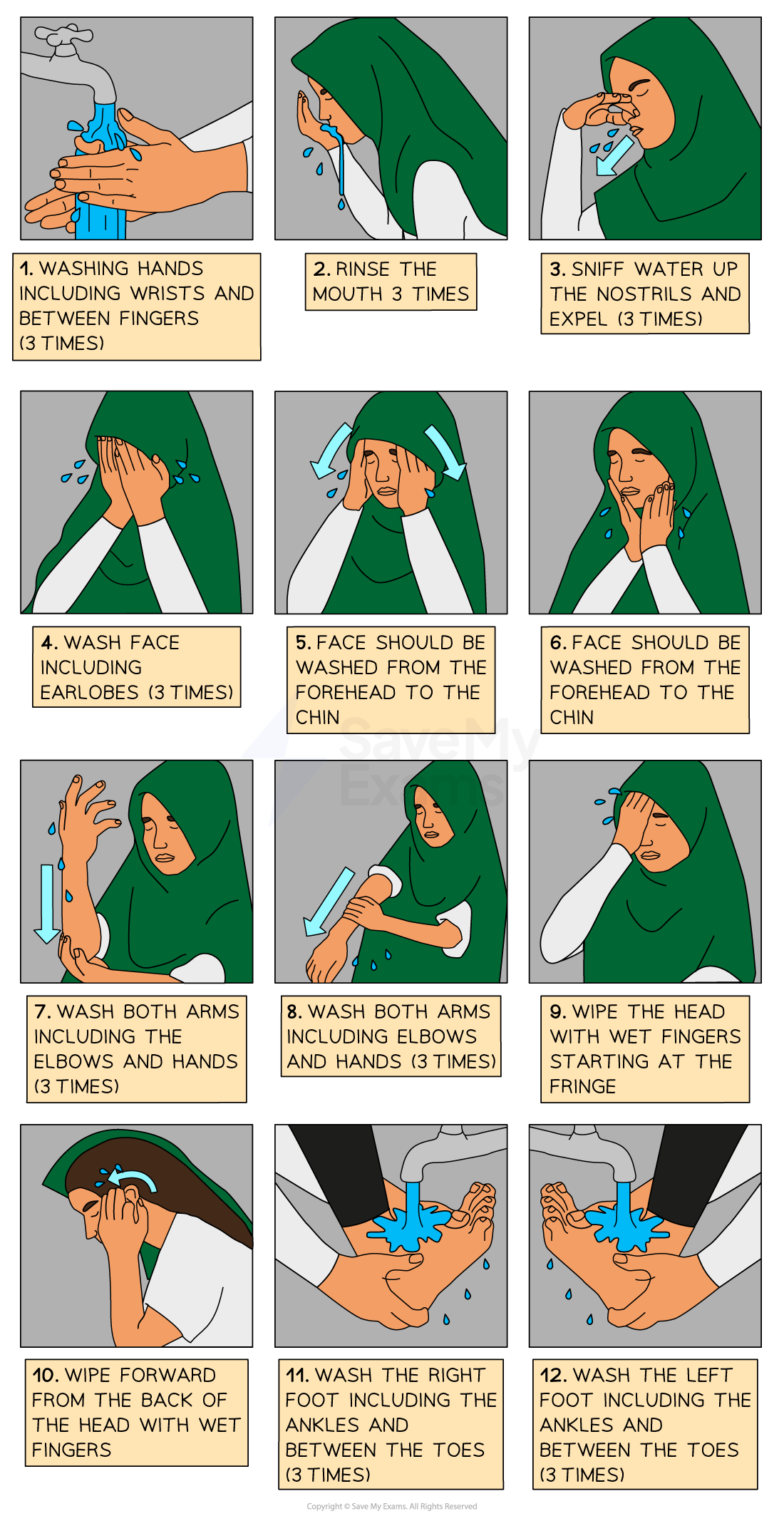
Ritual washing — wudu
Salah and frequency of prayer
-
Salah (prayer) is the second pillar of Islam for Sunni Muslims and one of the Ten Obligatory Acts for Shi’a Muslims
- It is considered to be the most important way of worshipping God
- It occurs five times daily: just after dawn, just after midday, late afternoon, just after sunset and after dark
-
The different prayers are given different names:
- Fajr — just before sunrise
- Zuhr — just after midday
- Asr — late afternoon
- Maghrib — just after sunset
- Isha — between sunset and midnight
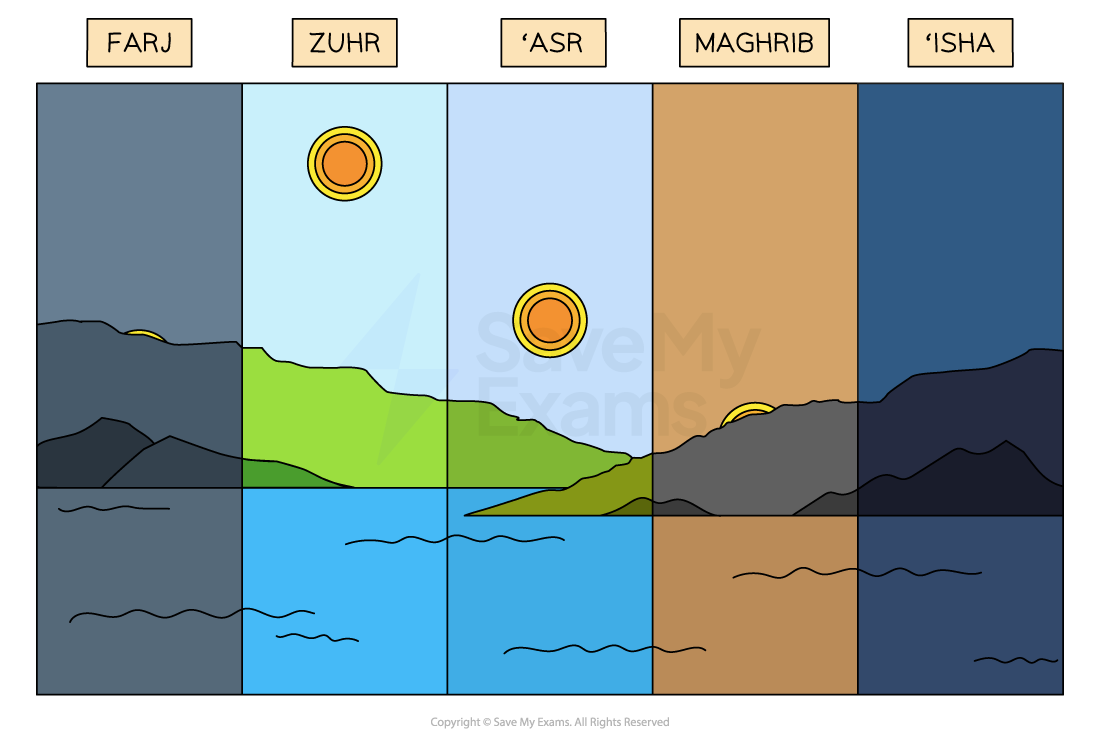
The five times of prayer
The times and sequence of the rak'ahs
-
All Muslims pray towards Makkah and perform rak’ah, a set sequence of movements, during the prayers
-
The actions that form the rak’ah during Muslim prayer are:
-
While standing, Muslims recite the first chapter from the Qur’an
-
While bowing, Muslims say in Arabic, “Glory be to my Lord who is the greatest” three times. This bowing position shows they believe God to be great
-
Returning to an upright position, they make a recitation praising God
-
They kneel with their forehead, nose, hands, knees and toes touching the floor
-
This is called prostration and shows complete obedience to God
-
They recite, “How perfect is my Lord the most high”
-
Muslims then sit, reciting “God is greatest”, and after pausing for a few seconds, they repeat “God is greatest”
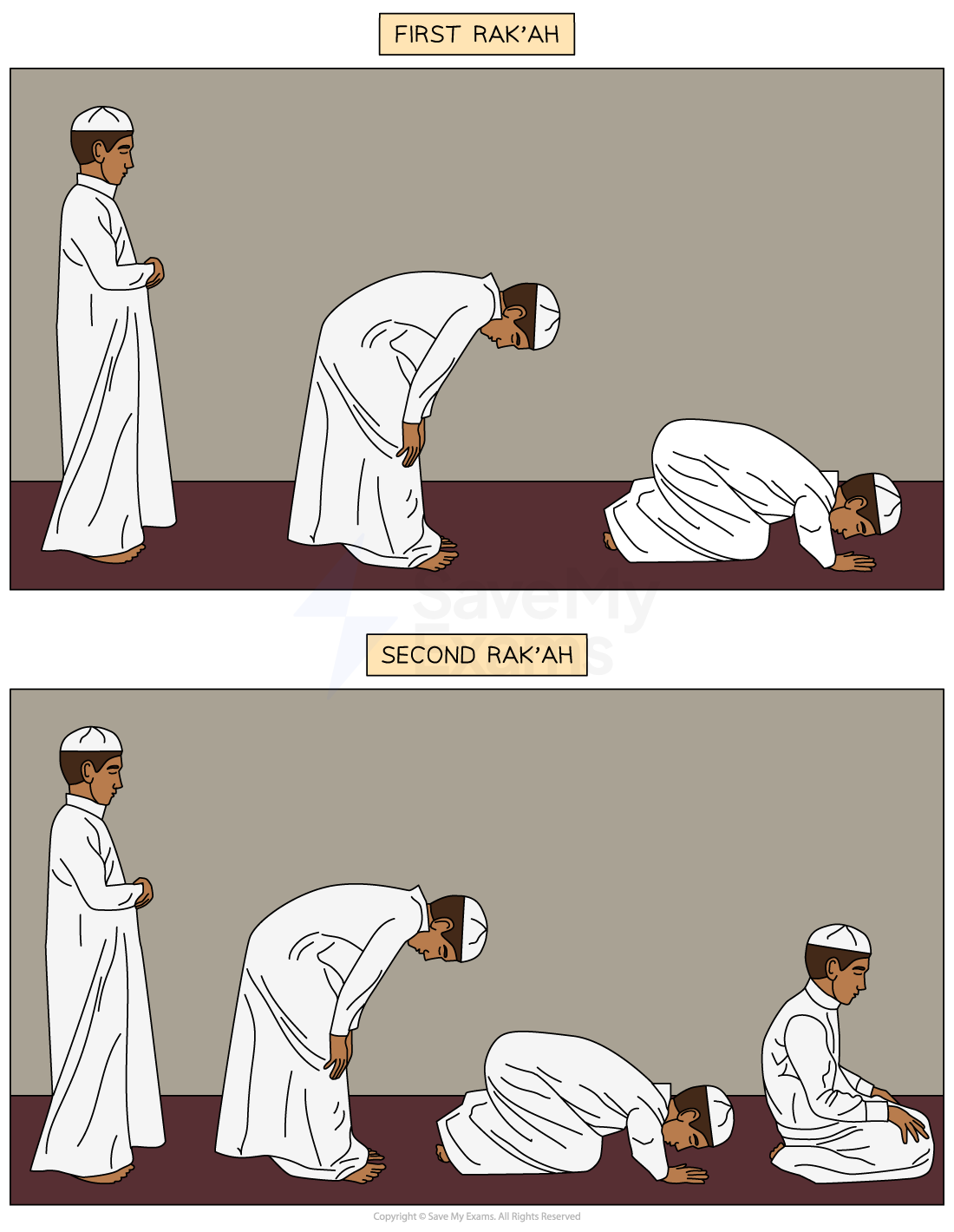
Positions of prayer — rak’ah
Jum'ah prayer & its significance
- Jum’ah is the midday communal prayers held on Friday; these are considered special
- There are various hadiths regarding the importance of Friday as a day of worship
blockquote “The best day on which the sun has risen is Friday; on it, Adam was created. On it, he was made to enter Paradise, on it, he was expelled from it. And the last hour will take place on no day other than Friday” (Kitab al-Salat 4:1857)
- The 62nd chapter of the Qur’an is named “al-Jumuʿah”**** because it mentions the Friday prayer
blockquote “Allah Almighty says in this chapter, ‘O you who believe! When the call is proclaimed to prayer on Friday, hasten earnestly to the Remembrance of Allah, and leave off business: That is best for you if you but knew!’” (Qur’an 62:9)
-
To prepare for prayers, Muslims bathe, apply perfume and brush their teeth to make their appearance pleasant to their fellow worshippers
-
The worshippers getting together aims to develop the feeling of unity among the Muslim community
-
All male Muslims are expected to attend unless they are ill or too old
- Women can, too, but they are also able to pray at home
-
Muslims read the Surah Al Kahf from the Qur’an on Fridays
- They believe that the one who reads it will find their entire week enlightened until the next Friday
-
Once the prayer is completed, the imam will deliver a sermon to remind Muslims of their obligation to God
- The sermon is in two parts, with time in between for personal prayer (du’a)
-
A series of rak’ahs is performed
-
Salutations are sent on the Prophet Muhammad(pbuh) during the Friday service
- The Prophet Muhammad (pbuh) said:
blockquote “Whoever sends Salah upon me once, Allah would send Salah upon him tenfold, erase ten sins from him and raise him ten degrees in rank”
Du'a prayer
-
The word du'a in Arabic means “calling”
- Du’a is a personal prayer where Muslims can call upon Allah
-
Muslims are encouraged to call upon Allah to ask for help, express thanks or ask for forgiveness, guidance and strength at any time throughout the day
-
Du’a is in addition to the daily prayers of Salah
-
Muslims can make these personal prayers in their own words, in any language
- However, there are also recommended examples in the Qur’an and Sunnah to help them if they need help finding the words
-
Du’a calls Allah to mind throughout the day for a Muslim, which strengthens their faith and connection to him
Dhikr prayer & its significance
- Dhikr means “remembrance”
- Dhikr prayer is a type of spiritual reflection, calling Allah to mind and remembering his many qualities, as the Qur’an instructs:
blockquote “O you who believe! Remember God with much remembrance.” (Qur’an 33:41)
-
Dhikr usually includes reciting the 99 beautiful names of Allah, using Misbahah to help
- Alternatively, a believer might count the names using their fingers
-
During dhikr, Muslims focus on their relationship with Allah
-
Dhikr may be performed alone or with a collective group
Different views about the use and importance of the Qur'an
Use and importance of the Qur’an in public worship
-
The Qur’an is central to public worship, especially during Friday (Jum’ah) prayers in the mosque
- It is recited in Arabic during Salah (daily prayers) and other religious services
-
The imam often reads the Qur’an and explains verses during sermons to teach and guide the community
-
During Ramadan, the entire Qur’an is often recited over the course of the month
-
Listening to the Qur’an being recited during worship helps Muslims feel spiritually connected and reminds them of Allah’s teachings
Use & importance of the Qur’an in private prayer and study
-
Muslims are encouraged to read the Qur’an daily, especially in the early morning
-
Many Muslims learn to recite the Qur’an in Arabic, even if it is not their first language
- Others learn Arabic so that they can study it in greater detail
-
Some Muslims aim to become Hafiz (one who has memorised the whole Qur’an), which is seen as a great honour
-
Muslims may read the Qur’an:
- For guidance when facing personal or moral decisions
- As an act of worship and devotion, even if they do not understand every word
- In study, to try to understand its full meanings
Different views about the use and importance of the Qur’an
-
All Muslims see the Qur’an as the literal word of God (Allah), as revealed to the Prophet Muhammad (pbuh)
-
Sunni and Shi’a Muslims agree on its sacred status
- However, they differ slightly in how they use or interpret it, especially alongside other sources of authority, for example, the Hadith
-
Some Muslims emphasise the spiritual power of the recitation of the Qur’an
-
Others may place more focus on studying the Qur’an intellectually and applying its teachings to social justice and daily life
Worked Example State two practices involved in Salah
[2 marks]
Final answer: Answer:
Muslims perform wudu, or ritual washing, in preparation for Salah [1 mark]
They face the Ka’aba in Makkah while praying [1 mark]
Exam Hint There are many key terms about Muslim worship in this section. One good practice is to make your own glossary of the most important vocabulary so that you can use it accurately in your exam answers. Flashcards containing the term on one side and the definition on the other are a good way to test yourself.
Was this revision note helpful?