The Six Articles of Faith (Cambridge International IGCSE Religious Studies)
Tawhid as one of the six articles of faith
The six articles of faith
- The six articles of faith, or six beliefs, are known as Iman al-Mufassal
- They are based on the Qur’an and the Hadith of Gabriel contained in the Kitab al-iman or Book of Faith
- The six articles of faith are central to the faith of all Muslims
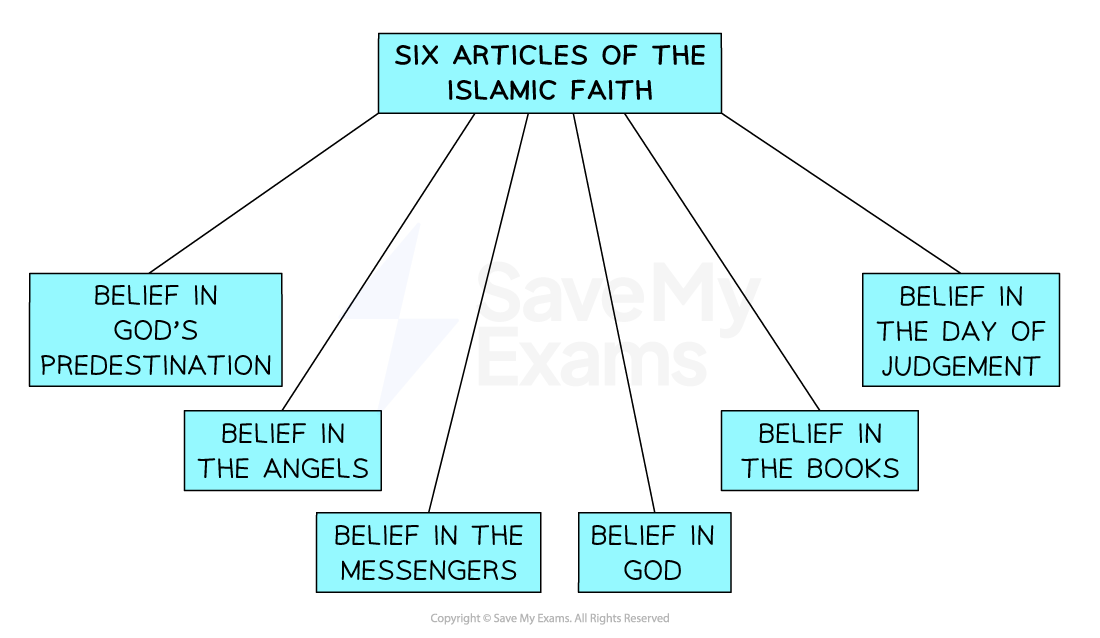
The six beliefs (articles) of Islamic faith
What is tawhid?
- Tawhid is the belief in one God, Allah
- Muslims believe that Allah is the Supreme Being, the creator of the universe
- Allah is One God,indivisible and absolute; nothing comes close to Him as the ultimate source of power and creation
blockquote “He is Allah, the One; Allah is eternal and absolute. None is born of Him; He is unborn. There is none like unto him” (Qur’an 112:1–4)
-
Allah has 99 names or characteristics, which make it clear that there is one true God. These include:
- Al-Ahad(the one and only)
- Al Wahid (the one)
-
According to a Hadith, the Prophet Muhammad (pbuh) said that Muslims should mention Tawhid first when telling non-Muslims about Islam
blockquote “Let the first thing to which you will invite them, be the Tauhid (Tawhid) of Allah” (Sahih al-Bukhari 93:469)
-
This means that:
- Tawhid is the most important belief for Muslims
- Islam is a monotheistic religion
Risalah (prophets) as one of the six articles of faith
-
Risalah is Arabic for “message”and refers to “prophethood”
- Risalah is the belief that Allah chose special people to communicate his word to humanity and to teach and guide people along the right path
-
These people are known as prophets
-
Prophets receive revelations from Allah through His angels
- Muslims believe that Allah has chosen many prophets to bring the message of Islam to people
-
There are 25 key prophets of Allah identified in the Qur’an, including:
- Adam
- Ibrahim (Abraham)
- **Musa **(Moses)
- Isa (Jesus)
- Muhammad (pbuh)
-
Muslims believe that there were 124,000 prophets who developed the religion over time
-
Muhammad (pbuh), the last of the prophets, is known as****“The Seal”
Akhirah (life after death)
Spec point —
I2.1c
-
Akhirah, or the afterlife, is a key belief in Islam and one of the six articles of faith
-
Muslims believe death is not the end of life
- After death, there will be a resurrection and an afterlife, known as Akhirah
-
All human life has a purpose
- Each person is responsible for their actions on this earth, and where a person will go in the afterlife is determined by the choices they make in this life
- Thus, this life is seen as preparation for the next life
-
As humans, we have been given free will, so we are able to make choices about what to believe and how to treat others
- Our choices during this mortal life are a test, and we will be judged according to how we have lived and held accountable for our actions
-
When a person dies, they are taken by Iz’rail (the angel of death) to Barzakh
- This is the stage between a person’s death and when they face judgement
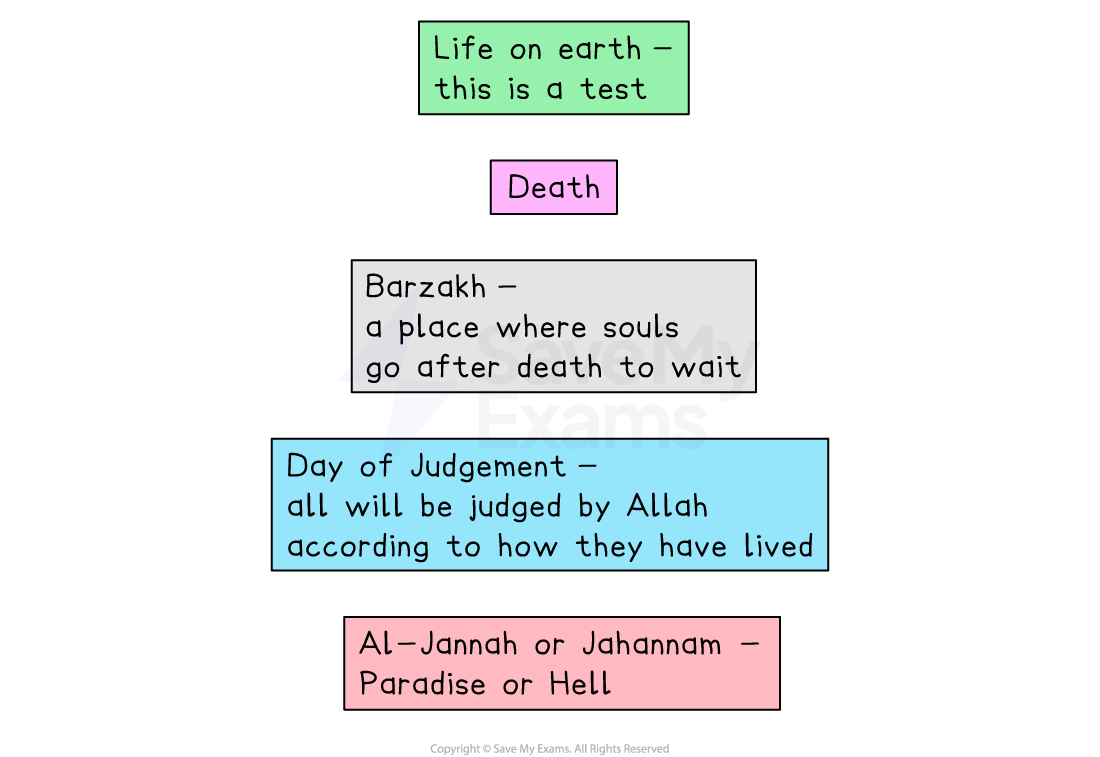
Stages of Akhirah
The Mala’ikah (angels)
Spec point —
I2.1d
The Mala’ikah as one of the six articles of faith
-
Muslims accept the existence of angels(called Malai’kah in Arabic)
-
Muslims believe in angels because they are mentioned in the Qur’an
-
Angels are heavenly beings who were created by Allah, are obedient to Him and are called by Him to perform various tasks, including:
-
Communicating with humans to deliver Allah’s messages via the prophets
-
Praising Allah and guarding his throne
-
Governing the universe and the laws of nature
-
Recording people’s good and bad deeds for the Day of Judgement— this is the responsibility of the kiraman katibin (noble scribes)
-
Welcoming humans into paradise
-
Some of the most significant angels in the Qur’an are:
-
Jibril(known as Gabriel in Christianity and Judaism), the Angel of Revelation, who revealed the whole Qur’an to Muhammad (pbuh)
-
Izra’il, the Angel of Death, who signals the coming of the Day of Judgement and takes souls to Allah when they die
-
Mika’il (known as Michael in Christianity and Judaism), the Angel of Mercy, who oversees life on earth and rewards those who have led a good life
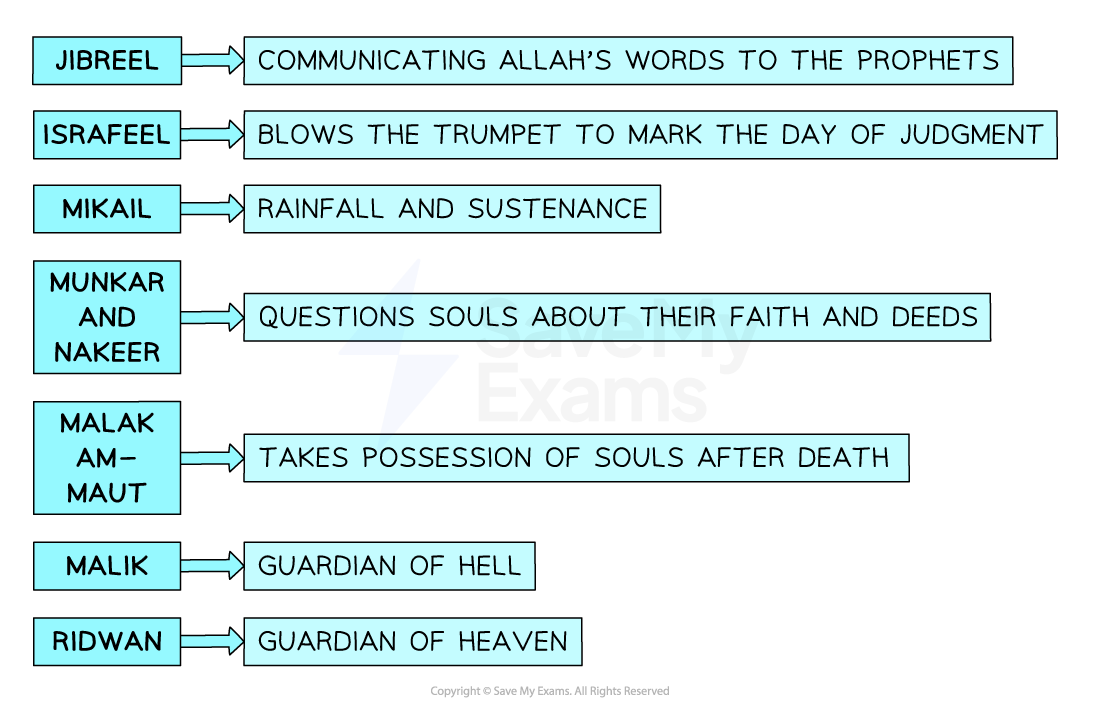
The role of angels in Islam
Qadar (predestination)
Spec point —
I2.1e
Qadar as one of the six articles of faith
- Muslims believe in Qadar or predestination
- This is the idea that Allah is omnipotent (all-powerful) and omniscient (all-knowing)
blockquote “He knows what is within the heavens and earth and knows what you conceal and what you declare. And God is Knowing of that within the breasts” (Qur’an, Surah 64:4)
-
This teaching from the Qur’an means that Allah is so omniscient that he even knows the secrets within our hearts
-
As the creator of everything, Allah has put predetermined and unchangeable rules in place that govern the universe
- These include the rules of science; for example, how the planets orbit the sun
-
Therefore, Allah knows everything that will happen
- The Qur’an teaches:
blockquote “He is the All-Knowing Creator: when He wills something to be, His way is to say ‘Be’ and it is!” (Qur’an Surah 36:81-82)
- Although Allah has given humans free will, nothing happens unless it is the **will of Allah **
- Muslims often use the phrase “insha’Allah”, meaning “if Allah is willing” or “if Allah allows it”**** about everyday events to express this belief
- Sometimes, people’s choices are in harmony with Allah’s will, and this is part of Qadar, helping to bring about God’s plan for the world
Kutub (holy books)
Spec point —
I2.1f
Kutub as one of the six articles of faith
-
Muslims believe in the authority of the **holy books, **or kutub, as one of the six articles of faith
-
Muslims believe that Allah’s messages are contained within the** kutub** (or kutubullah),meaning books of Allah. There are five “revealed” kutub:
- Tawrat
- Sahifah
- Zabur
- Injil
- Qur’an
-
The most important of these is the Qur’an, which has complete authority and is seen as the perfect word of God as revealed to Muhammad (pbuh)
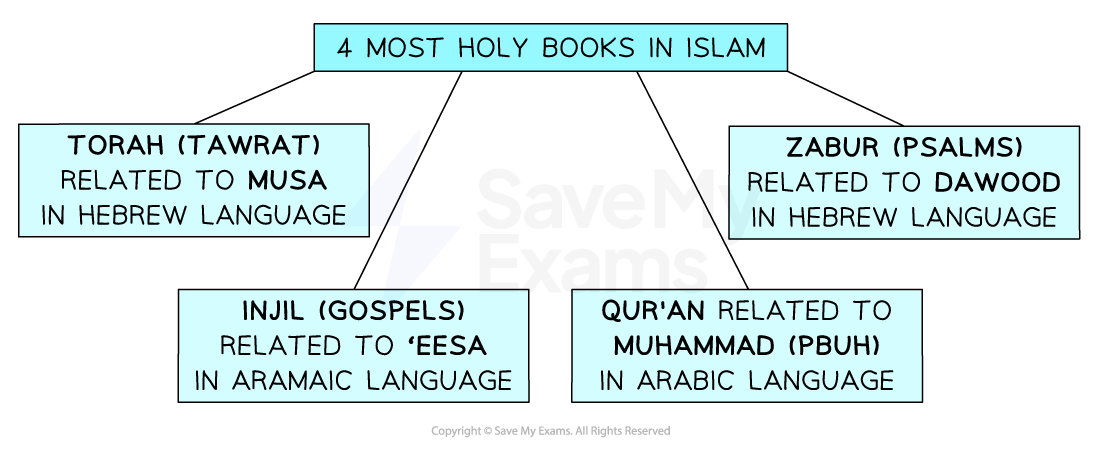
The holy books of Islam
-
The Tawrat (Torah) contains the revelations given to Musa (Moses) by Allah on Mount Sinai
- It contains the Ten Commandments
- The Qur’an says that it contains the “judgement of Allah” (Quran 5:43)
-
The Zabur (Psalms) of Dawud (David), a collection of prayers to Allah (some refer to them as poems)
- They contain lessons of guidance for the people
-
The Injil (Gospels) contain the messages Allah revealed to Isa (Jesus)
- Muslims believe that the Injil foretells the coming of the Prophet Muhammad (pbuh)
-
Although all of these religious texts are considered as having been revealed by Allah — and are held as sacred by Judaism, Christianity or both — Muslims do not hold them in the same regard as the Qur’an
- These holy books are believed to contain some errors and therefore are not the direct word of Allah
- Thus, they do not have the same authority as the Qur’an
Worked Example Name two of the six articles of faith in Islam
[2 marks]
Final answer: Answer:
Tawhid is one of the articles of faith [1 mark]
Another is the belief in Risalah [1 mark]
Exam Hint The Qur’an is of such central importance that it will be covered in greater detail later in these revision notes. When revising kutub as one of the six articles of faith, remember that the Qur’an is one of the kutub, but other religious texts also hold some authority as “revealed” books.
Was this revision note helpful?
Build on this topic