Ritual Dress in Jewish Worship (Cambridge International IGCSE Religious Studies)
The use and importance of the tallit
What is the tallit, and what is it used for?
-
The tallit is a prayer shawl traditionally worn by Jewish men during morning prayer services, festivals and on the Sabbath
- The tallit has 613 fringes known as “tzitzits,” which represent the 613 commandments or mitzvot that Jews have to follow
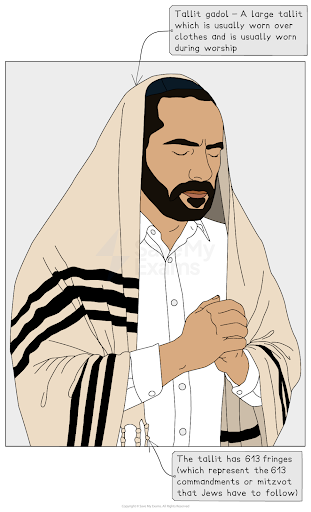
The tallit
-
There are two different types of tallit:
- Tallit gadol — A large tallit that is usually worn over clothes, rests on the shoulders and is usually worn during worship
- Tallit katan — A smaller tallit that is worn by many Jews as an undergarment between their T-shirt and jumper at all times
-
Many Reform and Liberal Jewish women now choose to wear a tallit, and this is becoming more acceptable in these movements
Why is the tallit important for Jews?
-
The tallit acts as a reminder of the mitzvot(commandments)
- The fringes(called tzitzit) on the tallit are commanded in the Torah
- Each time a Jew wears it, they are reminded to live according to G-d’s laws
blockquote “The Lord said to Moses as follows: Speak to the Israelite people and instruct them to make for themselves fringes on the corners of their garments throughout the ages; let them attach a cord of blue to the fringe at each corner. That shall be your fringe; look at it and recall all the commandments of the Lord and observe them, so that you do not follow your heart and eyes in your lustful urge” (Numbers 15)
-
The tallit acts as a spiritual focus during prayer
- The tallit helps the worshipper enter a **mindset **that helps them to focus
-
The tallit**** is also an expression of Jewish identity and faith
- Wearing the tallit shows a commitment to Jewish tradition and the community
-
It also has a practical use during important events in life and death
- It may be worn at bar mitzvahs and weddings and used to wrap a body in burial, which shows its lifelong significance
The importance of the tefillin
What are tefillin, and what are they used for?
-
Tefillin are worn mainly by Orthodox Jewish men during morning prayer
- Tefillin consist of two leather boxes that contain words from the Shema
- One of the boxes is tied onto the arm with the leather strap it is attached to, and the second box is tied to the head
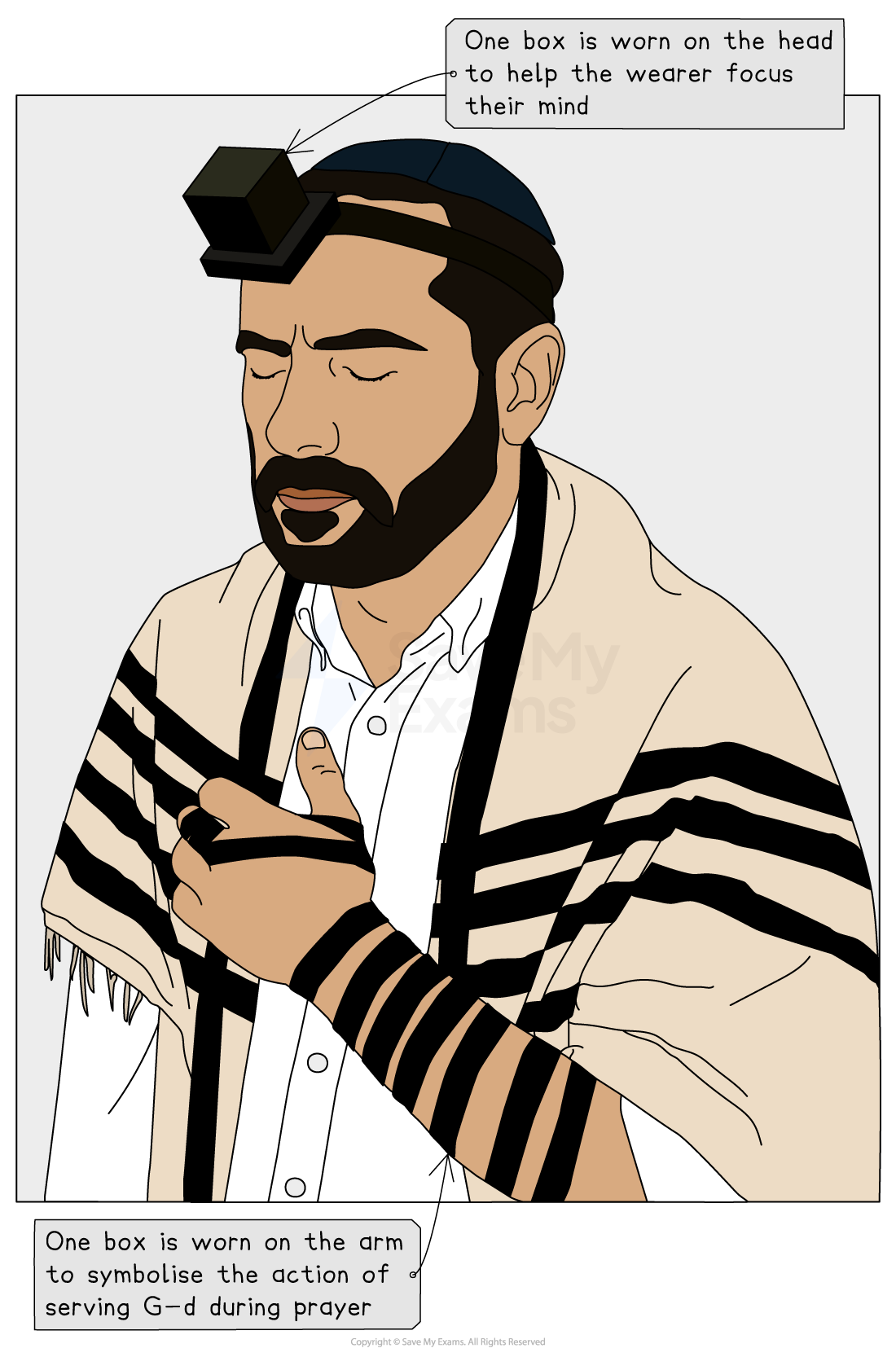
The tefillin
- The reason for wearing tefillin is based on a biblical law, which states:
blockquote “Love the Lord your G-d with all your heart, all your being, and all your might. These words that I am commanding you today must always be on your minds. Recite them to your children. Talk about them when you are sitting around your house and when you are out and about, when you are lying down and when you are getting up. Tie them on your hand as a sign. They should be on your forehead as a symbol. Write them on your house’s doorframes and on your city’s gates” (Deuteronomy 6:5–9)
- When the tefillin have been put on, a special prayer is said: “Blessed are You, Lord our G-d, King of the Universe, who has sanctified us with His commandments as to wear tefillin”
Why are tefillin important?
-
There are many reasons why tefillin are important within Judaism
- They fulfill the biblical command, “Bind them as a sign on your hands and between your eyes” (Deuteronomy 6:8)
- They help the wearer focus their mind(head) and actions(arm/hand) on serving G-d during prayer
- They are a symbol of devotion during weekday morning prayers
The importance of the kippah/yarmulke
What is the kippah/yarmulke?
-
The kippah (yarmulke), often referred to as a skullcap, is worn by Jews as a sign of Jewish identity
-
In Orthodox Judaism, the kippah is worn by Jewish men at all times, apart from when they are sleeping or washing
-
In Liberal and Reform Judaism, some women choose to wear the kippah if they are doing anything holy
- This could be during ceremonies at home, in the synagogue, during holy days or when they are reading the Torah
-
Unlike the wearing of the tallith and tefillin, there is no commandment for Jews to wear the kippah
-
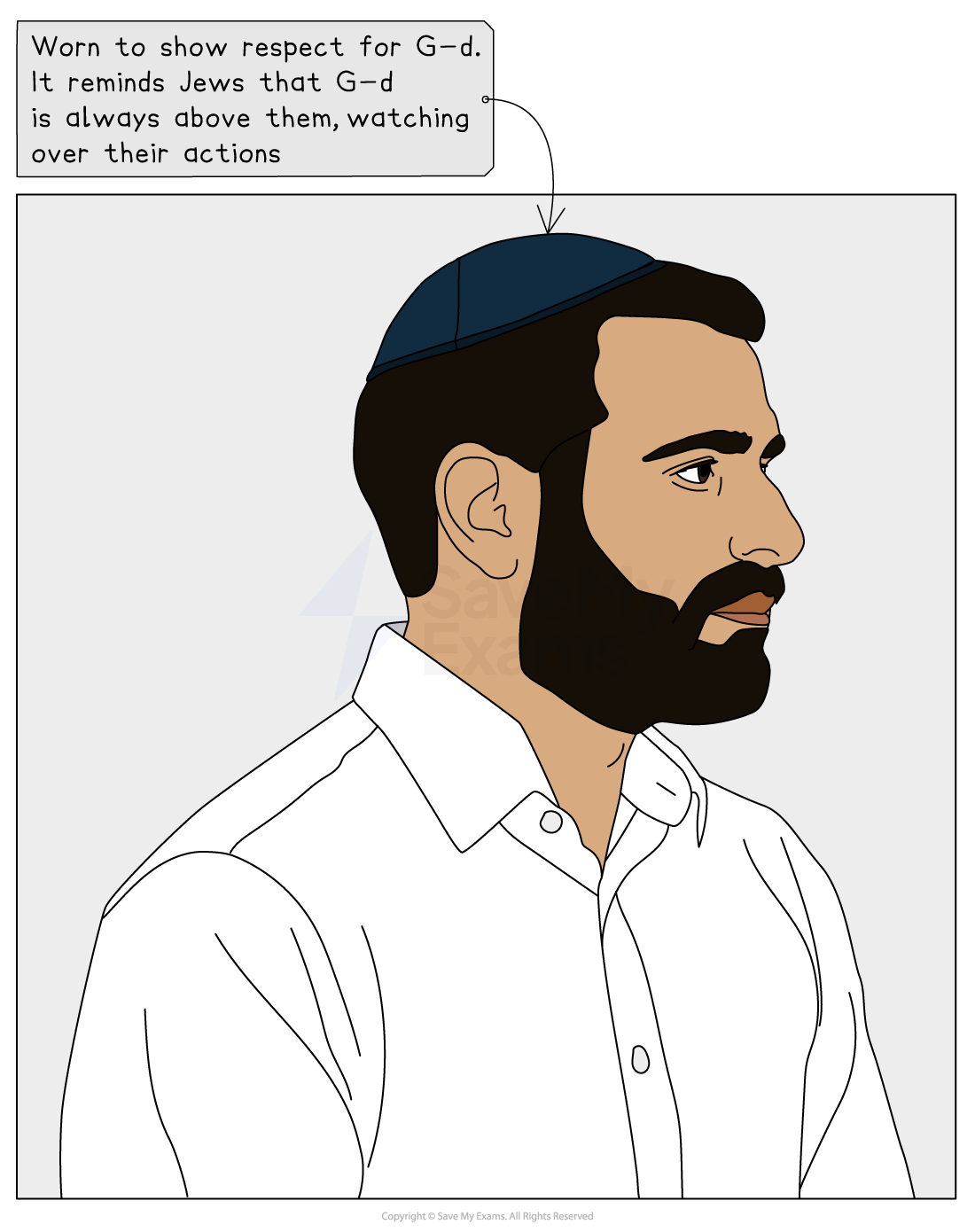
The kippah/yarmulke
What is the significance of the kippah/yarmulke?
-
One of the main reasons for wearing the skullcap is out of respect for G-d
- It reminds Jews that G-d is always above them, watching over their actions
-
It also acts as an outward sign of identity and belonging to the Jewish faith
- It serves as a visible sign of Jewish belief in G-d
-
It is also mentioned in the Talmud,* *which offers guidance to all Jews
blockquote “Cover your head so that the fear of heaven may be upon you” (Talmud – Kiddushin 31a)
Views of Jewish traditions on ritual dress
What is ritual dress?
-
Ritual dress is specific clothing worn for religious purposes, often during prayer, festivals or other significant occasions
- Common items include the tallit(prayer shawl), kippah(head covering) and tefillin
What are the views from different Jewish traditions on ritual dress?
-
Each Jewish tradition has a different idea of what ritual dress is appropriate
- There may even be differences of opinion from within each tradition
-
In Orthodox Judaism, ritual dress is worn regularly, not just for prayer, but it differs between men and women
-
Men will wear:
- A kippah (head covering) at all times
- A tallit(prayer shawl) during morning prayers
- Tefillin (leather boxes with Torah verses) during weekday morning prayers
-
Women may cover their hair(with a scarf or wig) after marriage as a sign of modesty
-
-
In Reform Judaism, ritual dress is seen as optional or symbolic
-
Ritual dress is worn mostly during prayer or festivals but not daily
-
Some Reform Jews do not wear tefillin, and women are often encouraged to wear a tallit if they choose
-
Emphasis is on personal choice, and there is less difference between the genders
-
In Conservative Judaism, there is a middle ground between Orthodox and Reform
-
In this tradition, ritual dress is encouraged during prayer
-
Both men and women are able to wear:
- A kippah
- A tallit
- Tefillin (in some communities)
-
Conservative Judaism is more flexible than Orthodox but still values tradition
-
Worked Example Name two items that Jews might wear as part of worship
[2 marks]
Final answer: Answer:
- Kippah
- Tallit
Exam Hint Create a simple table comparing Orthodox, Reform and Conservative views on:
- What is worn (e.g. kippah, tallit, tefillin)
- Who wears it (men, women or both)
- When it is worn (daily, prayer only, optional)
This helps you spot similarities and differences quickly, which may help with exam questions.
Was this revision note helpful?
Build on this topic