Electromotive Force (Cambridge International IGCSE Physics)
Exam board Cambridge International · IGCSEUpdated 2026-09-07
Spec point —
4.2.7· - Define electromotive force (e.m.f.) as the electrical work done by a source in moving a unit charge around a complete circuit (C)
- Know that e.m.f. is measured in volts (V) (Core)
Electromotive force
- Electromotive force (e.m.f.) is the name given to the potential difference of the power source in a circuit
- It is defined as:
The electrical work done by a source in moving a unit charge around a complete circuit
- Electromotive force (e.m.f.) is measured in volts (V)
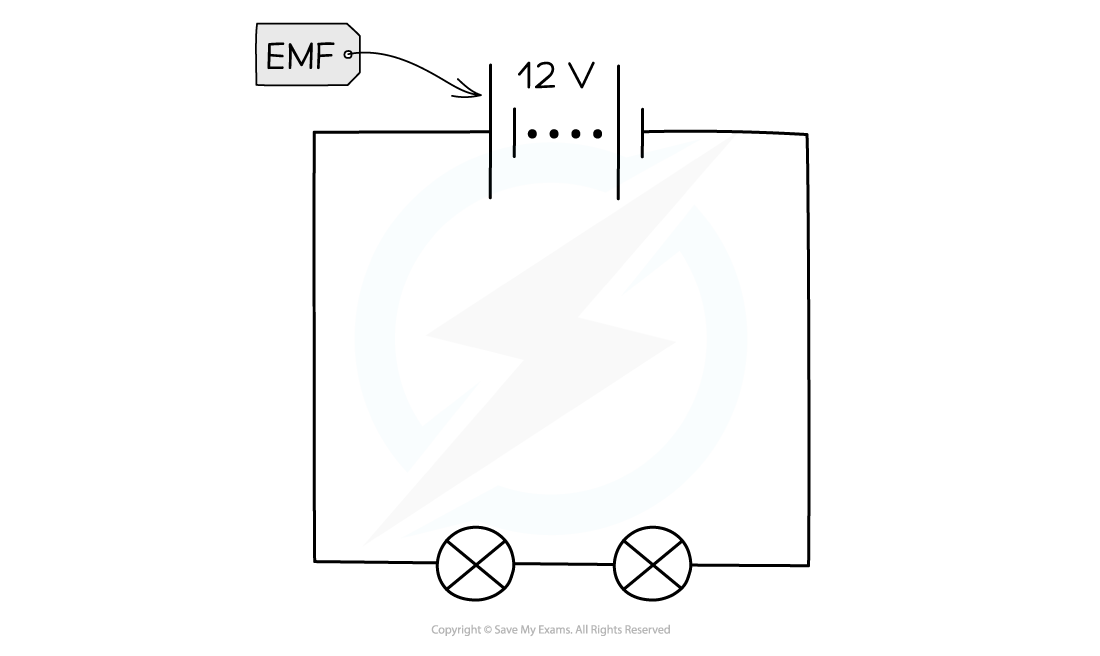
The e.m.f. is the voltage supplied by a power supply: 12 V in the above case
Calculating electromotive force
Spec point —
4.2.7· - Recall and use the equation for e.m.f. E = W/Q (E)
Extended Tier Only
- The definition of e.m.f. can also be expressed using the equation:
-
Where:
- = electromotive force (e.m.f.), measured in volts (V)
- = energy transferred to the charges from the power source, measured in joules (J)
- = charge moved, measured in coulombs (C)
-
This equation should be compared to the definition of potential difference as the two are closely related
Was this revision note helpful?
Build on this topic