Age of the Universe (Cambridge International IGCSE Physics)
The Hubble constant
Spec point —
6.2.7· Define the Hubble constant H0 as the ratio of the speed at which the galaxy is moving away from the Earth to its distance from the Earth;
- recall
- and use the equation H0 = v/d Know that the current estimate for H0 is 2.2 × 10^–18 per second
The Hubble constant
Extended Tier Only
- When Edwin Hubble looked at the absorption spectra of distant galaxies, he determined a relationship between the speed of a galaxy and its distance from Earth
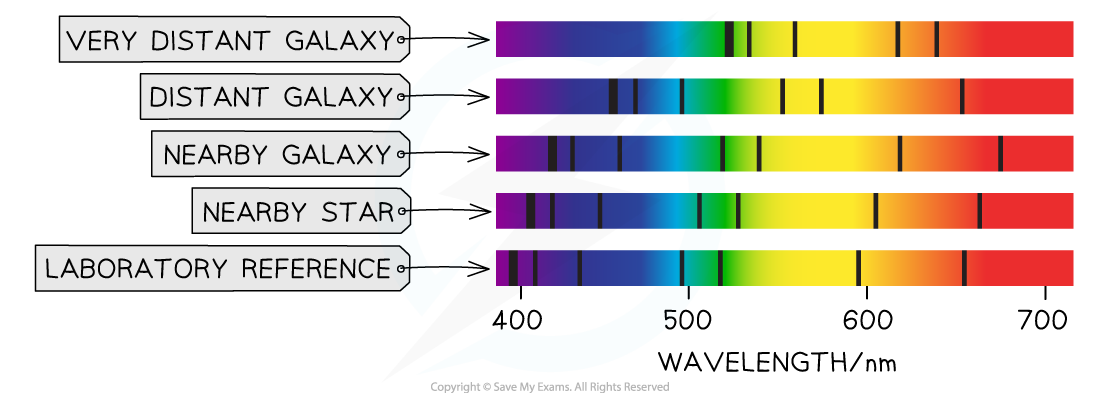
Hubble discovered that all galaxies show redshift, but the galaxies that are further away show a greater increase in redshift
- This is Hubble's law, which states
The speed of recession is proportional to the distance of the galaxy away from Earth
-
'Recession' speed means the speed at which something is moving away
-
This means that the further away a galaxy is from Earth:
- the faster it is moving away
- the greater the increase in redshift
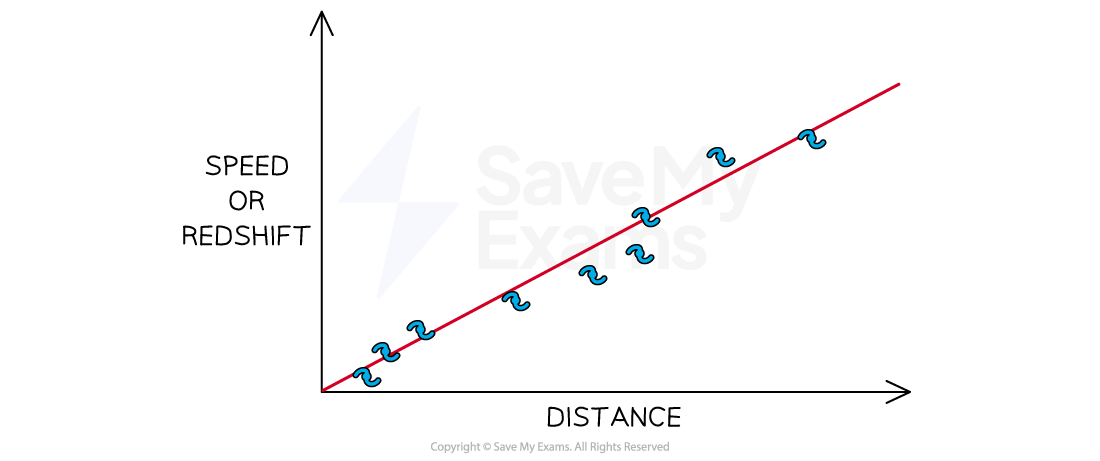
Hubble's law tells us the greater the distance to a galaxy, the greater the redshift, or the speed it moves away from Earth
- Hubble’s law can be expressed as an equation:
-
Where:
- = Hubble constant (per second)
- = recessional velocity of an object, the velocity of an object moving away from an observer (km/s)
- = distance between the object and the Earth (km)
-
From this equation, the Hubble constant can be defined as:
The ratio of the speed at which the galaxy is moving away from the Earth, to its distance from the Earth
- The accepted value of the Hubble constant is = 2.2 × 10⁻¹⁸per second
Exam Hint Make sure to learn the currently accepted value of the Hubble constant.
You will be expected to know that the current estimate for H0 is 2.2 × 10⁻¹⁸ per second.
Measuring recession speed & distance
Spec point —
6.2.7· - Know that the speed (v) at which a galaxy is moving away from the Earth can be found from the change in wavelength of the galaxy’s starlight due to redshift
- Know that the distance of a far galaxy (d) can be determined using the brightness of a supernova in that galaxy
Measuring recession speed & distance
Extended Tier Only
-
The Hubble constant can be determined from measurements of:
- redshift of the light emitted by a galaxy
- the brightness of supernovae in the galaxy
Measuring recession speeds of galaxies
- The speed of recession of a galaxy (i.e. how fast it is moving away from the Earth) can be found from the change in wavelength of the galaxy’s starlight due to redshift
Measuring distance using supernovae
-
The distance to a galaxy can be determined using the brightness of a supernova in that galaxy
-
Supernovae are exploding stars
- Certain types of supernovae have the same peak level of brightness (absolute magnitude), meaning they can be used as standard candles
- These supernovae are so bright that they can be used for measuring distances to the most distant galaxies
Age of the Universe
Spec point —
6.2.7· Know that the equation d/v = 1/H0
- represents an estimate for the age of the Universe and
- that this is evidence for the idea that all the matter in the Universe was present at a single point
Age of the Universe
Extended Tier Only
- Hubble's law can be rearranged to give the expression:
-
Since time is equal to distance divided by speed, the term represents an estimate of the age of the Universe
-
Hubble's law provides further evidence for the Big Bang
-
It shows that the Universe has been expanding since the beginning of time
- If we looked at time in reverse, we would see galaxies were closer together in the past
- This suggests that the Universe must have originated from a single point and has been expanding outwards ever since
Hubble's law graph
- Using measurements from galactic redshift and brightness of supernovae, a graph of recession velocity against distance can be plotted
Graph of galaxy recession velocity against distance
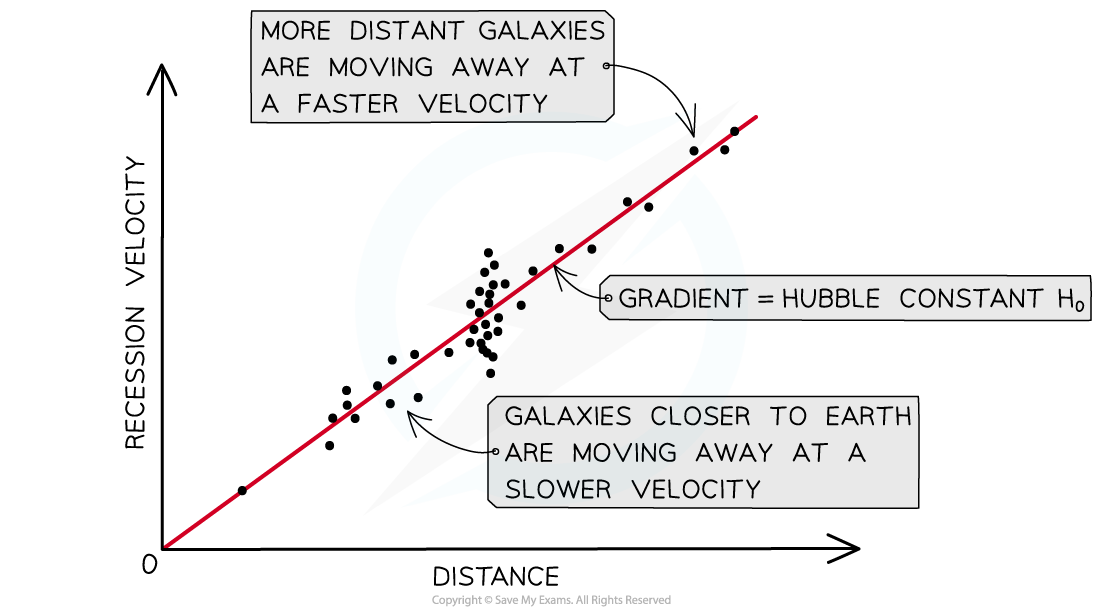
A key aspect of Hubble’s law is that the furthest galaxies appear to move away the fastest
-
The gradient of the graph represents the age of the Universe
- When the distance equals zero, this represents all the matter in the Universe being at a single point
- This is the singularity that occurred at the moment of the Big Bang
-
Astronomers have used this formula to estimate the age of the Universe is about 13.8 billion years
Worked Example A distant galaxy is 20 light-years away from Earth.
Use Hubble’s law to determine the velocity at which the galaxy moves away from Earth.
[3]
Answer:
Step 1: List the known quantities
- Distance to the galaxy, = 20 light-years
- 1 light year = 9.5 × 10¹⁵ m
- Hubble constant, = 2.2 × 10⁻¹⁸ per second
Step 2: Convert 20 light-years to m
[1 mark]
Step 3: Substitute values into Hubble's Law
[1 mark]
- The galaxy moves away from Earth at a velocity of 0.42 m/s [1 mark]
Exam Hint If you are taking the Extended paper, remember that you have to learn the values for a light year and the Hubble constant.
Was this revision note helpful?
Build on this topic