Nuclear Fusion (Cambridge International IGCSE Physics)
Spec point — Know that energy is released by nuclear fusion in the Sun Know that research is being carried out to investigate how energy released by nuclear fusion can be used to produce electrical energy on a large scale
Nuclear fusion
Extended Tier Only
-
The Sun releases energy by the process of nuclear fusion in its core
- Nuclear fusion is the process where two light atomic nuclei join together to create a heavier nucleus, releasing massive amounts of energy in the process
- In the Sun, hydrogen nuclei fuse together to form helium nuclei
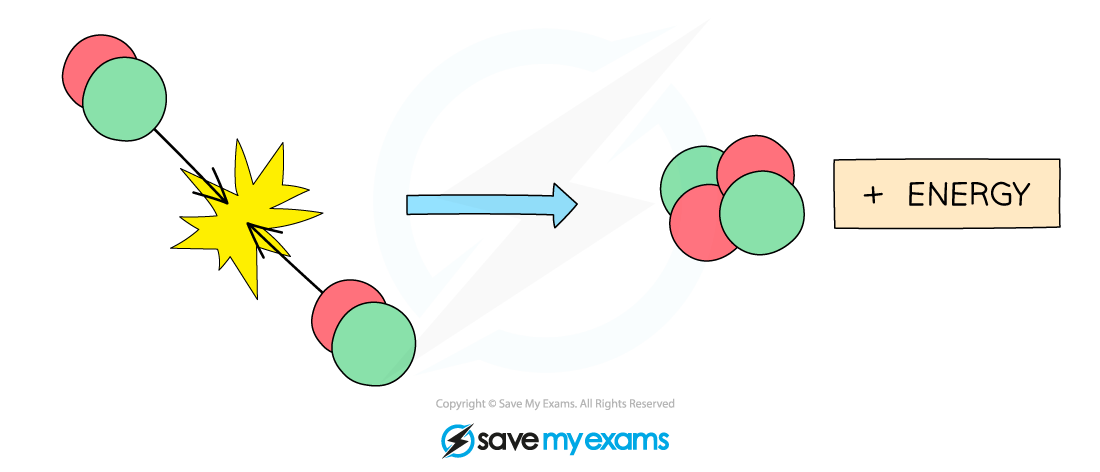
Fusion is the process in which small nuclei, such as hydrogen, are fused together to form larger nuclei, releasing energy in the process
-
It is theoretically possible to produce a fusion reactor that could be used to generate electricity
- If this technology can be made to work at scale, it could supply very large amounts of electricity without producing carbon dioxide
-
Fusion requires extremely high temperatures and high pressures, like in the centre of a star
- This is to overcome the repulsive forces between nuclei
-
Scientists are currently researching how to sustain a fusion reaction at lower temperatures
- International research projects, funded mainly by governments working together, are making progress with some promising results
-
Experiments have now released more energy from the fusion reaction than was delivered to the fuel, but not yet more than the total energy required to run the whole facility
- Producing a sustained net energy gain remains the goal
- If they succeed, virtually limitless amounts of energy could be produced, with large-scale, carbon-free electricity generation
Exam Hint Note that fusion and fission are different processes. Nuclear fusion is the process where two light atomic nuclei join together to create a heavier nucleus. In contrast, nuclear fission is the splitting of a large, unstable nucleus into two smaller nuclei.
Was this revision note helpful?
Build on this topic