Electric Motors (Cambridge International IGCSE Physics)
The d.c. motor
Spec point —
4.5.1· Know that a current-carrying coil in a magnetic field may experience a turning effect and that the turning effect is increased by increasing: (a) the number of turns on the coil (b) the current (c) the strength of the magnetic field
The d.c. motor
-
The motor effect can be used to create a simple d.c. electric motor
- The force on a current-carrying coil causes it to rotate in a single direction
-
A simple d.c. motor consists of:
- a coil of wire (which is free to rotate) between the poles of a permanent magnet
- a split-ring commutator and brushes connected to a source of d.c.
-
The brushes and commutator are designed to reverse current every half turn:
- the brushes ensure current is maintained without tangling wires
- the coil rotates continuously in the same direction
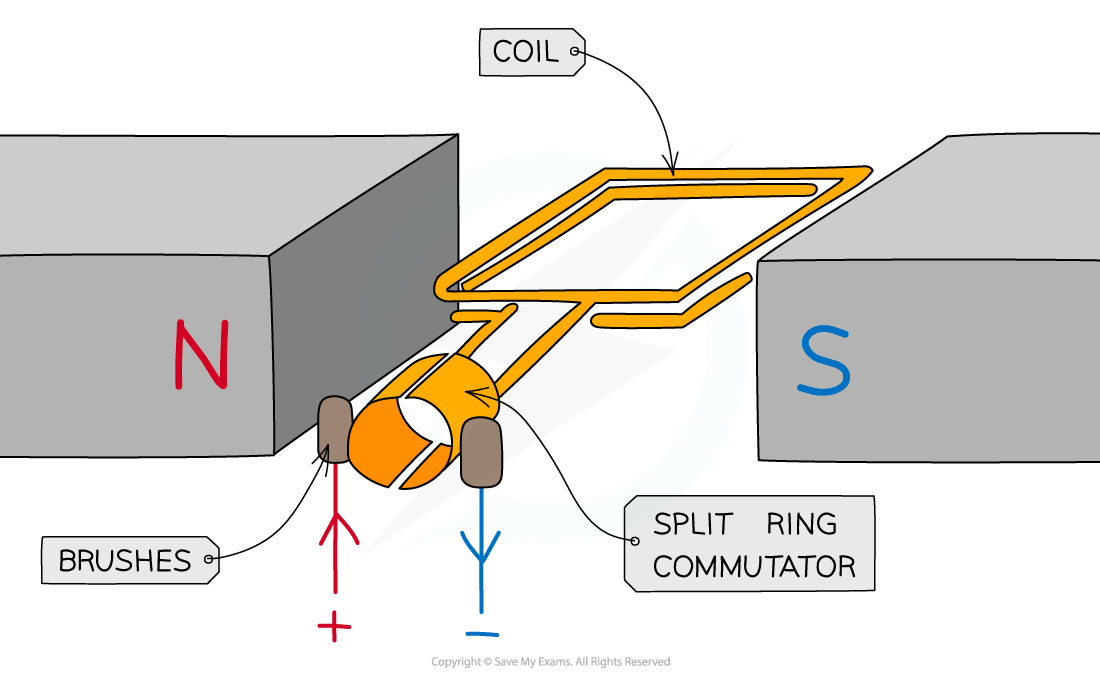
In a simple d.c. motor, a coil placed in a magnetic field may experience a turning effect
-
As current flows through the coil, it produces a magnetic field which interacts with the external magnetic field
-
Forces act in opposite directions on each side of the coil, causing a turning effect
- The greater the force on the coil, the greater the turning effect and the faster it will turn
-
The turning effect is increased by increasing:
- the number of turns on the coil
- the current in the coil
- the strength of the magnetic field
Exam Hint Motors and generators look very similar, but they do very different things.
When tackling a question on either of them, make sure you are writing about the right one. A motor takes in electricity and turns it into motion. A generator takes in motion and generates electricity.
You might be expected to give explanations of how these two things happen - make sure that you understand their subtle differences.
Operation of a d.c. motor
Spec point — Describe the operation of an electric motor, including the action of a split-ring commutator and brushes
Extended Tier Only
-
In a d.c. motor, when the coil of wire is horizontal, it forms a complete circuit with a cell
- The coil is attached to a split-ring(a circular tube of metal split in two)
- This split-ring is connected in a circuit with the cell via contact with conducting carbon brushes
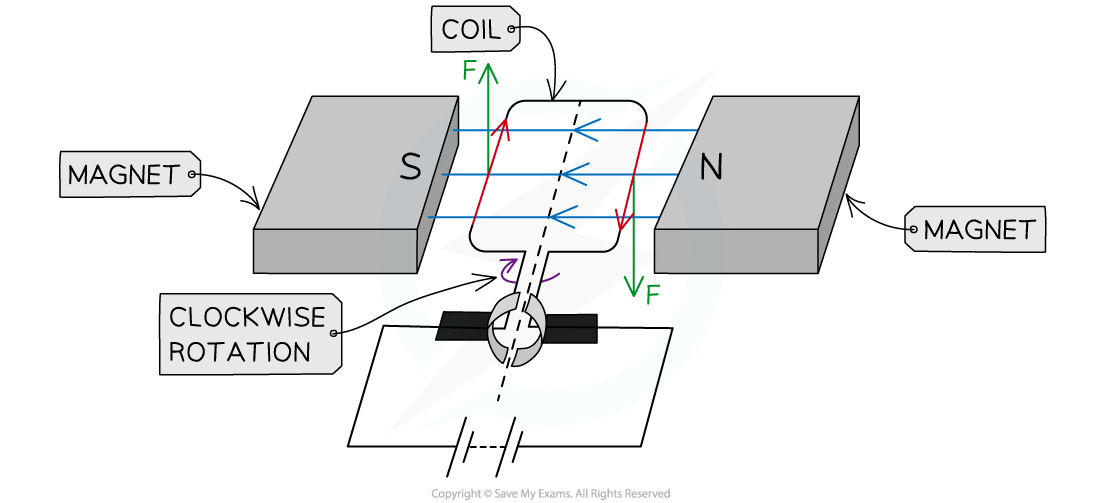
Forces on the horizontal coil in a d.c. motor
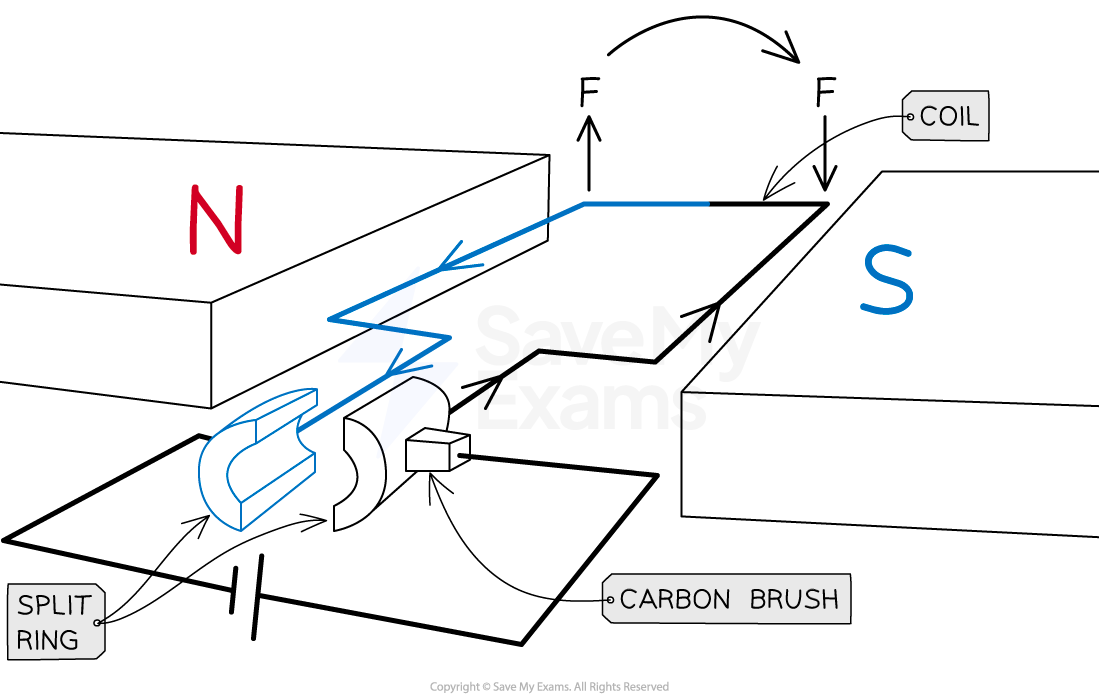
Forces acting in opposite directions on each side of the coil, causing it to rotate. The split-ring connects the coil to the flow of current
-
Current flowing through the coil produces a magnetic field
- This magnetic field interacts with the uniform external field, so a force is exerted on the wire
-
Forces act in opposite directions on each side of the coil, causing it to rotate:
- On the blue side of the coil, current travels towards the cell so the force acts upwards (using Fleming’s left-hand rule)
- On the black side, current flows away from the cell so the force acts downwards
-
Once the coil has rotated 90°, the split-ring is no longer in contact with the brushes
- No current flows through the coil so no forces act
Coil in the vertical position in a d.c. motor
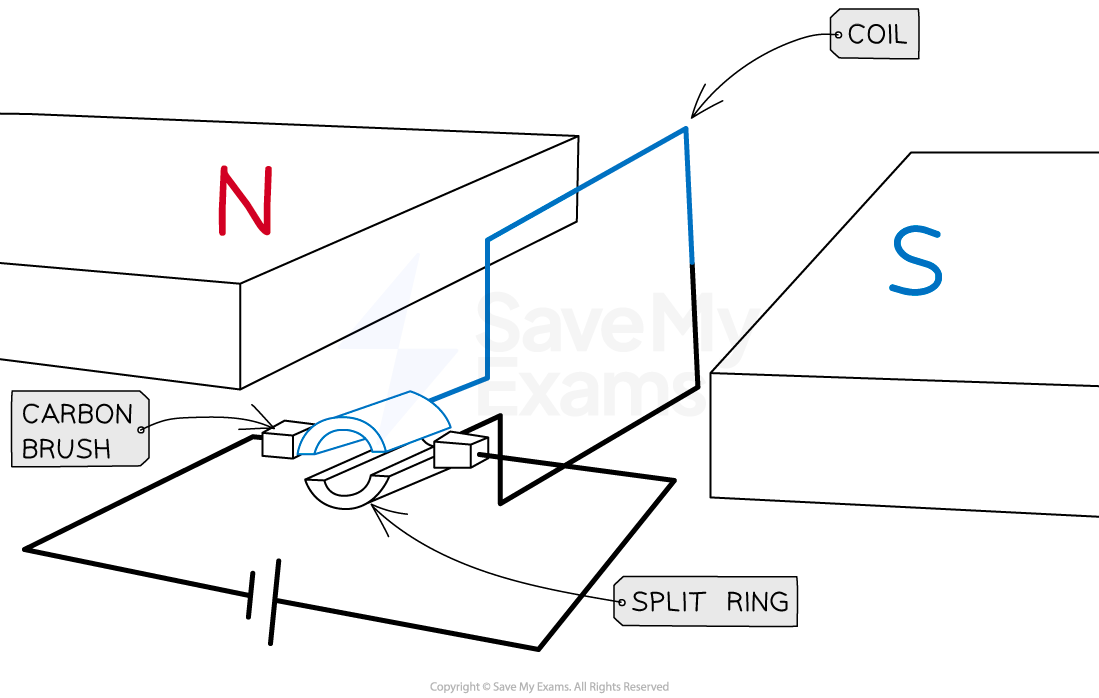
No force acts on the coil when vertical, as the split-ring is not in contact with the brushes
-
Even though no force acts, the momentum of the coil causes the coil to continue to rotate slightly
-
The split-ring reconnects with the carbon brushes and current flows through the coil again
- Now the blue side is on the right and the black side is on the left
-
Current still flows toward the cell on the left and away from the cell on the right, even though the coil has flipped
- The black side of the coil experiences an upward force on the left and the blue side experiences a downward force on the right
- The coil continues to rotate in the same direction, forming a continuously spinning motor
Forces on the coil when rotated 180°
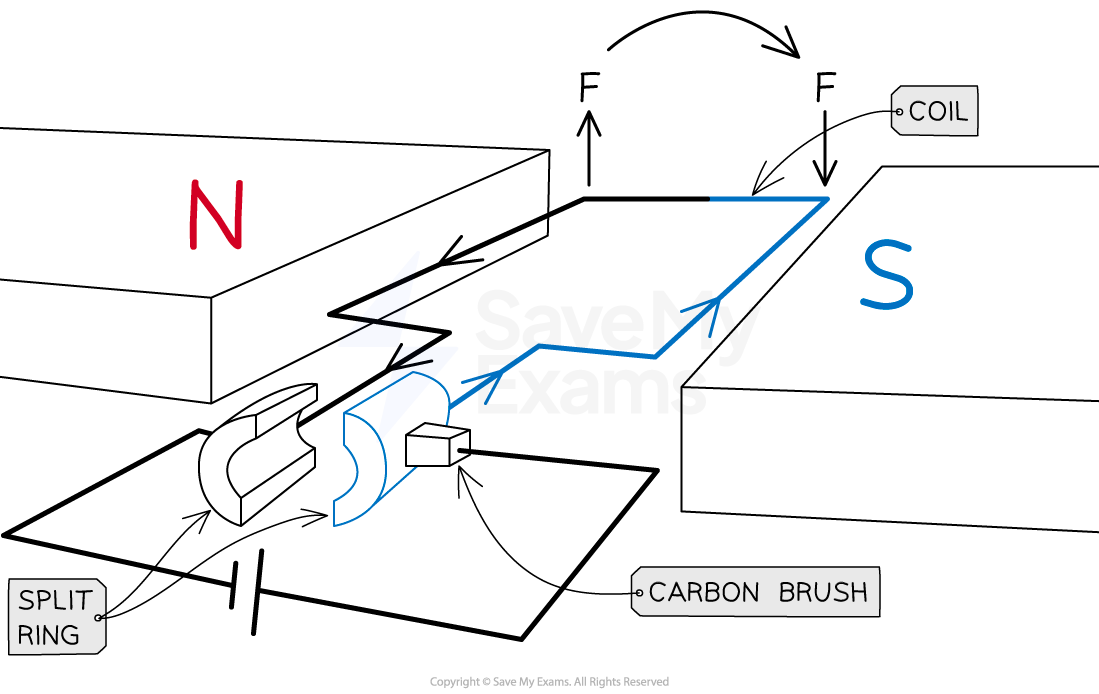
Even though the coil has flipped, the current still flows anticlockwise and the forces still cause rotation in the same direction
Factors affecting the d.c. motor
-
The speed at which the coil rotates can be increased by:
- increasing the current
- using a stronger magnet
-
The direction of rotation of the coil in the d.c. motor can be changed by:
- reversing the direction of the current supply
- reversing the direction of the magnetic field by reversing the poles of the magnet
-
The force supplied by the motor can be increased by:
- increasing the current in the coil
- increasing the strength of the magnetic field
- adding more turns to the coil
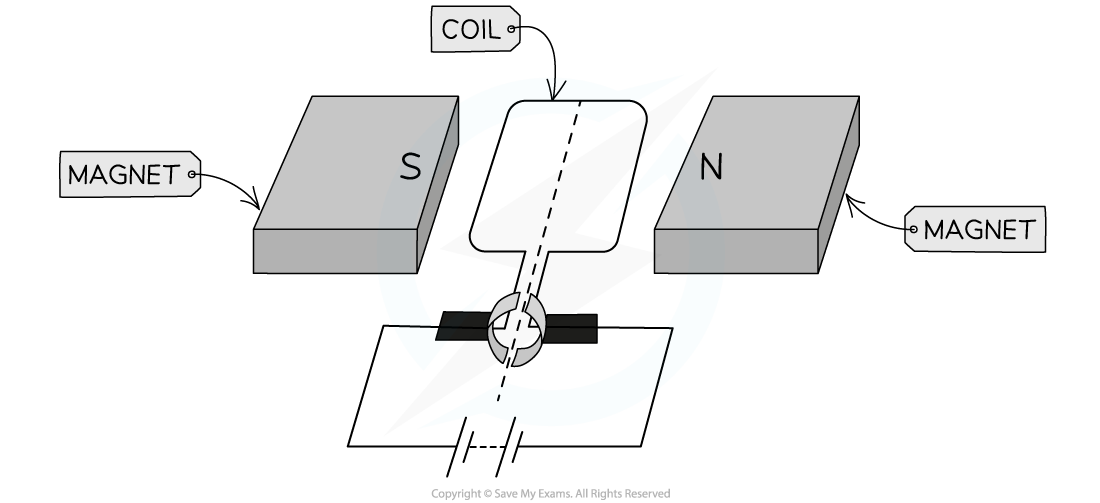
Worked Example A d.c. motor is set up as shown below.
Determine whether the coil will be rotating clockwise or anticlockwise.
[3]
Answer:
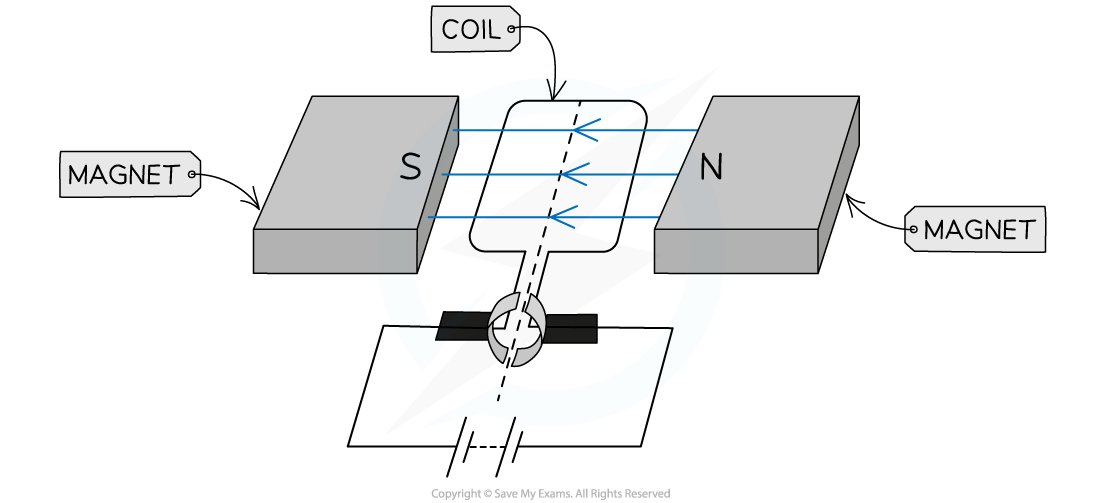
Step 1: Draw arrows to show the direction of the magnetic field lines
- These will go from the north pole of the magnet to the south pole of the magnet
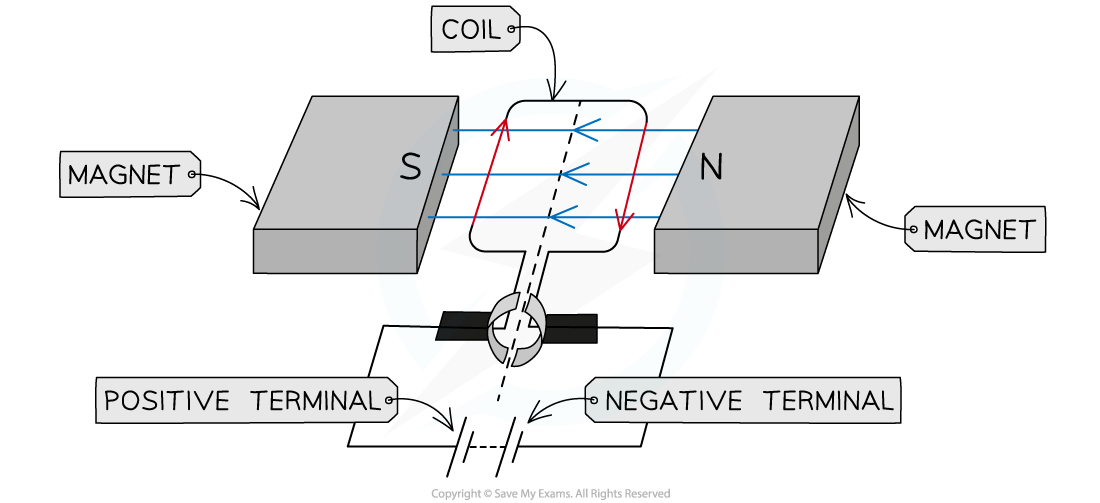
Step 2: Draw arrows to show the direction the current is flowing in the coils
- Current will flow from the positive terminal of the battery to the negative terminal [1 mark]
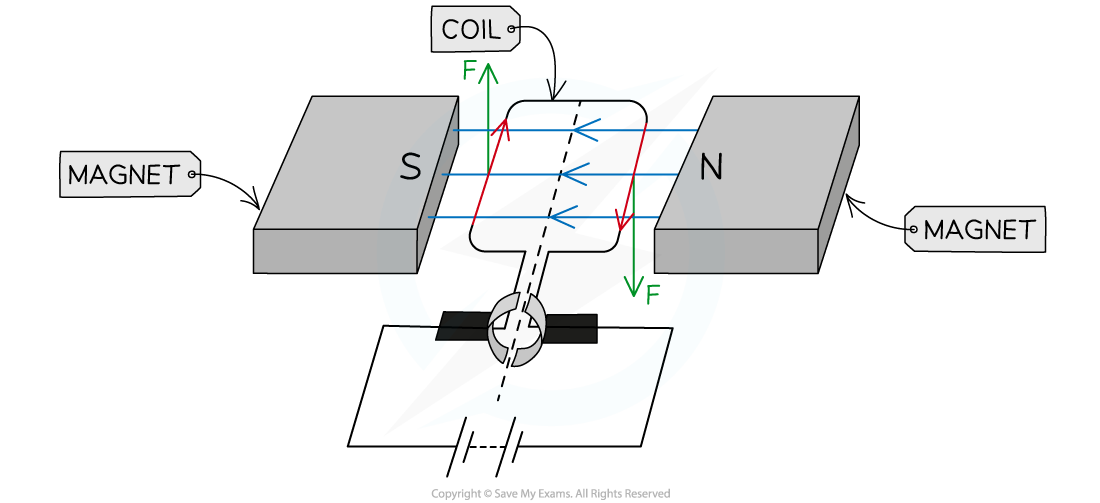
Step 3: Use Fleming’s left-hand rule to determine the direction of the force on each side of the coil
- Start by pointing your First Finger in the direction of the (magnetic) Field
- Now rotate your hand around the first finger so that the seCond finger points in the direction of the Current
- The THumb will now be pointing in the direction of the THrust (the force) [1 mark]
Step 4: Use the force arrows to determine the direction of rotation
- The coil will be turning clockwise [1 mark]
Exam Hint It is important to remember all the steps that cause the rotation of the coil in a d.c. motor. Use Fleming’s left-hand rule to convince yourself of the direction of the force on each side of the coil. These should be in opposite directions because the directions of the current through each side are opposite.
Additionally, don't be confused if you see the phrase 'split-ring commutator'. This is another way of referring to the split-ring in the circuit and they mean the same thing.
Was this revision note helpful?
Build on this topic