EMF & Potential Difference in Circuits (Cambridge International IGCSE Physics)
E.m.f. in series
Spec point —
4.3.3· Calculate the combined e.m.f. of several sources in series
- When several cells are connected together in series, their combined e.m.f. is equal to the sum of their individual e.m.f.s
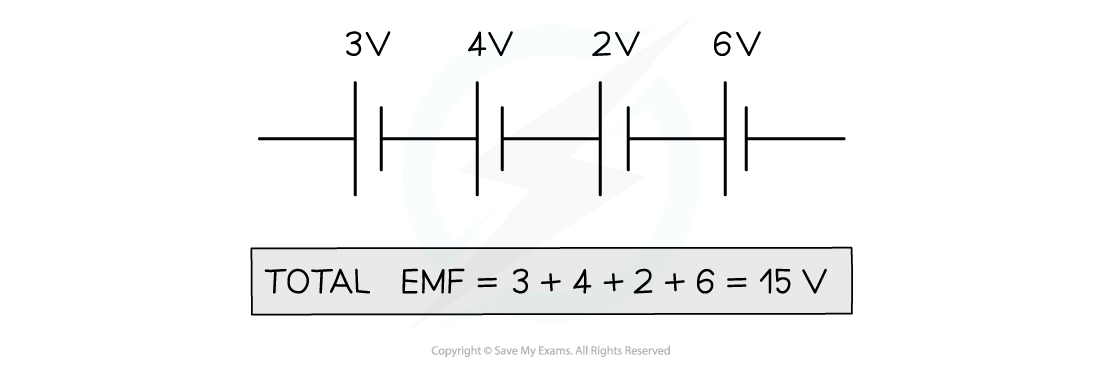
The total e.m.f. of these cells is equal to the sum of their individual e.m.f.s
Potential difference in series circuits
Spec point —
4.3.3· Recall and use in calculations, the fact that: (b) the total p.d. across the components in a series circuit is equal to the sum of the individual p.d.s across each component
Potential difference in series circuits
Extended Tier Only
- In a series circuit, the sum of potential differences across the components is equal to the total e.m.f. (electromotive force) of the power supply
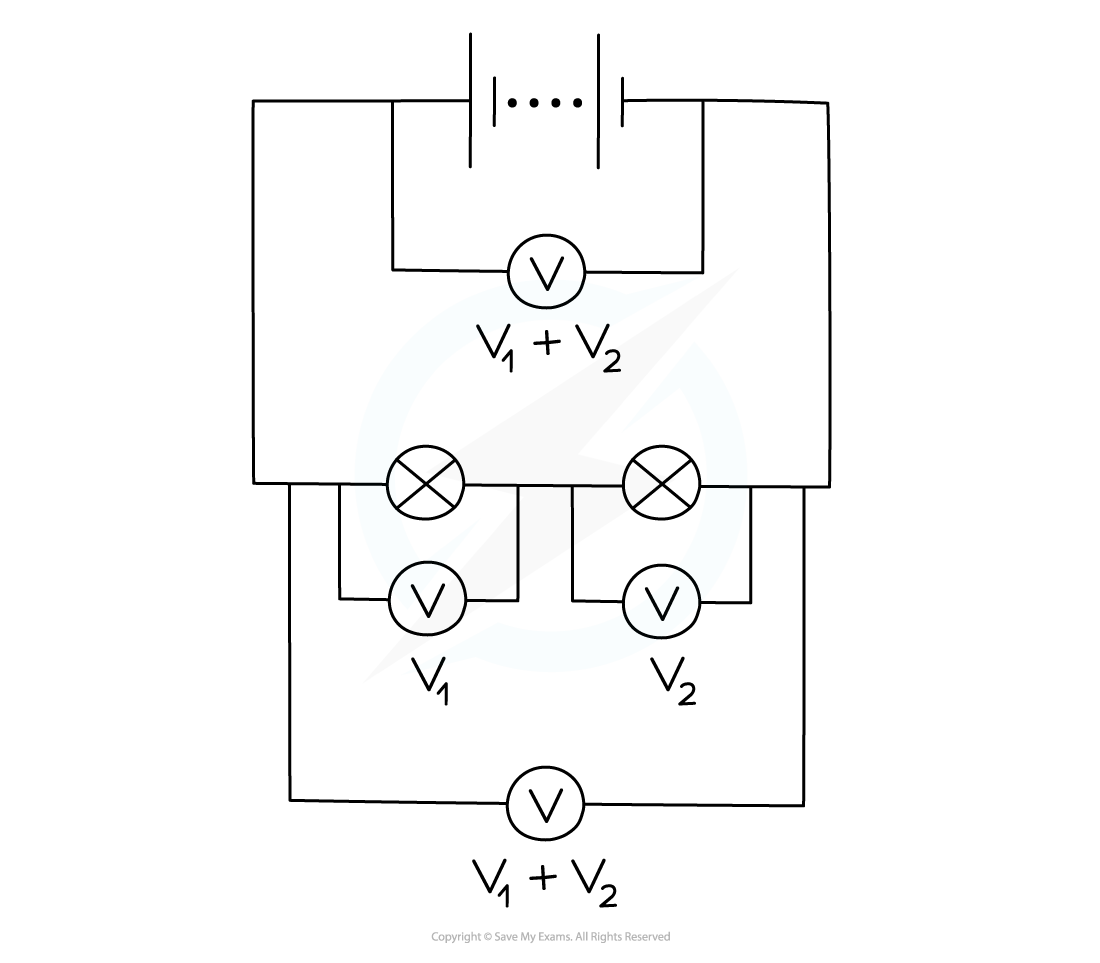
In a series circuit, the components share the e.m.f. of the power supply
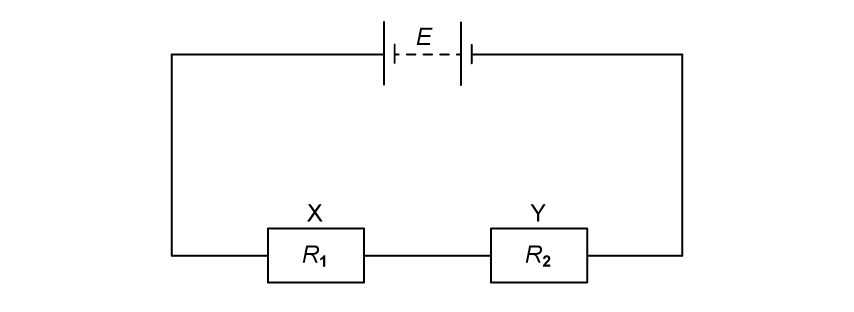
Worked Example In the circuit diagram below, the power source has an e.m.f., E, of 16 V. There is a potential difference of 10 V across component X. Calculate the potential difference across component Y.
[2]
Answer:
Step 1: Recall the rule for potential difference in series
- The sum of potential differences across components in series is equal to the e.m.f. across the power source [1 mark]
Step 2: Write an equation to determine the potential difference across Y
Where:
- is the e.m.f. of the power source = 16 V
- * *is the potential difference across X = 10 V
- * *is the potential difference across Y
Step 3: Substitute in the known quantities and calculate VY
- Therefore, the potential difference across Y is 6 V [1 mark]
Potential difference in parallel circuits
Spec point —
4.3.3· Recall and use in calculations, the fact that: (c) the p.d. across an arrangement of parallel resistances is the same as the p.d. across one branch in the arrangement of the parallel resistances
Potential difference in a parallel circuit
Extended Tier Only
- The potential difference across each branch of a parallel circuit is the same as the e.m.f. of the power source
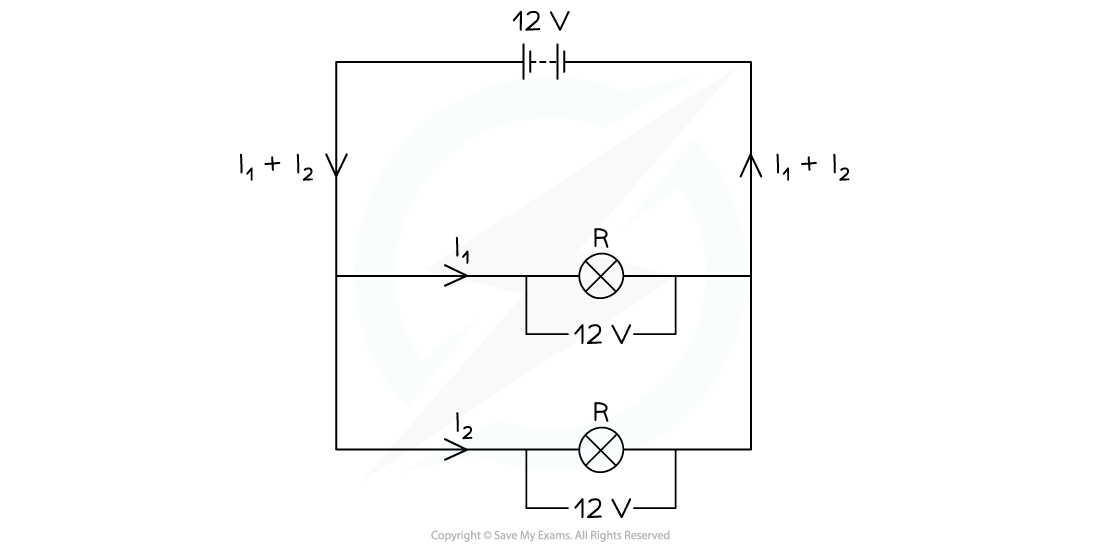
The power source has an e.m.f. of 12 V and there is a potential difference of 12 V across each branch
-
It is important to notice that the potential difference in a parallel circuit is equal across each branch
- In the example above, if one branch in the circuit contained multiple components, the 12 V would be split between the components on that branch
Was this revision note helpful?
Build on this topic