Investigating Conductors & Insulators (Cambridge International IGCSE Physics)
Electrical conductors & insulators
Spec point —
4.2.4· Recall and use a simple electron model to explain the difference between electrical conductors and insulators and give typical examples
Conductors
-
A conductor is a material that allows charge (usually electrons) to flow through it easily
-
Some examples of conductors are:
- silver
- copper
- aluminium
- steel
-
The best conductors tend to be metals
-
On the atomic scale, metallic conductors are made up of positively charged metal ions with their outermost electrons delocalised
- This means the electrons are free to move
-
Metals conduct electricity very well because:
- Current is the rate of flow of electrons
- So, the more easily electrons are able to flow, the better the conductor
Metallic lattice structure
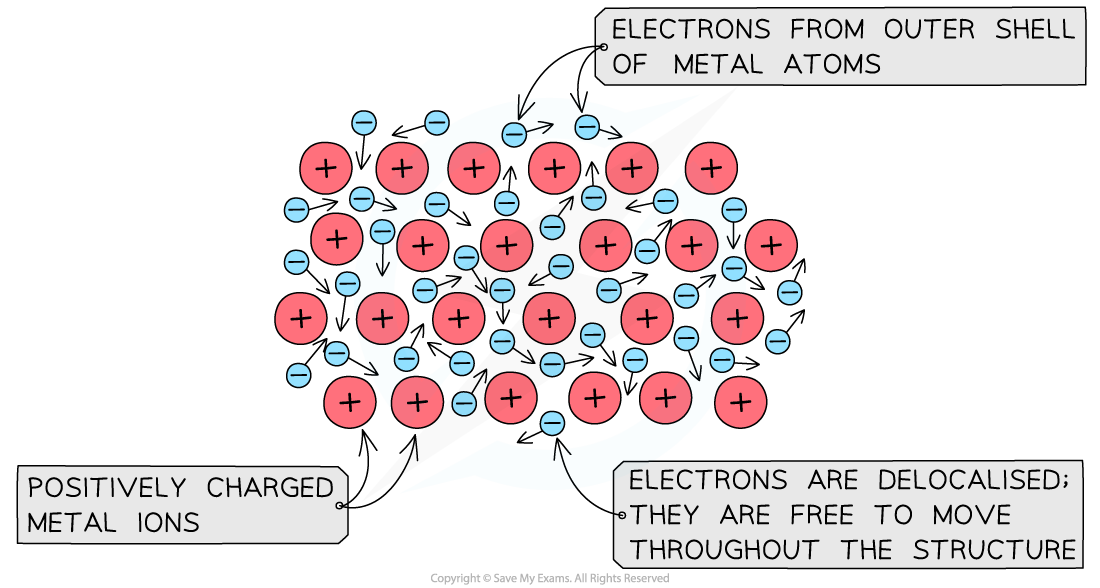
The lattice structure of a conductor with positive metal ions and delocalised electrons
Insulators
-
An insulator is a material that has no free charges and hence does not allow the flow of charge through it very easily
-
Some examples of insulators are:
- rubber
- plastic
- glass
- wood
-
Some non-metals, such as wood, allow some charge to pass through them
-
Although they are not very good at conducting, they do conduct a little in the form of static electricity
- For example, two insulators can build up charge on their surfaces and if they touch this would allow that charge to be conducted away
Conductors and insulators

Different materials have different properties of conductivity
Investigating electrical conductors & insulators
Spec point —
4.2.4· Describe an experiment to distinguish between electrical conductors and insulators
Aim of the experiment
- The aim of this experiment is to distinguish between good and bad conductors using a gold leaf electroscope
Variables
- Independent variable = Different materials
- Dependent variable = Electrical conductivity of materials
Equipment
Equipment list
| Equipment | Purpose |
|---|---|
| Gold-leaf electroscope | To distinguish between electrical conductors and insulators |
| Polythene rod | To charge the electroscope by contact |
| Cloth | To charge the rod by friction |
| Different conducting and insulating materials (metal, plastic, glass, graphite, wood, fabric, rubber) | To observe the effects of these on the gold-leaf electroscope when uncharged |
Method
- Before beginning the experiment, ensure the plate of the electroscope is uncharged by touching it with a finger. The leaf should hang straight down next to the stem
- Charge a polythene rod by rubbing it with a cloth
- Touch the charged rod to the plate of the electroscope. The leaf should stay risen if the electroscope has been successfully charged
- Touch the plate of the charged electroscope with the first object to be tested and record any observations
- Repeat for different materials
Example results table
| Material | Gold leaf falls quickly or slowly | Good or bad conductor |
|---|---|---|
| Metal | ||
| Plastic | ||
| Glass | ||
| Graphite | ||
| Wood | ||
| Fabric | ||
| Rubber |
Analysis of results
-
Good conductors, such as metals, allow charge to flow through them easily:
- Therefore, a good conductor will cause the leaf to fall quickly as it allows charge to flow to or from the plate
- The faster the leaf falls, the better the conductor
-
Poor conductors, such as glass, do not allow charge to flow as easily:
- Therefore, a poor conductor will cause the leaf to fall slowly as the charge is unable to flow as well
- If the leaf does not move at all, the material is a good insulator
-
The expected results are shown in the table below:
Table of conductors and insulators
| Good conductors | Poor conductors (insulators) |
|---|---|
| Metal | Plastic |
| Graphite | Glass |
| Wood | |
| Fabric | |
| Rubber |
Evaluating the experiment
- An electrometer (electronic instrument capable of measuring electric charge) could be used instead of an electroscope to allow for numerical comparisons between good and poor conductors
Was this revision note helpful?
Build on this topic