Magnets (Cambridge International IGCSE Physics)
Induced magnetism
Spec point —
4.1.2· - Describe induced magnetism
- State the differences between the properties of temporary magnets (made of soft iron) and the properties of permanent magnets (made of steel)
- State the difference between magnetic and non-magnetic materials Describe the forces between magnetic poles and between magnets and magnetic materials, including the use of the terms:
- north pole (N pole),
- south pole (S pole),
- attraction and repulsion,
- magnetised and unmagnetised
Induced magnetism
Magnetic materials
-
Very few metals in the periodic table are magnetic
-
The magnetic metals are:
- iron
- cobalt
- nickel
- steel is an alloy which contains iron, so it is also magnetic
Magnetic materials are attracted to a magnet; non-magnetic materials are not
- Magnetic materials (which are not magnets) will always be attracted to the magnet, regardless of which pole is held close to it
Magnetic materials are attracted to both poles of a permanent magnet
-
Bringing a material close to a known magnet will determine if the material is magnetic, non-magnetic or if it is a magnet itself
- It is a magnet if it is repelled by the known magnet
- It is a magnetic material if it is attracted to the known magnet
- It is a non-magnetic material if it is neither attracted nor repelled by the known magnet
Types of magnets
-
There are two types of magnets:
- permanent magnets
- induced (also called temporary) magnets
Permanent magnets
-
Permanent magnets are made out of permanent magnetic materials, for example, steel
-
A permanent magnet will produce its own magnetic field
- It will not lose its magnetism
Temporary (induced) magnets
-
An induced magnet is a material with a soft iron core that becomes a magnet temporarily when it is placed in a magnetic field
- Induced magnetism always causes a force of attraction between the permanent magnet creating the magnetic field and the induced magnet
- When this happens it is said that the material has been magnetised
- This means that the end of the material closest to the magnet will have the opposite pole to that of the magnet pole closest to the material
-
When removed from the magnetic field, the material will lose its induced magnetism quickly and become unmagnetised
- Some objects such as paperclips or needles (made from steel) can be magnetised and will remain magnetic for a while
- Other objects, such as electromagnets or transformers (which are made from soft iron) will be unmagnetised(no longer magnetised) as soon as the cause of the induced magnetism is removed
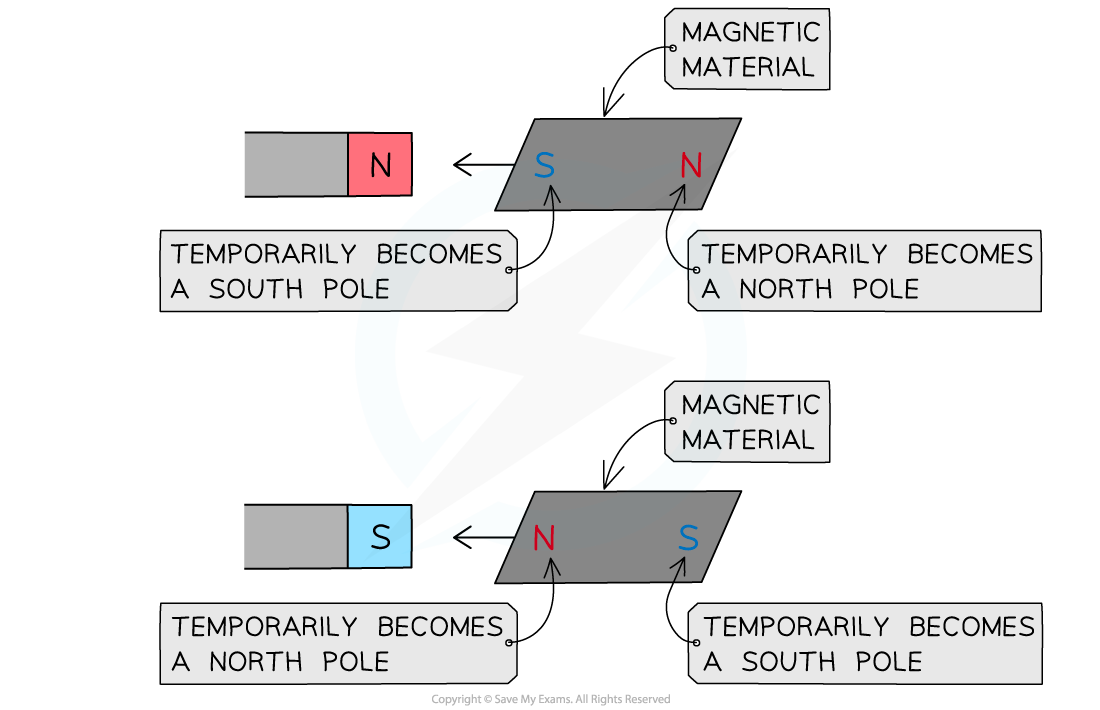
Inducing magnetism in a magnetic material
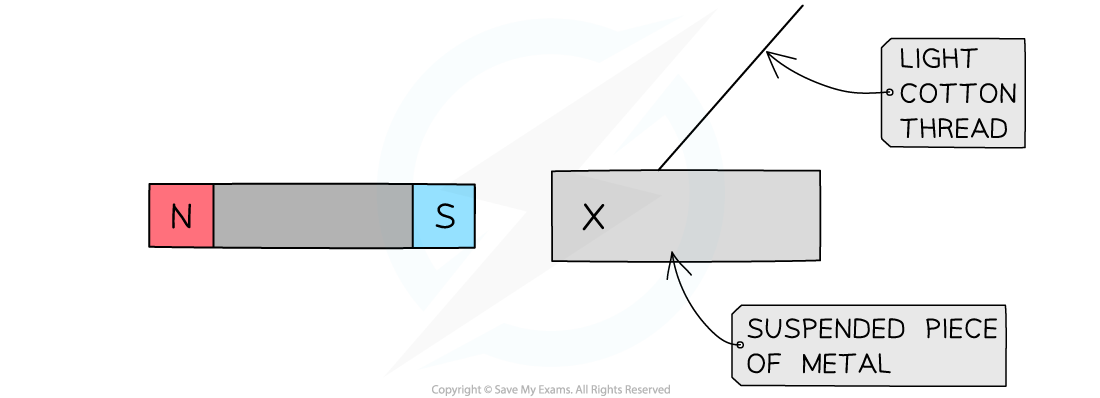
Worked Example The diagram below shows a magnet held close to a piece of metal suspended by a light cotton thread. The piece of metal is attracted towards the magnet.
Which of the following rows in the table gives the correct type of pole at X and the correct material of the suspended piece of metal?
Type of pole at X Material of suspended piece of metal A North Nickel B South Nickel C North Aluminium D South Aluminium [1]
Answer:
The correct answer is A [1 mark]
X must be a north pole
- The piece of metal is being attracted towards the magnet
- The law of magnetism states that opposite poles attract
The material of the suspended piece of metal is nickel
- Nickel is a magnetic material (it will experience a force when it is placed in a magnetic field, in this case it is attracted towards the magnet)
B is incorrect because X cannot also be a south pole (and hence is a north pole)
- If the pole at X was a south pole then the piece of metal would be repelled from the magnet because the law of magnetism states that like poles repel
C and D are incorrect because aluminium is not a magnetic material
- A non-magnetic material would be unaffected by the magnetic field produced by the magnet
Induced magnetism video
Spec point —
4.1.2· nan
Was this revision note helpful?