Evaporation (Cambridge International IGCSE Physics)
Spec point —
2.2.5· - Describe evaporation in terms of the escape of more energetic particles from the surface of a liquid (C)
- Know that evaporation causes cooling of a liquid (C)
Evaporation
-
Evaporation is a change in state of a liquid to a gas
-
It happens:
- At any temperature
- Only from the surface of a liquid
-
The molecules in a liquid have a range of energies
- Some have lots of energy, others have very little
- Their average energy relates to the temperature of the liquid
-
Evaporation occurs when more energetic molecules moving near the surface of the liquid have enough energy to escape
- The average energy of the liquid is reduced when the particles with most energy leave
- Therefore liquids are cooled down by evaporation
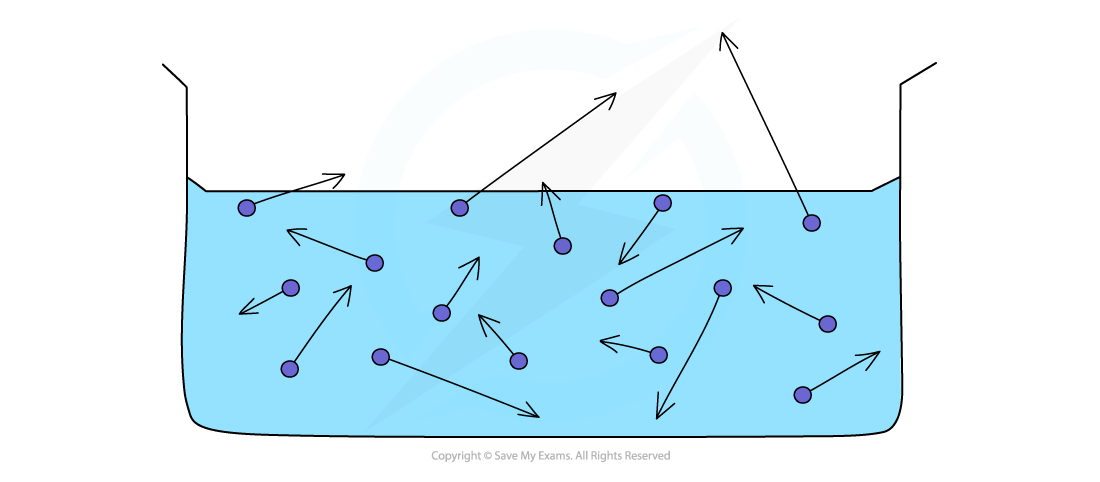
Evaporation occurs when more energetic molecules near the surface of a liquid escape
Factors affecting evaporation & explaining cooling
Spec point —
2.2.5· - Describe how temperature, surface area and air movement over a surface affect evaporation (E)
- Explain the cooling of an object in contact with an evaporating liquid (E)
Factors affecting evaporation & explaining cooling
Extended Tier Only
Factors affecting evaporation
- These factors all affect the rate of evaporation
Temperature of the liquid
-
Increased temperature increases the kinetic energy of the molecules in the liquid
- Molecules with more energy are more likely to overcome the intermolecular forces holding them in the liquid state and escape the surface
- Therefore higher temperature leads to a higher rate of evaporation
Surface area of the liquid
-
Molecules only escape the intermolecular forces of attraction at the surface of the liquid
- Therefore a larger surface area leads to a higher rate of evaporation
Air movement
-
Air movement carries away the water vapour which has just evaporated
- This replaces the air above the liquid with drier air, which accepts water vapour more easily
- Therefore increasing air movement (e.g. wind or a fan) increases the rate of evaporation
Evaporation and cooling
-
The process of evaporation can be used to cool things down
-
As evaporation occurs, the liquid cools
- This is because the most energetic particles escape from the surface
- The average kinetic energy of the remaining particles reduces, so the temperature of the liquid falls
-
An object in contact with an evaporating liquid is cooled
- This is because thermal energy is transferred from the object to the cooler liquid
- This process is used in some refrigerators and air conditioning units
Exam Hint Note that the rate of evaporation depends on the surface area of the liquid, not on the volume of liquid.
Boiling vs evaporation
Spec point —
2.2.5· Describe the differences between boiling and evaporation
Extended Tier Only
-
Boiling is also a change in state from liquid to gas
- Boiling happens only at the boiling point of the liquid
- The change of state happens throughout the liquid (seen as bubbles at the bottom of a pan of boiling water, for example)
-
The following table shows the difference between boiling and evaporation:
| Feature | Boiling | Evaporation |
|---|---|---|
| Change of state | Liquid to gas | Liquid to gas |
| Temperature | Boiling point | Any temperature between melting and boiling point |
| Where it happens | Throughout the whole liquid | From the surface |
Exam Hint If you are asked for the differences between boiling and evaporation, remember that 'evaporation happens only at the surface' and 'there are no bubbles in evaporation' count as the same difference, not two. Make sure one of your differences is about temperature.
Was this revision note helpful?