Background Radiation (Cambridge International IGCSE Physics)
Spec point —
5.2.1· Know what is meant by background radiation
Background radiation
- Background radiation is defined as:
The radiation that exists around us all the time
-
There are two types of background radiation:
- Natural sources from radioactive elements that have always existed on Earth and in outer space
- Man-made sources from human activity that adds to the amount of radiation humans are exposed to on Earth
-
The count rate of detected levels of background radiation can vary significantly from place to place
Sources of background radiation
Spec point —
5.2.1· Know the sources that make a significant contribution to background radiation including: (a) radon gas (in the air) (b) rocks and buildings (c) food and drink (d) cosmic rays
Sources of background radiation
-
The sources that make a significant contribution to background radiation include:
- radon gas (in the air)
- rocks and buildings
- food and drink
- cosmic rays
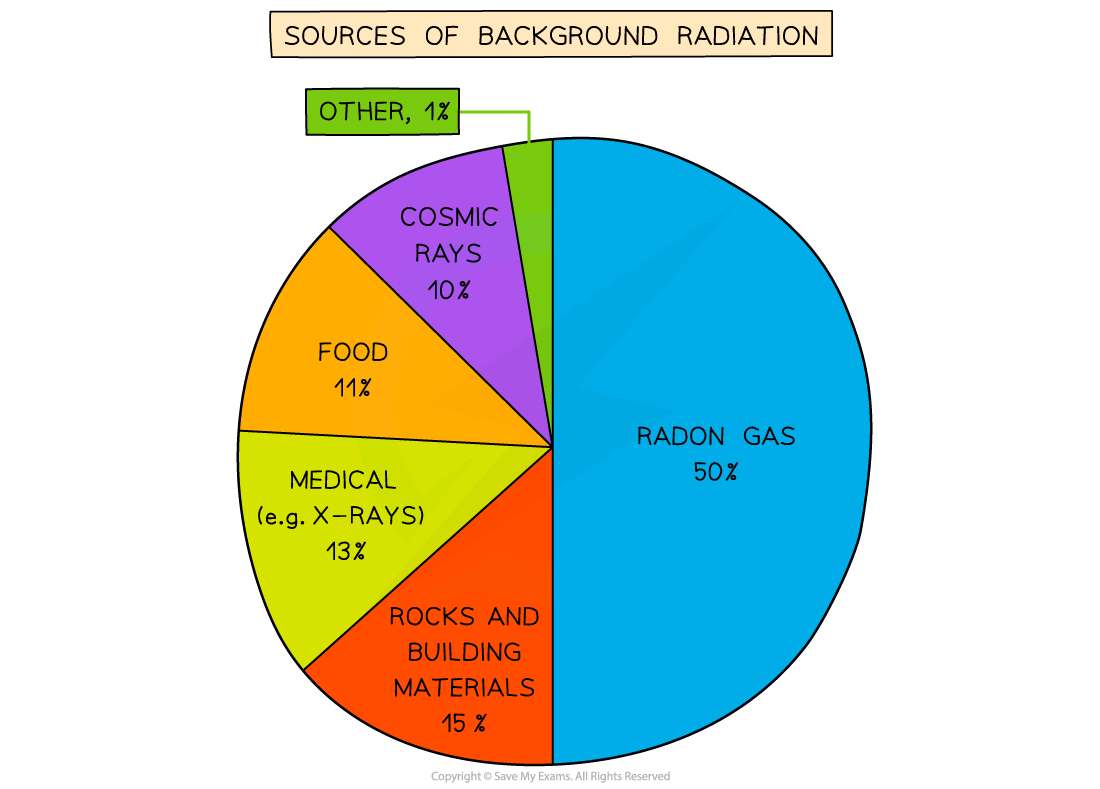
Background radiation is the radiation that is present all around in the environment. Radon gas is given off from some types of rock
Natural sources
-
Rocks and buildings
- Natural radioactivity can be found in building materials, including decorative rocks, stone and brick
- Heavy radioactive elements, such as uranium and thorium, occur naturally in rocks in the ground
- Uranium decays into radon gas
-
Radon gas (in the air)
- Radon gas is an alpha emitter
- Radon gas is particularly dangerous if it is inhaled into the lungs in large quantities
- The gas is tasteless, colourless and odourless, but it is not generally a health issue unless levels are significantly high
-
Radioactive material in food and drink
- Naturally occurring radioactive elements can get into food and water since they are in contact with rocks and soil containing these elements
- Some foods contain higher amounts such as potassium-40 in bananas
- However, the amount of radioactive material is minuscule and is not a cause for concern
-
Cosmic rays from space
- The sun emits an enormous number of protons every second
- Some of these enter the Earth’s atmosphere at high speeds
- When they collide with molecules in the air, this leads to the production of gamma radiation
- Other sources of cosmic rays are supernovae and other high-energy cosmic events
-
Carbon-14 in biological material
- All organic matter contains a tiny amount of carbon-14
- Living plants and animals constantly replace the supply of carbon in their systems hence the amount of carbon-14 in the system stays almost constant
Man-made sources
-
Medical sources
- In medicine, radiation is used frequently
- Uses include X-rays, CT scans, radioactive tracers, and radiation therapy
-
Nuclear waste
- While nuclear waste itself does not contribute much to background radiation, it can be dangerous for the people handling it
-
Nuclear fallout from nuclear weapons
- Fallout is the residue radioactive material that is thrown into the air after a nuclear explosion, such as the bomb that exploded at Hiroshima
- While the amount of fallout in the environment is presently very low, it increases significantly in areas where nuclear weapons are tested
-
Nuclear accidents
- Accidents such as that in Chernobyl contributed a large dose of radiation into the environment
- While these accidents are now extremely rare, they can be catastrophic and render areas devastated for centuries
Exam Hint The sources that make the most significant contribution are the natural sources:
- Radon gas
- Rocks and buildings
- Food and drink
- Cosmic rays
Make sure you remember these for your exam!
Detecting radiation
Spec point —
5.2.1· - Know that ionising nuclear radiation can be measured using a detector connected to a counter
- Use count rate measured in counts/s or counts/minute
Detecting radiation
- Ionising nuclear radiation can be measured using a detector connected to a counter
Count rate
-
The detector uses count rate measured in counts/s or counts/minute
- The count rate is the number of decays per second
-
The count rate decreases the further the detector is from the source
- This is because the radiation becomes more spread out the further away it is from the source
Geiger–Müller tube detects count rate
-
The Geiger-Müller tube is the most common device used to measure and detect the count rate of radiation
-
Each time it absorbs radiation, it transmits an electrical pulse to a counting machine
- This makes a clicking sound and it displays the count rate on a screen
-
The greater the frequency of clicks, or the higher the count rate, the more radiation the Geiger-Müller tube is absorbing
- Therefore, it matters how close the tube is to the radiation source
- The further away from the source, the lower the count rate detected
Geiger–Müller tube detects count rate
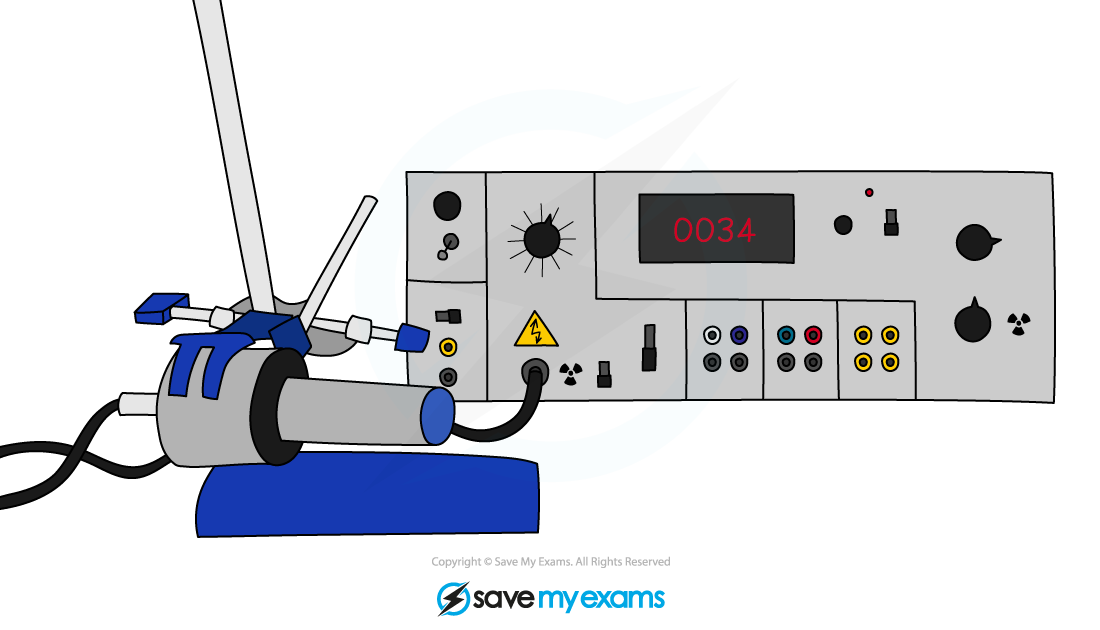
A Geiger-Müller tube (or Geiger counter) is a common type of radiation detector detecting count rate
-
Examples of other radiation detectors include:
- Photographic film (often used in badges)
- Ionisation chambers
- Scintillation counters
- Spark counters
Worked Example A Geiger-Müller tube is used to detect radiation in a particular location. What is the count rate if it counts 16 000 decays in 1 hour?
[2]
Answer:
Step 1: Identify the different variables
- The number of decays is 16 000
- The time is 1 hour
Step 2: Determine the time period in seconds
- 1 hour is equal to 60 minutes, and 1 minute is equal to 60 seconds
[1 mark]
Step 3: Divide the total counts by the time period in seconds
- Therefore, there are 4.5 decays per second [1 mark]
Exam Hint If asked to name a device for detecting radiation, the Geiger-Müller tube is a good example to give. You can also refer to it as a GM tube, a GM detector, GM counter, Geiger counter etc. (The examiners will allow some level of misspelling, providing it is readable). Don’t, however, refer to it as a ‘radiation detector’ as this is too vague and may simply restate what was asked for in the question.
It is important to regulate the exposure of humans to radiation. The amount of radiation received by a person is called the dose.
Accounting for background radiation
Spec point —
5.2.1· Use measurements of background radiation to determine a corrected count rate
Extended Tier Only
- Measurements of background radiation are used to determine a corrected count rate
- This can be done by taking readings with no radioactive source present and then subtracting this from readings with the source present
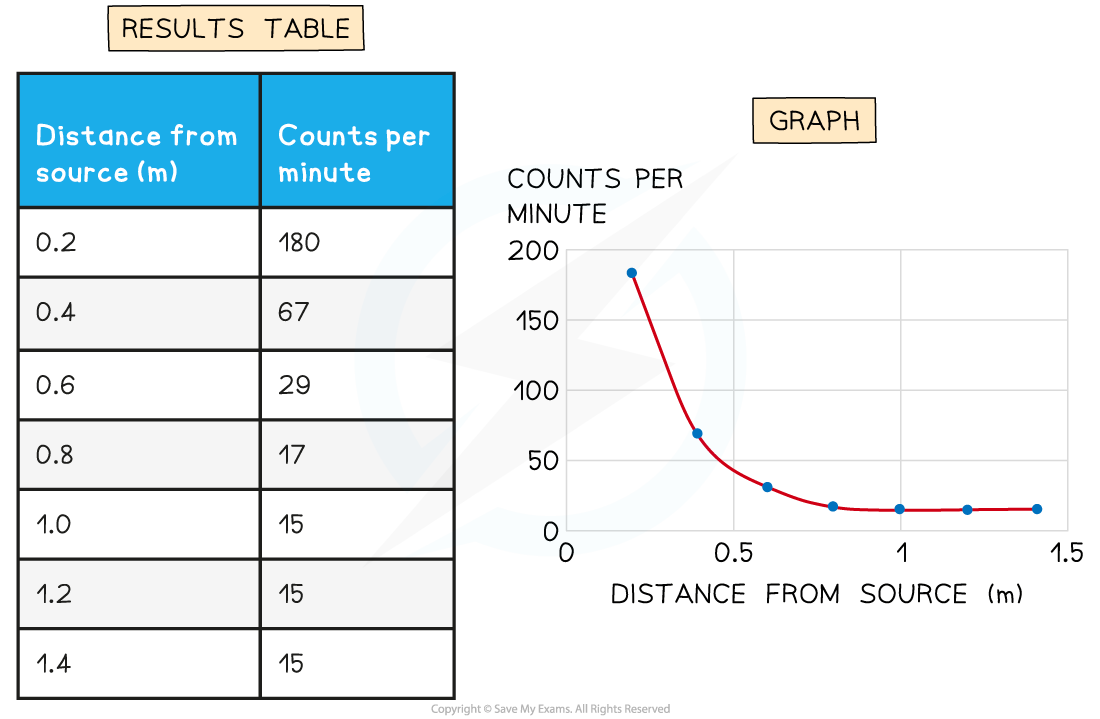
Worked Example A student is using a Geiger-counter to measure the counts per minute at different distances from a source of radiation. Their results and a graph of the results are shown here.
Distance from source / m Counts per minute 0.2 180 0.4 67 0.6 29 0.8 17 1.0 15 1.2 15 1.4 15
Determine the background radiation count.
[1]
Answer:
Step 1: Determine the point at which the source radiation stops being detected
- The background radiation is the amount of radiation received all the time
- When the source is moved back far enough it is all absorbed by the air before reaching the Geiger-counter
- Results after 1 metre do not change
- Therefore, the amount after 1 metre is only due to background radiation
Step 2: State the background radiation count
- The background radiation count is 15 counts per minute [1 mark]
Was this revision note helpful?
Build on this topic