Transverse & Longitudinal Waves (Cambridge International IGCSE Physics)
Transverse waves
Spec point —
3.1.3· Know that for a transverse wave, the direction of vibration is at right angles to the direction of propagation and understand that electromagnetic radiation, water waves and seismic S-waves (secondary) can be modelled as transverse
-
Waves can exist as one of two types:
- Transverse
- Longitudinal
-
Transverse waves are defined as:
Waves where the direction of vibration is at right angles to the direction of propagation
- For a transverse wave, the particles of the medium vibrate perpendicular to the direction in which the wave is travelling
- Mechanical transverse waves can travel through solids and along the surface of a liquid, but not through the body of a liquid or through a gas
- Non-mechanical transverse waves can move in a vacuum
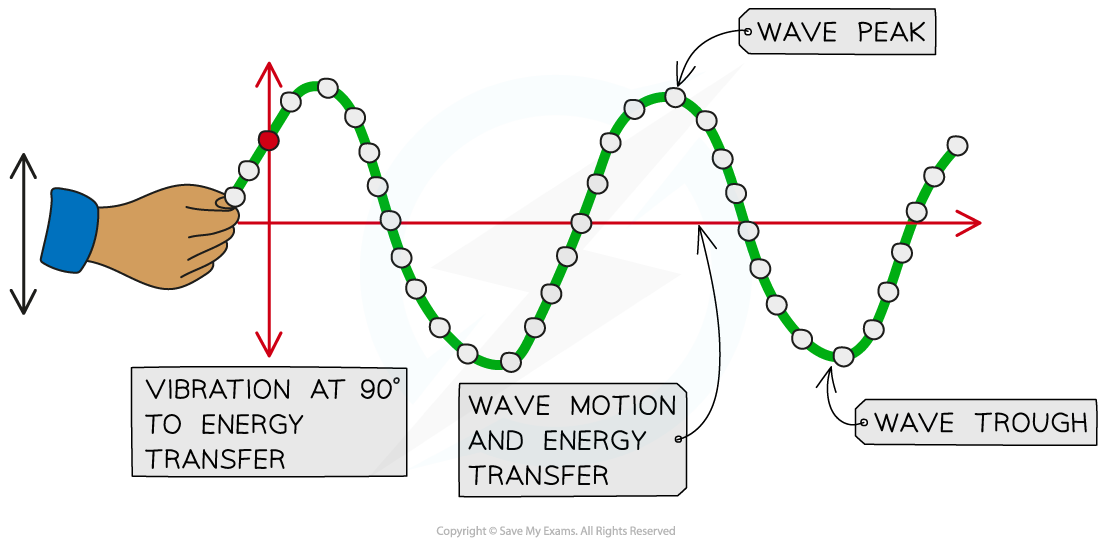
Transverse waves can be seen in a rope when it is moved quickly up and down
-
Examples of waves that can be modelled as transverse are:
- Electromagnetic waves (such as radio waves, visible light, X-rays)
- Ripples on the surface of water
- Seismic S-waves (secondary earthquake waves)
Longitudinal waves
Spec point —
3.1.3· Know that for a longitudinal wave, the direction of vibration is parallel to the direction of propagation and understand that sound waves and seismic P-waves (primary) can be modelled as longitudinal
- Longitudinal waves are defined as:
Waves where the direction of vibration is parallel to the direction of propagation
-
For a longitudinal wave:
- The particles of the medium vibrate back and forth parallel to the direction in which the wave travels
- They can move in solids, liquids and gases
- They cannot move in a vacuum (since there are no particles)
-
The key features of a longitudinal wave are:
- Regions where the particles of the medium are close together, called compressions
- Regions where the particles of the medium are spread apart, called rarefactions
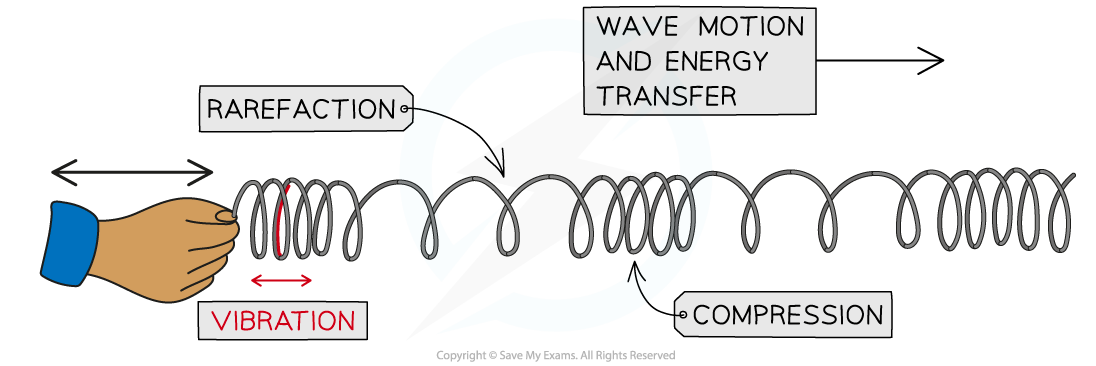
Longitudinal waves can be seen in a slinky spring when it is moved quickly backwards and forwards
-
Examples of waves that can be modelled as longitudinal waves are:
- Sound waves
- Seismic P-waves (primary earthquake waves)
Difference between transverse and longitudinal waves
| Property | Transverse waves | Longitudinal waves |
|---|---|---|
| Structure | Crests (peaks) and troughs | Compressions and rarefactions |
| Vibration | Right angles to the direction of propagation | Parallel to the direction of propagation |
| Vacuum | Only electromagnetic waves can travel in a vacuum | Cannot travel in a vacuum |
| Material | Can move in solids and the surfaces of liquids | Can move in solids, liquids and gases |
| Density | A constant density | The density of the medium varies |
| Pressure | Has a constant pressure | The pressure of the medium varies |
Exam Hint Make sure you state the direction of vibration with respect to the direction of wave travel when defining transverse and longitudinal waves. Saying that a wave travels in the direction of energy transfer will not gain the mark, because this is true of every wave.
Remember that P-waves are longitudinal, while S-waves are transverse.
Was this revision note helpful?