Logarithms (Cambridge International IGCSE Maths)
Logarithms
What are logarithms?
-
A logarithm is the inverse function of an exponential function
-
Making the subject of gives
- This is pronounced "log base a of b"
- This is the definition of a logarithm
- The number is called the base of the logarithm
-
-
If no base is given, it means the base number is 10
-
means
- In the past, this was a common base to use
- The log button on a calculator is always base 10
-
How do I interpret logarithms?
-
log base a of b, *, is the power that you raise to, to get
-
This is the power required to take the small number, , to the big number,* *
-
For example, is the power needed to get 5 to 125
- The power needed is 3 (because 53 = 125)
- So
-
Similarly
- (as )
-
It works for negative powers (reciprocals)
- (as )
-
It works for fractional powers (roots)
- (as )
-
-
Where possible, use a calculator to check
-
Use the
log _... end _ (... )button which allows you to change the base number- This is a different button to the log button (base 10)
-
How do I convert between logarithms and exponentials?
-
and are mathematically identical statements
- You can convert between the two
-
Learn to read as " is the power that you raise to, to get "
-
This allows you to convert logs to exponentials
-
-
This also works the other way
-
means
- Though it is often easier to think of making the subject
- To make the subject, take log base a of both sides,
-
-
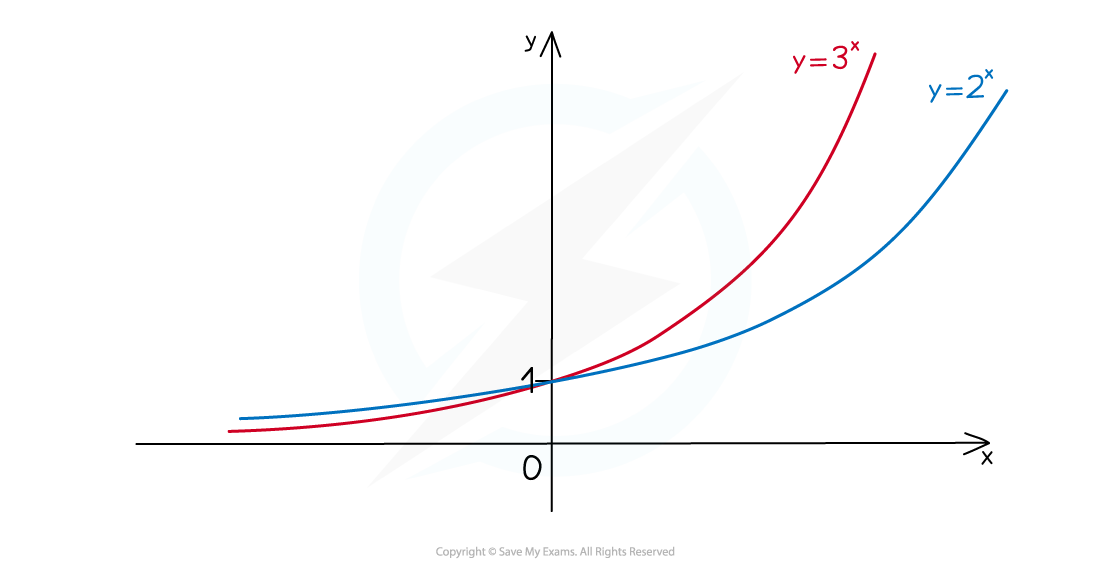
This means you can relate logarithms to exponential graphs
-
e.g. the graph of passes through the point
- so
-
Exam Hint In the exam, you can rewrite a logarithm question as an exponential question if you prefer.
How do I solve equations with logarithms?
-
Equations where is in the power are called exponential equations
-
Some can be solved easily by inspection (seeing the answer)
- For example, is solved by
-
Others cannot
- For example,
-
These must be solved using logarithms by making the subject
- means
- Type this into your calculator to get
-
-
Alternatively, you can also solve equations using logs of base 10 only
- The rule for base 10 is if then where means base 10
- For example, means
Exam Hint Whilst you still need to know both methods, mark schemes will accept different correct answers with logarithms, depending on whether you have used logs of base 10 or logs of a different base.
How do I use logarithms in compound interest questions?
-
You can use logarithms to work out the power, , in compound interest questions
-
e.g.you put £500 into a bank account with 5% interest per year; after how many whole years does it exceed £900?
- Make the subject: so (or )
- This gives so years
- (it has not exceeded 900 after 12 years)
-
How do I find inverse functions using logarithms?
-
For exponential functions, you can use logarithms to find their inverse functions
-
Use the standard process for finding inverse functions
-
e.g.
- then swap and to get
- Make the subject using logarithms:
- Finally make the subject to give
-
Worked Example (a) Solve the equation , giving your answer correct to 3 significant figures.
Method 1
To make the subject, take log base 4 of both sides
Use the
log _... end _ (... )button on your calculator to find
Round to 3 significant figures
Final answer: to 3 s.f.
Method 2
Using logs of base 10, solve by using * *
Use the log button on your calculator to find
Round to 3 significant figures
Final answer: to 3 s.f.
(b) Without using a calculator, solve the equation
log with no base means log base 10
Rewrite this statement as a exponential relationship 4 is the power that you raise 10 to, to get
Simplify and make the subject
(c) Make the subject of
Take log base 7 of both sides
Rearrange to make the subject Start by dividing both sides by
Then add 1 to both sides
in base 10 is also accepted
Was this revision note helpful?
Build on this topic