Multiplication & Division (Cambridge International IGCSE Maths)
Multiplication
How do I multiply two numbers without a calculator?
-
There are a variety of written methods that can be used to multiply large numbers
- You only need to know one method, but be able to use it confidently
- Four common methods are described below, but there are many other valid methods
How do I use the column method?
-
This is an efficient method if you are confident with multiplication
-
To use the column method:
-
Write one number above the other lining up the digits using place value columns
-
Multiply the first digit (on the right) from the bottom value by each digit in the top value
- Write the result under the line with the digits in the correct place value columns
-
Multiply the next digit in the bottom value by each digit in the top value
- Always work from right to left
- Use 0s as place holders when multiplying digits in columns other than the ones column
-
For example, 87 × 426 = 37 062
bottom | _ _ _ 8 7 | _ x 4 2 6 | bottom | _ 5 2 2 | _ 1 7 4 0 | 3 | 4 8 0 0 | | 3 | 7 0 6 2 |
-
How do I use the lattice method?
-
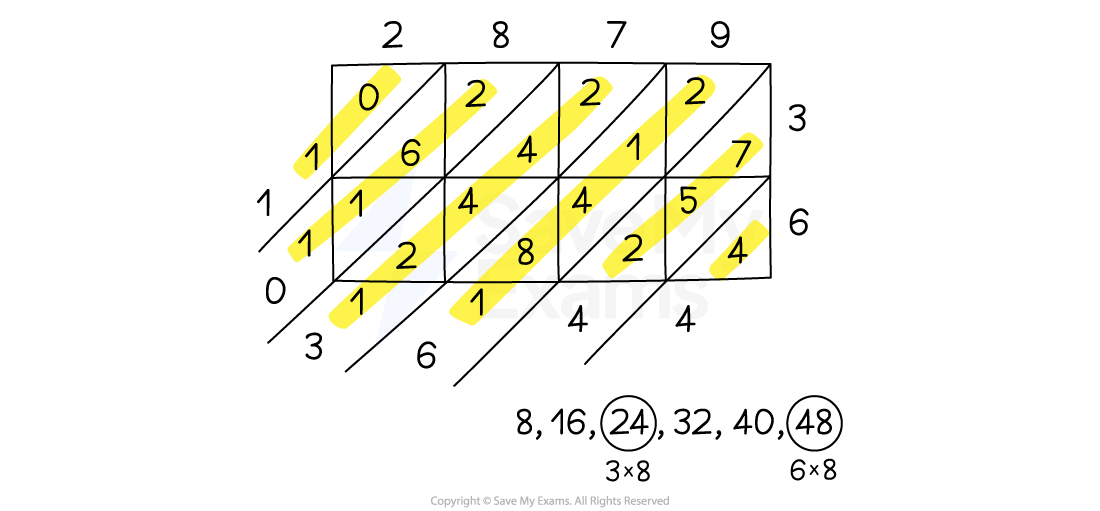
The lattice method is good for numbers with two or more digits
- This method allows you to work with individual digits
-
To use the lattice method:
-
Draw a grid
- The number of rows should be the same as the number of digits in one number
- The number of columns should be the same as the number of digits in the other number
- Draw diagonal lines through the boxes
-
Multiply each pair of digits, writing the result in the relevant box
- Ones should be written in the bottom half of the box and tens in the top half of the box
-
Add the digits along the diagonals and write the result in the diagonal outside the grid
- Carry the tens of any 2 digit result into the next diagonal
-
-
For example, 2879 × 36 = 103 644
How do I use the grid method?
-
This method keeps the value of the larger number intact
- It may take longer with two larger numbers
- Be careful lining up numbers with lots of zeros!
-
To use the grid method
-
Draw a grid
- The number of rows should be the same as the number of digits in one number
- The number of columns should be the same as the number of digits in the other number
-
Label the rows and columns with the values of each digit
- E.g. For 3516 you would use 3000, 500, 10 and 6
-
Multiply together the relevant values and put the results in the boxes
-
Add up all of the cells in the boxes
-
-
For example, 3516 × 7 = 24 612

How do I use the repeated addition method?
-
This is best for smaller, simpler cases
- You may have seen this called ‘chunking’
-
To use the repeated addition method
- Build up to the answer using simple multiplication facts that can be worked out easily
- To find 13 × 23 : 1 × 23 = 23 2 × 23 = 46 4 × 23 = 92 8 × 23 =184
- So, 13 × 23 = 1 × 23 + 4 × 23 + 8 × 23 = 23 + 92 + 184 = 299
What words are used for multiplication and division?
- Multiplication may be phrased using the words lots of, times or product
- Division may be phrased using the words quotient, share and per
Exam Hint A good way to check your answer without a calculator is to estimate it (e.g. by rounding everything to 1 significant figure).
Worked Example Multiply 725 by 19.
Answer:
Using the grid method
- Split the numbers up using the place value
- Multiply numbers to fill in the grid
× 700 20 5 10 7000 200 50 9 6300 180 45 Add together the numbers in the grid
charalign center stackalign right end 7000 200 50 6300 180 | + none none 45 end | horizontal line 13775 endUse an estimate to check your answer
- 700×20 is equal to 14 000
Final answer: 725 × 19 = 13 775
Division
How do I divide a number by another without a calculator?
-
The most common written method for division is short division (or "the bus stop method")
- There are other methods such as long division, but short division is generally the most efficient
-
While short division is best when dividing by a single digit, for bigger numbers you may need a different approach
-
You can use other number skills to help
- eg. cancelling fractions, “shortcuts” for dividing by 2 and 10, and the repeated addition (“chunking”) method covered in Multiplication
Short division (bus stop method)
-
Unless you can use simple shortcuts such as dividing by 2 or by 10, this method is best used when dividing by a single digit
-
To find 174 ÷ 3
-
Starting from the left; 3 fits into 1, 0 times, with a remainder of 1
- Carry the remainder of 1 over to the next digit, which forms 17
long division by 3 yields 0 pile 1 7 ^ 1 none 4 end pile end long division
-
3 fits into 17, 5 times, with a remainder of 2
- Carry the remainder of 2 over to the next digit, which forms 24
long division by 3 yields 05 pile 1 7 ^ 1 4 ^ 2 end pile end long division
-
3 fits into 24, 8 times, with no remainder
long division by 3 yields 058 pile 1 7 ^ 1 4 ^ 2 end pile end long division
-
So, 174 ÷ 3 = 58
-
Factorising & cancelling
-
This involves treating division as you would if you were asked to simplify fractions
-
For example, 1008 ÷ 28 can be written as
-
This can then be simplified
- 252 ÷ 7 can then be calculated using short division; the answer is 36
-
Dividing by 10, 100, 1000, … (Powers of 10)
-
This is a case of shifting digits along the place value columns For example
-
380 ÷ 10 = 38.0 (shifts by 1 column)
-
45 ÷ 100 = 0.45 (shifts by 2 columns)
-
28 ÷ 1000 = 0.028 (shifts by 3 columns)
- For cases like this, it can help to add leading zeros
- 0028 ÷ 1000 may be easier to visualise
-
Worked Example Divide 568 by 8.
Answer:
This is division by a single digit so short division would be an appropriate method If you spot it though, 8 is also a power of 2 so you could just halve three times
Using short division, the bus stop method:
8 fits into 5, 0 times, with a remainder of 5 8 fits into 56, 7 times exactly 8 fits into 8, 1 time exactly
Use an estimate to check your answer
- 600 ÷ 10 is equal to 60
568 ÷ 8 = 71

Was this revision note helpful?
Build on this topic