Linear Simultaneous Equations (Cambridge International IGCSE Mathematics)
Linear simultaneous equations
What are linear simultaneous equations?
-
When there are two unknowns (x and y), we need two equations to find them both
-
For example, 3x + 2y = 11 and 2x - y = 5
- The values that work are x = 3 and y = 1
-
-
These are called linear simultaneous equations
- Linear because there are no terms like x2 or y2
How do I solve linear simultaneous equations by elimination?
-
Elimination removes one of the variables, x or y
-
To eliminate the x's from 3x + 2y = 11 and 2x - y = 5, make the number in front of the x (the coefficient) in both equations the same (the sign may be different)
-
Multiply every term in the first equation by 2
- 6x + 4y = 22
-
Multiply every term in the second equation by 3
- 6x - 3y = 15
-
Subtracting the second equation from the first eliminates x
- When the sign in front of the term you want to eliminate is the same, subtract the equations
-
- bottom | 6 x + 4 y = 22 | | 6 x - 3 y = 15 | | 7 y = 7
-
The y terms have become 4y - (-3y) = 7*y *(be careful with negatives)
- Solve the resulting equation to find y
- y = 1
-
Then substitute y = 1 into one of the original equations to find x
- 3x + 2 = 11, so 3*x *= 9, giving x = 3
-
Write out both solutions together, x = 3 and y = 1
-
Alternatively, you could have eliminated the y's from 3*x + 2y = 11 and 2x *- y = 5 by making the coefficient of y in both equations the same
-
Multiply every term in the second equation by 2
-
Adding this to the first equation eliminates y (and so on)
- When the sign in front of the term you want to eliminate is different, add the equations
-
+ bottom | 3 x + 2 y = 11 | | 4 x - 2 y = 10 | | 7 x = 21
How do I solve linear simultaneous equations by substitution?
-
Substitution means substituting one equation into the other
-
This is an alternative method to elimination
- You can still use elimination if you prefer
-
-
To solve 3x + 2y = 11 and 2x - y = 5 by substitution
-
Rearrange one of the equations into y = ... (or x = ...)
- For example, the second equation becomes y = 2x - 5
-
Substitute this into the first equation
- This means replace all y's with 2x - 5 in brackets
- 3x + 2(2x - 5) = 11
-
Solve this equation to find x
- x = 3
-
Then substitute x = 3 into y = 2x - 5 to find y
- y = 1
-
How do I solve linear simultaneous equations graphically?
-
Plot both equations on the same set of axes
-
To do this, you can use a table of values
- or rearrange into y = mx + c if that helps
-
-
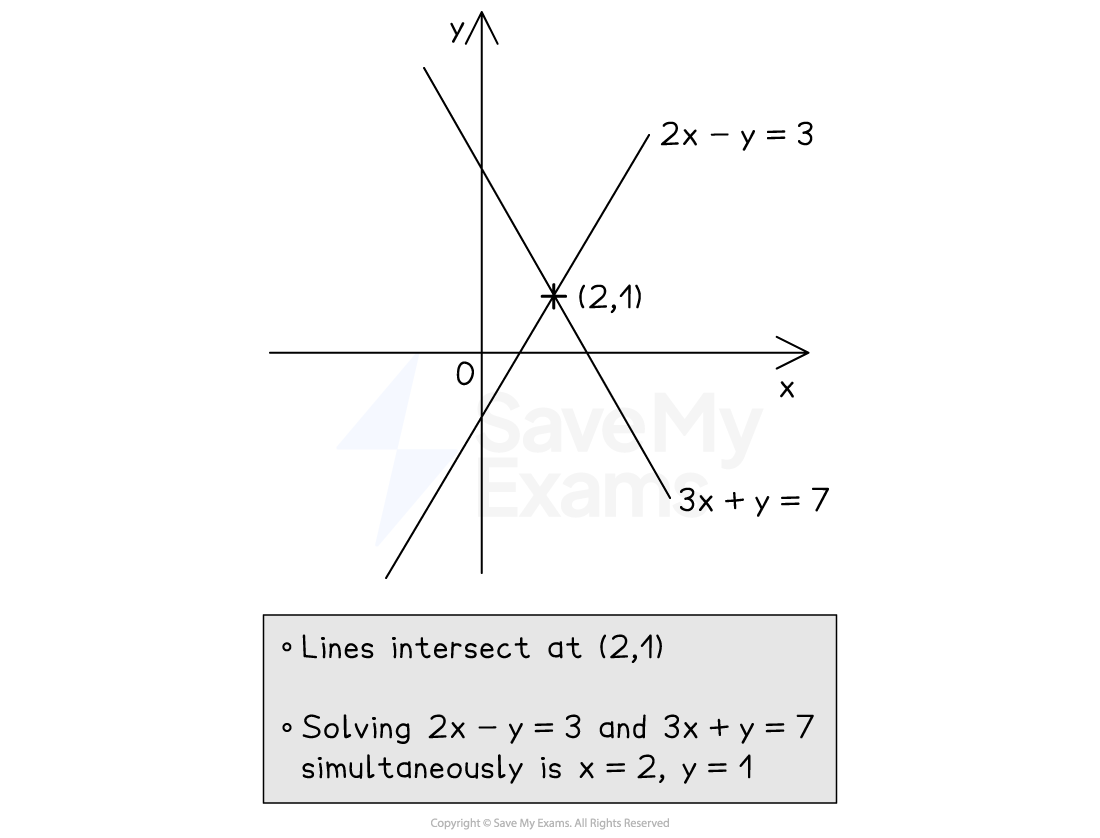
Find where the lines intersect (cross over)
- The x and *y solutions to the simultaneous equations are the *x and y coordinates of the point of intersection
-
For example, to solve 2x - y = 3 and 3x + y = 7 simultaneously
- First plot them both on the same axes (see graph)
- Find the point of intersection, (2, 1)
- The solution is x = 2 and y = 1
Exam Hint Always check that your final solutions satisfy both original simultaneous equations!
Write out both solutions (x and y) together at the end to avoid examiners missing a solution in your working.
Worked Example Solve the simultaneous equations
Answer:
It helps to number the equations
We will choose to eliminate the y terms Make the y terms equal by multiplying all parts of equation 1 by 3 and all parts of equation 2 by 2
*The 6 y terms have different signs, so they can be eliminated by adding equation 4 to equation 3 *
15 x + 6 y = 33 > bottom + 8 x - 6 y = 36 > 23 x = 69Solve the equation to find x(divide both sides by 23)
Substitute x = 3 into either of the two original equations
* *
Solve this equation to find* y*
Substitute x = 3 and y= - 2 into the other equation to check that they are correct
* *
*
Write out both solutions together
- This question can also be done by eliminating x first (multiplying equation 1 by 4 and equation 2 by 5 then subtracting)
How do I form simultaneous equations?
-
Introduce two letters, x and y, to represent two unknowns
- Make sure you know exactly what they stand for (and any units)
-
Create two different equations from the words or contexts
-
3 apples and 2 bananas cost £1.80, while 5 apples and 1 banana cost £2.30
- 3x + 2y = 180 and 5x + y = 230 x is the price of an apple, in pence y is the price of a banana, in pence
- This question could also be done in pounds, £
-
-
Solve the equations simultaneously
-
Give answers in context (relate them to the story, with units)
- x = 40, y = 30
- In context: an apple costs 40p and a banana costs 30p
-
Some questions don't ask you to solve simultaneously, but you still need to
-
Two numbers have a sum of 19 and a difference of 5, what is their product?
- x + y = 19 and x - y = 5
- Solve simultaneously to get x = 12, y = 7
- The product is xy = 12 × 7 = 84
-
Exam Hint Always check that you've answered the question! Sometimes finding x and y isn't the end.
E.g. you may have to state a conclusion related to the context of the problem.
Worked Example At a bakery a customer pays £9 in total for six bagels and twelve sausage rolls.
Another customer buys nine bagels and ten sausage rolls, which costs £12.30 in total.
Find the cost of 5 bagels and 15 sausage rolls.
Answer:
The two variables are the price of bagels, , and the price of sausage rolls,
Write an equation for the first customer's purchases, and label it equation 1
Write an equation for the second customer's purchases, and label it equation 2
We will choose to eliminate the * *terms Make the terms equal by multiplying all parts of equation 1 by 3 and all parts of equation 2 by 2 Label these as equations 3 and 4
To eliminate , subtract equation 4 from equation 3
Solve for
Substitute this into either equation to find , we will use equation 1
So sausage rolls cost £0.15 each and bagels cost £1.20 each
Use these values to find the price of 5 bagels and 15 sausage rolls
Final answer: £8.25
Was this revision note helpful?
Build on this topic