-
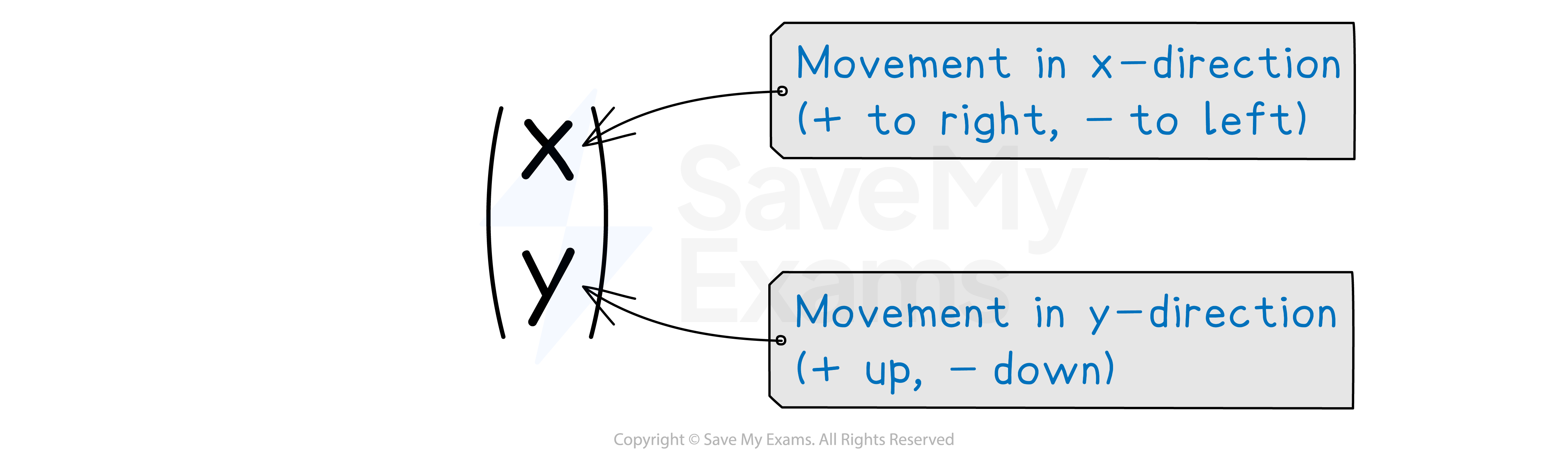
A column vector can be used to describe how to get from one point to another point
- This is also called a translation vector
- (63) means 6 units to the right and 3 units up
-
Adding and subtracting vectors is done by looking at the top numbers and bottom numbers separately
-
To add column vectors
-
Add the top numbers together
-
Add the bottom numbers together
- (52)+(3−1)=(5+32+(−1))=(81)
-
To subtract column vectors
-
Subtract the second top number from the first
-
Subtract the second bottom number from the first
- (52)−(3−1)=(5−32−(−1))=(23)
-
A scalar is a number not a vector
- It does not have a direction
-
To multiply a column vector by a scalar
-
Multiply the top number by the scalar
-
Multiply the bottom number by the scalar
- 3(2−1)=(3×23×(−1))=(6−3)
-
You need to follow the order of operations
- 2(52)+5(3−1)
-
STEP 1
Multiply each vector by the scalar in front of it
- (2×52×2)+(5×35×(−1))=(104)+(15−5)
-
STEP 2
Add or subtract the new column vectors
- (10+154+(−5))=(25−1)
Worked Example
a=(p3) and b=(−21).
Given that 2a+3b=(4q), find the value of p and the value of q.
Answer:
Write the left-side side as one vector
Multiply each vector by the scalar in front of it
(2p6)+(−63)=(4q)
Add the vectors together
(2p−69)=(4q)
The top components are equal
Form and solve an equation
2p−62pp=5=4=10
The bottom components are equal
9=q
p=5 and q=9