-
Vectors can be used to prove things that are true in geometrical diagrams
- Vector proofs can be used to find additional information that can help us to solve problems
-
Two vectors are parallel if one is a scalar multiple of the other
-
This means if b is parallel to a, then b = *ka
- where k is a constant number(scalar)
-
For example, a=(13) and b=(26)
- (26)=2×(13) so b=2a
- b is a scalar multiple of a, so b is parallel to a
-
If the scalar multiple is negative, then the vectors are parallel and in opposite directions
-
c=(−3−9)=−3a
- c is parallel to a and in the opposite direction
-
If two vectors factorise with a common bracket, then they are parallel
- They can be written as scalar multiples
-
For example
-
9a + 6b factorises to 3(3a + 2b)
-
12a + 8b factorises to 4(3a + 2b)
-
This means 12a+8b=34(9a+6b)
- so they are scalar multiples of each other
- and therefore parallel
-
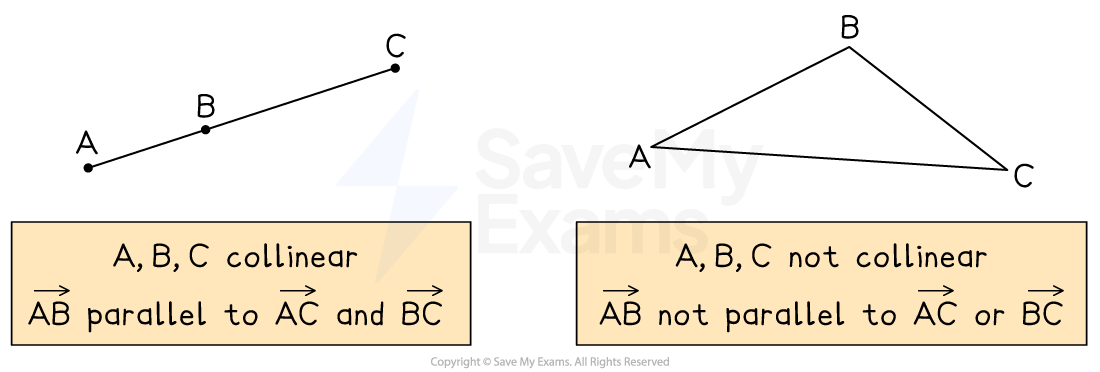
You may be asked to prove that three points lie on a straight line
- Points that lie on a straight line are collinear
-
To show that the points A, B and C are collinear
-
prove that two line segments are parallel
-
and show that there is at least one point that lies on both segments
- This makes them parallel and connected(not parallel and side-by-side)
-
For example, if you show that BC→=2AB→ then
-
the line segments AB and BC are parallel
-
and they have a common point, B
- So A, B and C must be collinear
-
Similarly, AC→=3AB→ means AC and AB are parallel
-
and they have a common point, A
- so A, B and C must be collinear
-
Convert ratios into fractions
-
In the example shown, if AX:XB=3:5 then
-
AX→=83AB→
-
XB→=85AB→
- The ratio 3:5 has 3 + 5 = 8 parts
-
Always check which ratio you are being asked for
- AX→=53XB→
- XB→=35AX→
Worked Example
The diagram shows trapezium OABC.
OA→=2a
OC→=c
AB is parallel to OC, with AB→=3OC→.
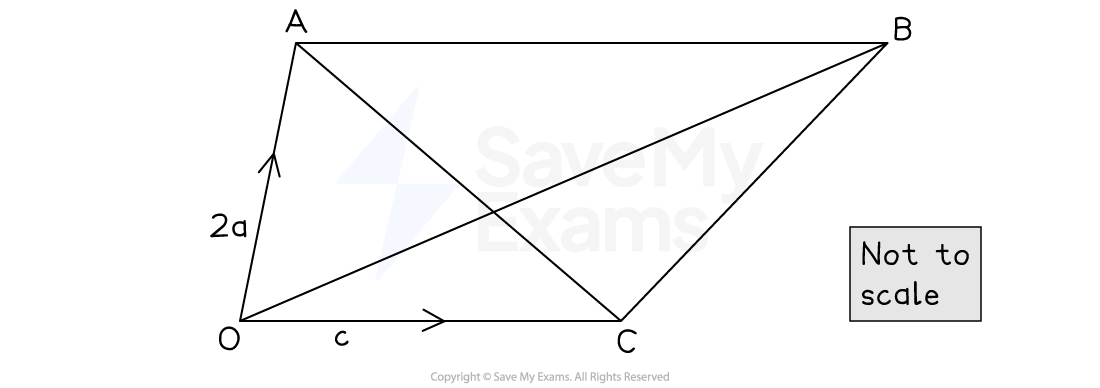
(a) Find expressions for vectors OB→ and AC→ in terms of a *and c.
Answer:
AB→=3OC→ and OC→=c so AB→=3c.
OB=2a+3c=OA+AB
OB→=2a+3c
AC=−OA+OC=−2a+c=AO+OC
AC→=c−2a
(b) Point P lies on AC such that AP: PC = 3 : 1.
Answer:
Find expressions for vectors AP→ and OP→ in terms of a and c.
*AP : PC = 3 : 1 means that *AP→=3+13AC→=43AC→
AP=43AC=43(−2a+c)
AP→=−23a+43c
OP=2a+(−23a+43c)=OA+AP
OP→=21a+43c
(c) Hence, prove that point P lies on line OB, and determine the ratio OP→:PB→.
Answer:
*To show that O, P, and B are collinear (lie on the same line), note that *OP=121a+43c=141(2a+3c)
OP=141(2a+3c)=141OB
OP→=41OB→ therefore OP is parallel to OB **
** and so P must lie on the line OB
If OP=141OB then PB=43OB
OP→:PB→=1:3