12 markseasy
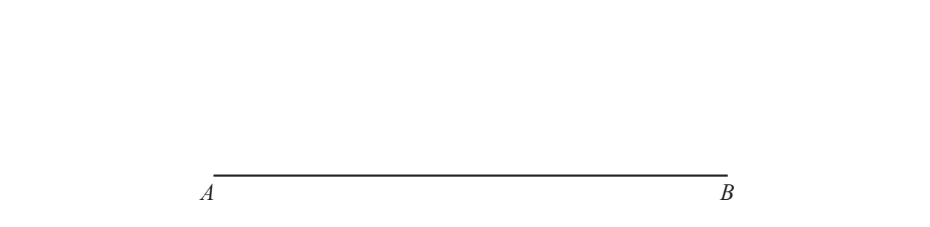
In triangle , = 7.6cm and = 6.2 cm.
Using a ruler and compasses only, construct triangle . Leave in your construction arcs. The side has been drawn for you.
26 questions · 106 marks · ≈ 2 hours
In triangle , = 7.6cm and = 6.2 cm.
Using a ruler and compasses only, construct triangle . Leave in your construction arcs. The side has been drawn for you.
Using a straight edge and compasses only, construct the equilateral triangle . Side has been drawn for you.

top
The diagram shows the base of a triangle. The lengths of the other two sides are 6cm and 4cm.
Using a ruler and compasses only, construct the other two sides of the triangle. Show all your construction arcs.
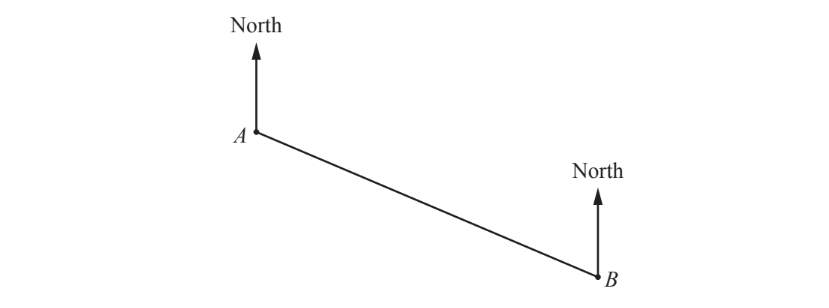
Measure the bearing of from .
This scale drawing shows the window in the room. The scale is 1 centimetre represents 40 centimetres.
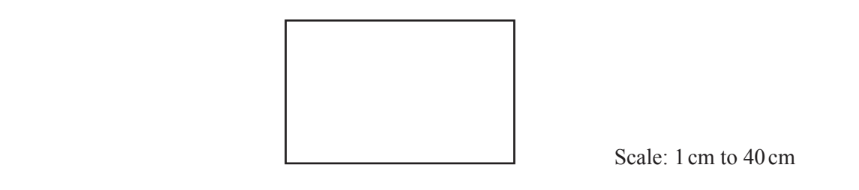
Work out the actual length and height of the window.
Length = ........................................................ cm Height = .................................................... cm
The scale drawing shows the positions of town and town . The scale is 1 centimetre represents 15 kilometres.
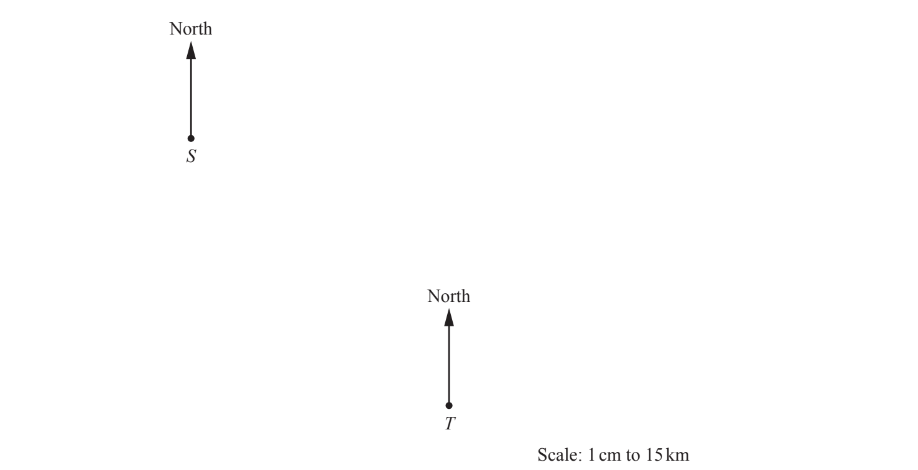
i) Find the actual distance between these two towns.
....................................... km [2]
ii) Measure the bearing of town from town .
(1 mark)
Using a straight edge and compasses only, construct the equilateral triangle . The base has been drawn for you.

In triangle = 7cm and = 5 cm.
i) Using a ruler and compasses only, construct triangle . has been drawn for you.

(2 marks)
ii) Measure angle .
(1 mark)
A field, ABC, is in the shape of a triangle. AC = 500m and BC = 650m.
Using a ruler and compasses only, complete the scale drawing of the field ABC. Leave in your construction arcs. Use a scale of 1 cm to represent 100m. The side AB has been drawn for you.

The scale drawing shows the positions of two towns, and . The scale is 1 centimetre represents 10 kilometres.
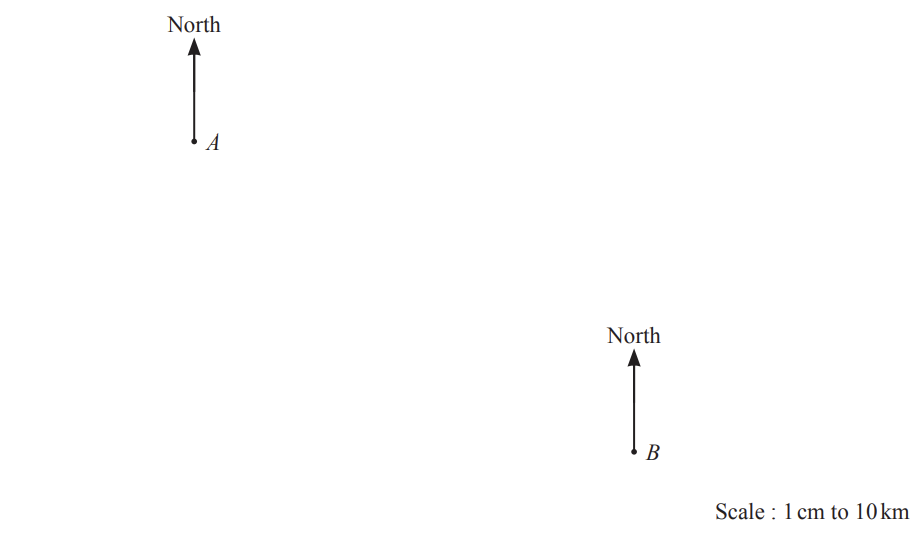
i) Work out the actual distance between town and town .
............................................ km [2]
ii) Town C is 85 km from town A on a bearing of 100°.
On the scale drawing, mark the position of town C.
(2 marks)
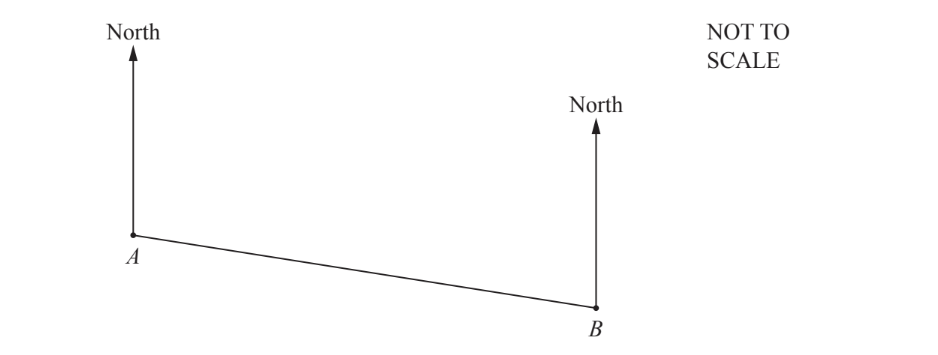
The bearing of from is 105°. Find the bearing of from .
Using a ruler and pair of compasses only, construct a triangle with sides 5cm, 8cm and 10 cm. Leave in your construction arcs.
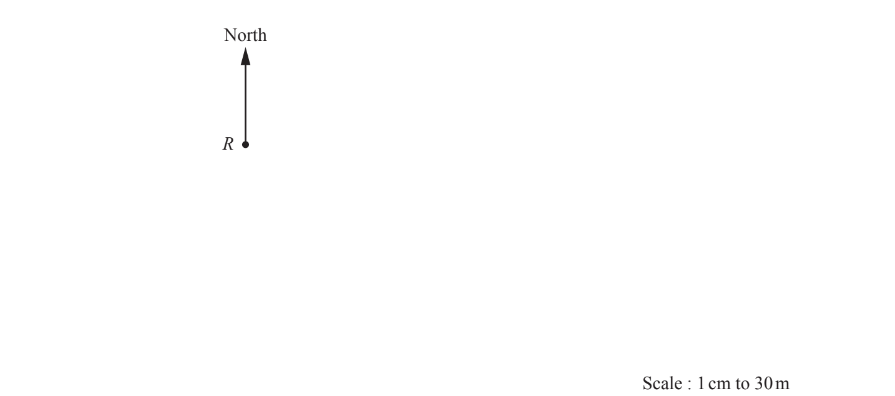
The scale drawing shows a rock, .
The scale is 1 centimetre represents 30 metres.
A lighthouse, , is 210m from , on a bearing of 125°.
On the diagram, mark the position of .
The scale drawing shows the positions of two towns, Yatterford () and Rexley (), on a map. The scale is 1 centimetre represents 15 kilometres.
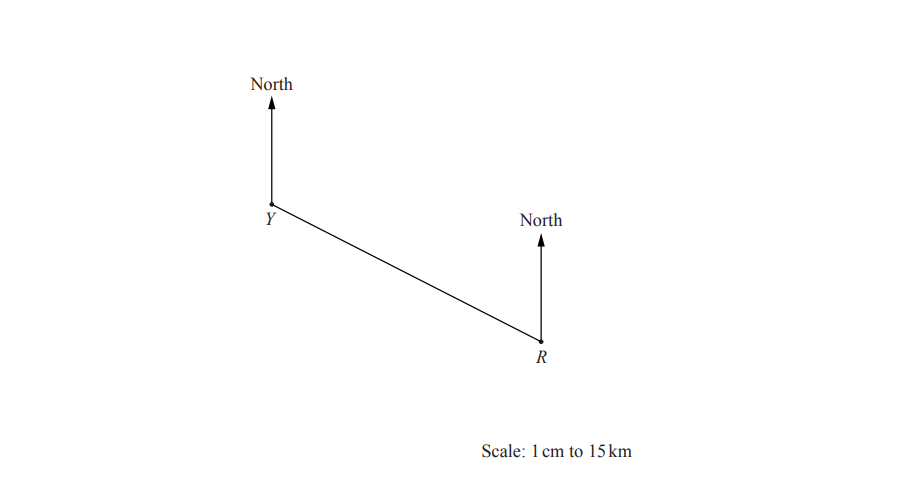
i) Write the scale of the map in the form 1: .
1 : ..................................... [2]
ii) Work out the actual distance of Rexley from Yatterford.
............................. km [2]
iii) Measure the bearing of Rexley from Yatterford.
(1 mark)
iv) A hospital is to be built on an area of land between 45km and 60km from Yatterford. The bearing of the hospital from Yatterford is between 250° and 295°.
On the map, construct and shade the region in which the hospital is to be built.
(5 marks)
The bearing of Bartown from Whitestoke is 073°.
Work out the bearing of Whitestoke from Bartown.
A triangle has sides 5 cm, 7 cm and 9 cm.
Using a ruler and compasses only, construct the triangle. The 5 cm line has been drawn for you. Show all your construction arcs.
The scale drawing shows the position of a boat, .
The scale is 1 centimetre represents metres.
A lighthouse, is metres from , on a bearing of .
On the scale drawing, mark the position of .
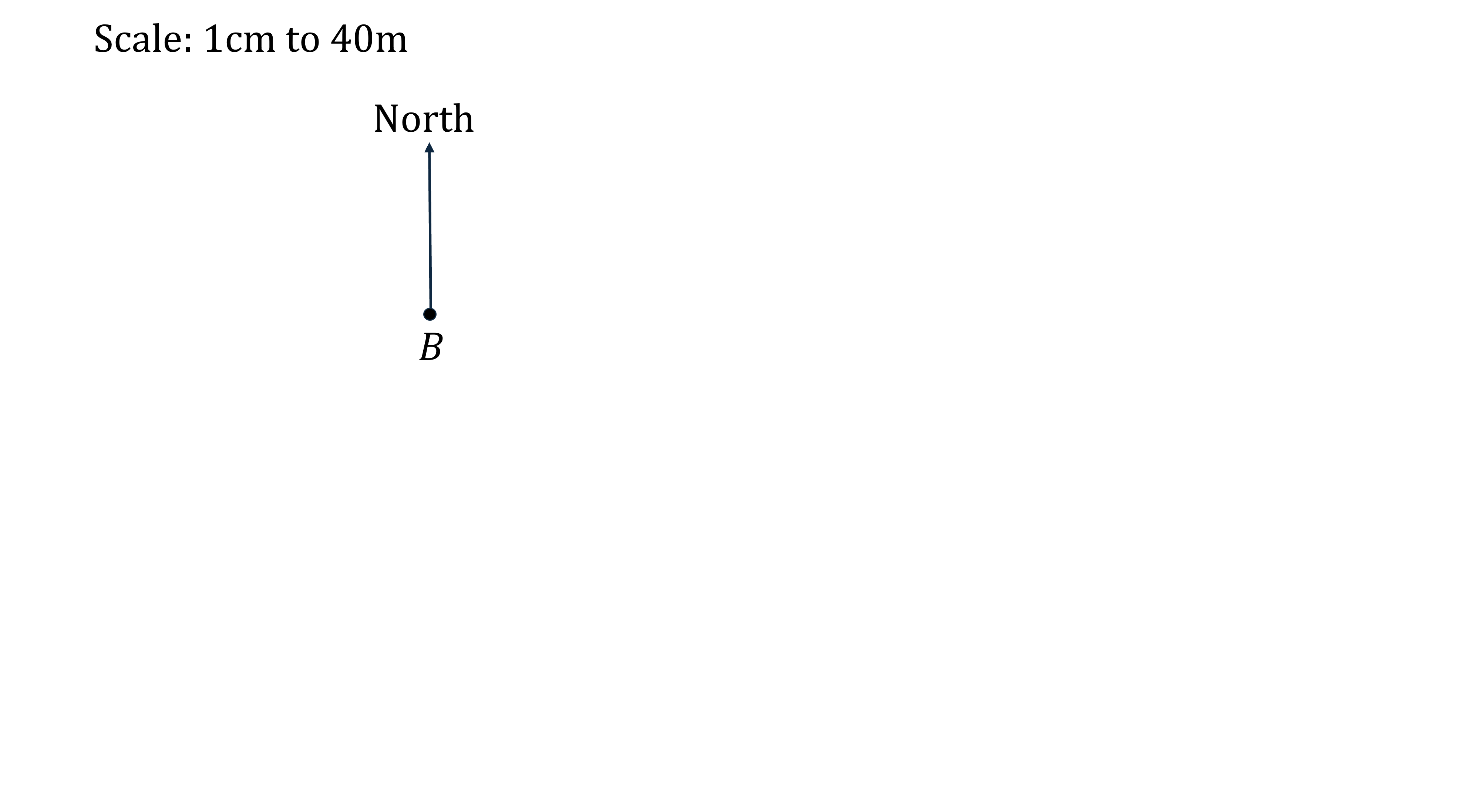
Point is 36 km from point on a bearing of 140°.
Using a scale of 1 centimetre to represent 4 kilometres, mark the position of .
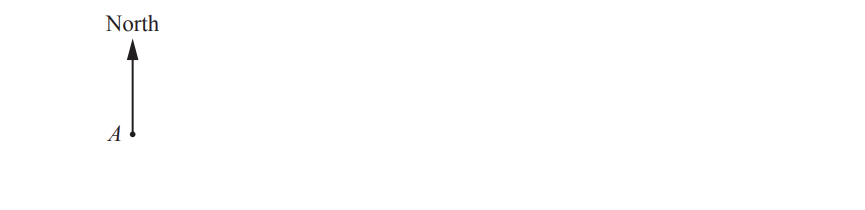
Scale: 1cm to 4 km
Extract:
Point B is 36 km from point A on a bearing of 140°.
Using a scale of 1 centimetre to represent 4 kilometres, mark the position of B.
Scale: 1cm to 4 km
i) Point C is 28 km from and 20km from . The bearing of fromis less than 140°. Using a ruler and compasses only, construct triangle . Show all your construction arcs.
(3 marks)
ii) Measure angle .
Angle = .................................................. [1]
The scale drawing shows the positions of town and town . The scale is 1 cm represents 12 kilometres.
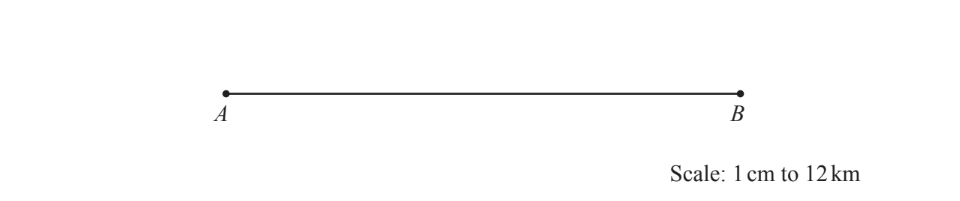
Find the actual distance between town and town .
........................................... km
Extract:
The scale drawing shows the positions of town A and town B. The scale is 1 cm represents 12 kilometres. Town C is 72 km from town A and 96km from town B.
Town is 72 km from town and 96km from town . On the scale drawing, construct the position of town .
A circular garden has diameter 11.4 m.
Draw the garden accurately, using a scale of 1cm represents 1.5 m.
Scale: 1cm to 1.5m
On a map, the distance between two towns is 9.6cm. The scale of the map is 1 : 50000.
Work out the actual distance between the two towns in kilometres.
........................................... km
The scale drawing shows the positions of a rock, , and a statue, , on a map. The scale is 1 centimetre represents 6 metres.
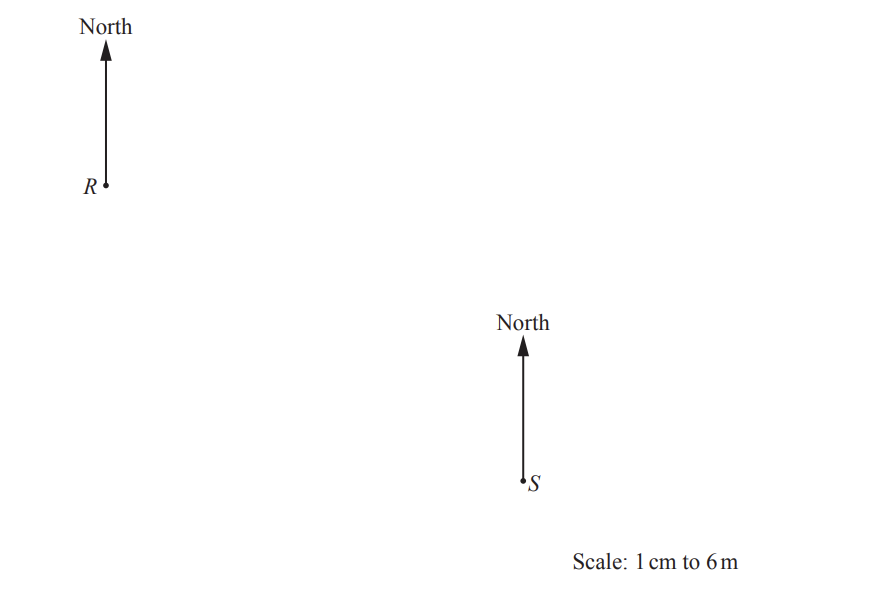
i) Work out the actual distance between and .
............................................. m [2]
ii) A flagpole, , is on a bearing of 164° from .
Work out the bearing of from .
(2 marks)
iii) Ishaan uses the map to find some treasure, . is on a bearing of 076° from and on a bearing of 337° from .
Mark the position of on the map.
(2 marks)
The scale drawing shows a map of Kingswood Park. There are two straight paths and one circular path. The scale is 1cm represents 200m.
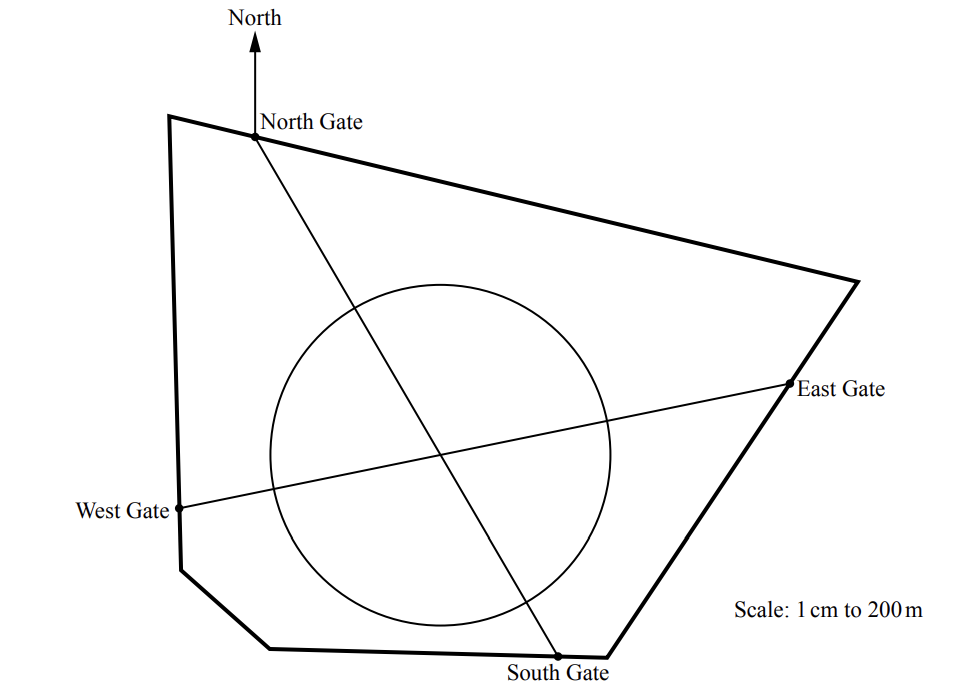
i) Yana walks along the straight path from East Gate to West Gate.
Work out the distance she walks. Give your answer in kilometres.
.......................................... km [2]
ii) Measure the bearing of South Gate from North Gate.
(1 mark)
iii) The entrance, P, to a children’s play area is 500 metres from North Gate on a bearing of 195°. Mark the position of P on the map.
(2 marks)
iv) Ivan runs once around the circular path.
Calculate the distance Ivan runs.
............................................ m [4]
The scale drawing shows the positions of two buoys,and , in the sea. The scale is 1 centimetre represents 20 kilometres.
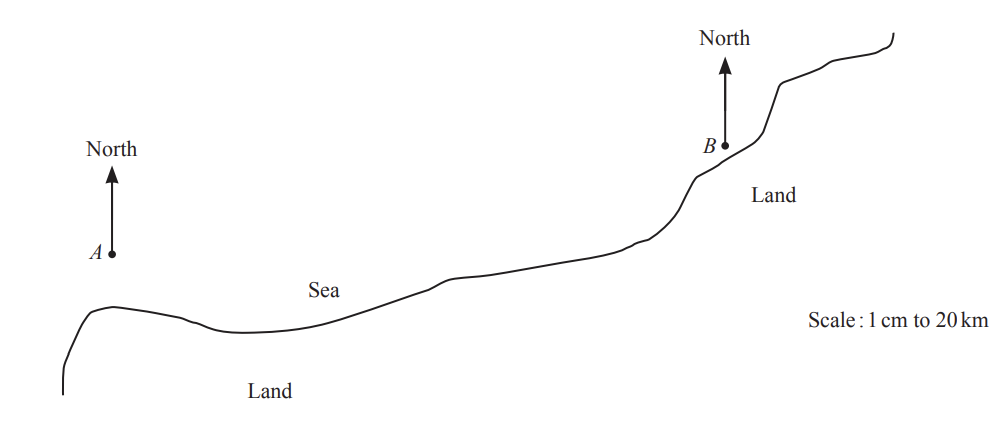
i) Work out the actual distance between buoy and buoy .
.............................................. km [2]
ii) Measure the bearing of buoy from buoy .
(1 mark)
iii) Buoy is 120 km from buoy on a bearing of 300°.
On the scale drawing, mark the position of buoy .
(2 marks)
The scale drawing shows the positions of town and town .
The scale is 1 centimetre represents 12 kilometres.
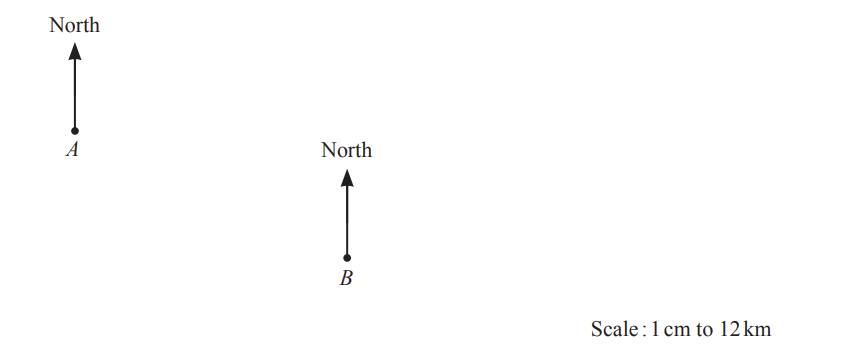
i) Measure the bearing of town from town
(1 mark)
ii) Find the actual distance from town to town .
.............................................. km [2]
iii) Town is on a bearing of 064° from town and 028° from town .
On the scale drawing, mark the position of town .
(2 marks)
The bearing of town from town is 245°.
Work out the bearing of town from town .
The diagram shows three towns, and .
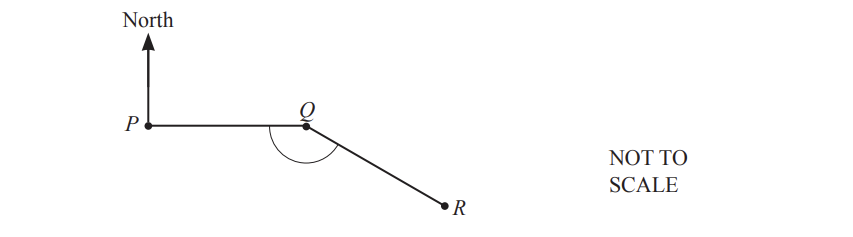
The bearing of town from town is 090°.
i) Complete the statement.
Town ....................................... is due west of town .......................................
(1 mark)
ii) and are two sides of a regular decagon.
Work out angle .
Angle = ................................................... [3]
The scale drawing shows town , town and town on a map. There is a straight road between town and town . The scale of the map is 1 centimetre represents 8 kilometres.
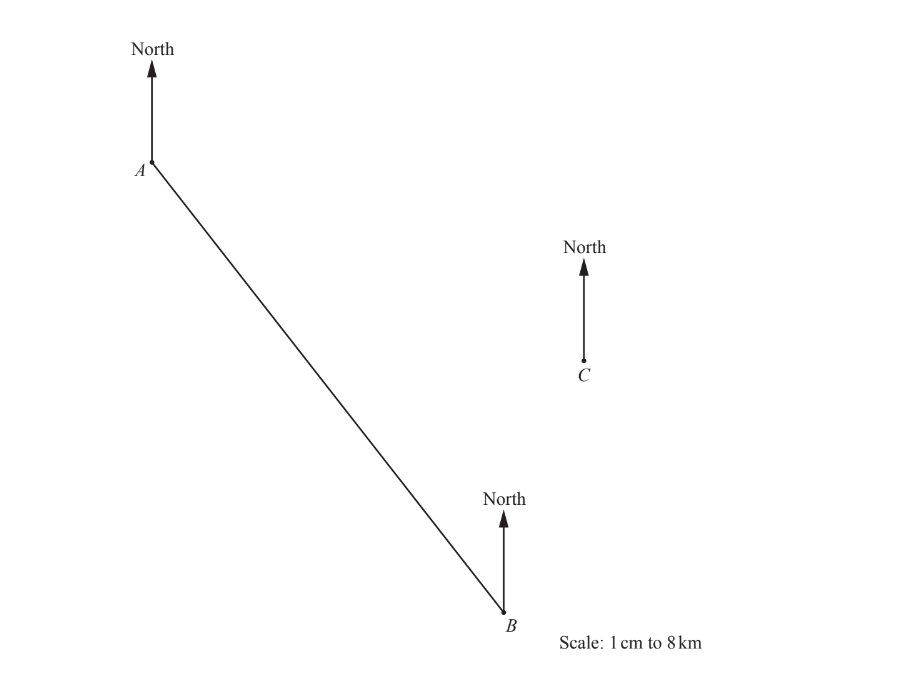
Measure the bearing of town from town .
Extract:
The scale of the map is 1 centimetre represents 8 kilometres.
Work out the actual distance, in kilometres, between town and town .
............................................... km
Extract:
The scale of the map is 1 centimetre represents 8 kilometres.
Write the scale of the map in the form 1 : .
1 : ...................................................
Extract:
The scale drawing shows town ![A], town ![B] and town ![C] on a map.
There is a straight road between town ![A] and town ![B].
The scale of the map is 1 centimetre represents 8 kilometres.
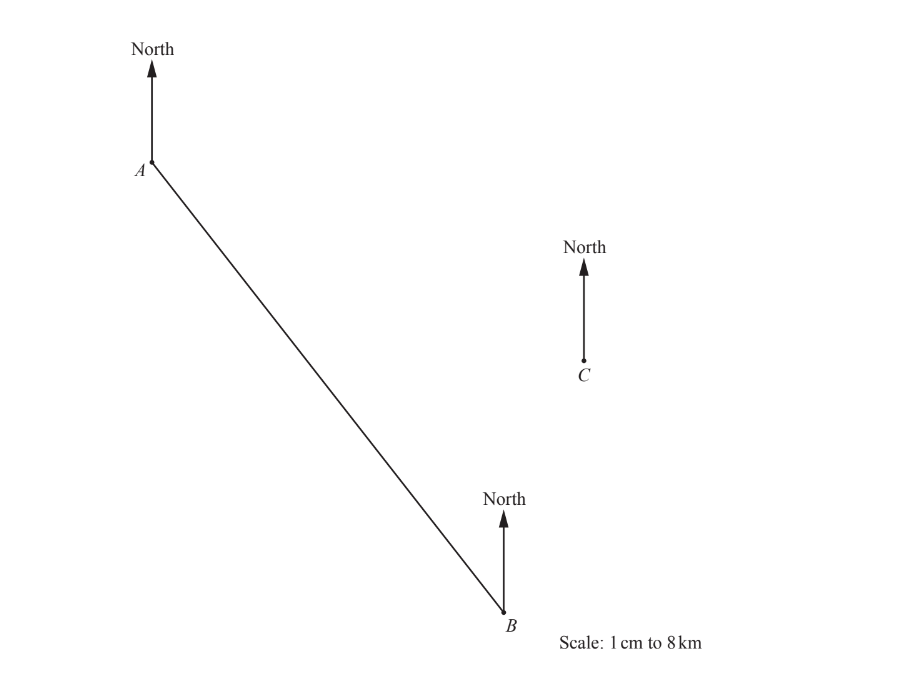
A straight road from town is on a bearing of 246°. It meets the road from town to townat point .
On the map, draw the road from town to point . Label the position of .
Extract:
Work out the actual distance, in kilometres, between town ![A] and town ![B].
i) Josie is at point at 10 50 She arrives at town 37 minutes later.
Work out the time that she arrives at town .
(1 mark)
Sammy leaves town and travels to town at a constant speed of 75 km/h.
iia) Work out the time for this journey. Give your answer in hours and minutes, correct to the nearest minute.
.................... h ................. min [3]
iib) Sammy wants to arrive at town at the same time as Josie. Work out the time that Sammy must leave town .
(1 mark)
The scale drawing shows the positions of an airport () and a train station () on a map.
The scale is 1 centimetre represents 2 kilometres.
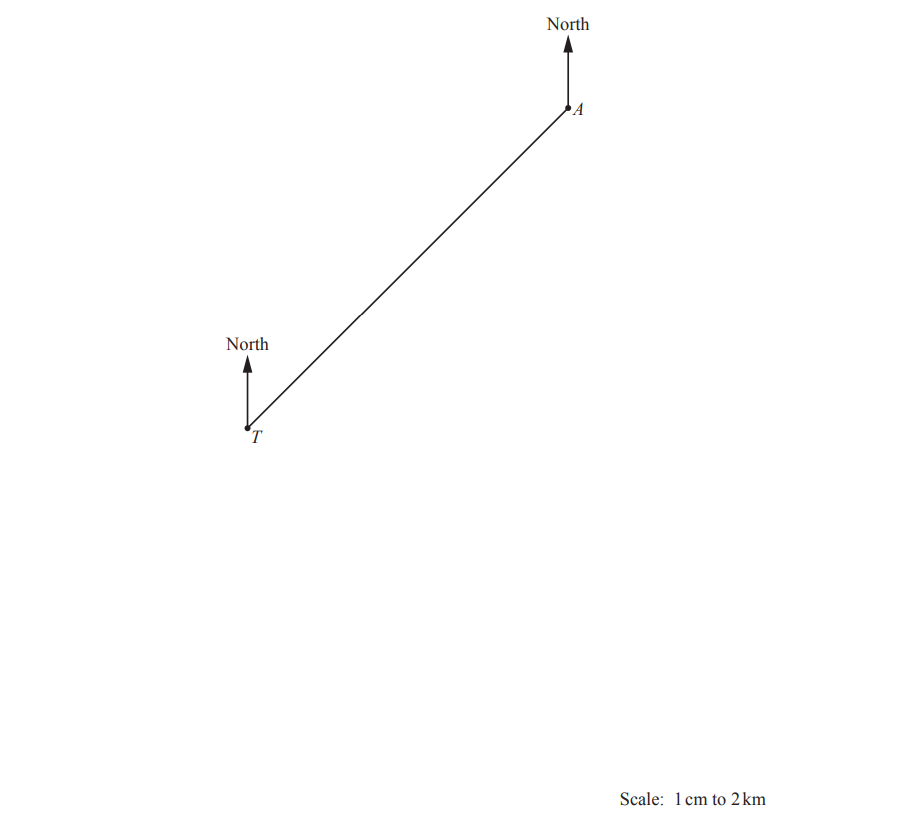
Work out the actual distance, in kilometres, of the train station from the airport.
.............................. km
Extract:
The scale drawing shows the positions of an airport (![A]) and a train station (![T]) on a map. The scale is 1 centimetre represents 2 kilometres.
Measure the bearing of the airport from the train station.
The bus station is not shown on the map. The bearing of the bus station from the train station is 318°.
Work out the bearing of the train station from the bus station.