Recognition Systems (Cambridge International IGCSE ICT)
What is a recognition system?
-
A recognition system is a way of using computer technology to automatically identify something
-
Common examples of recognition systems include:
- Facial recognition
- Speech recognition
- Optical character recognition
OMR & OCR
What is OMR?
-
Optical Mark Recognition (OMR) detects marked areas on paper by using a special machine to read the marks
-
Examples include:
- Multiple-choice examination
- Barcodes
- QR codes
-
Automates data collection and entry
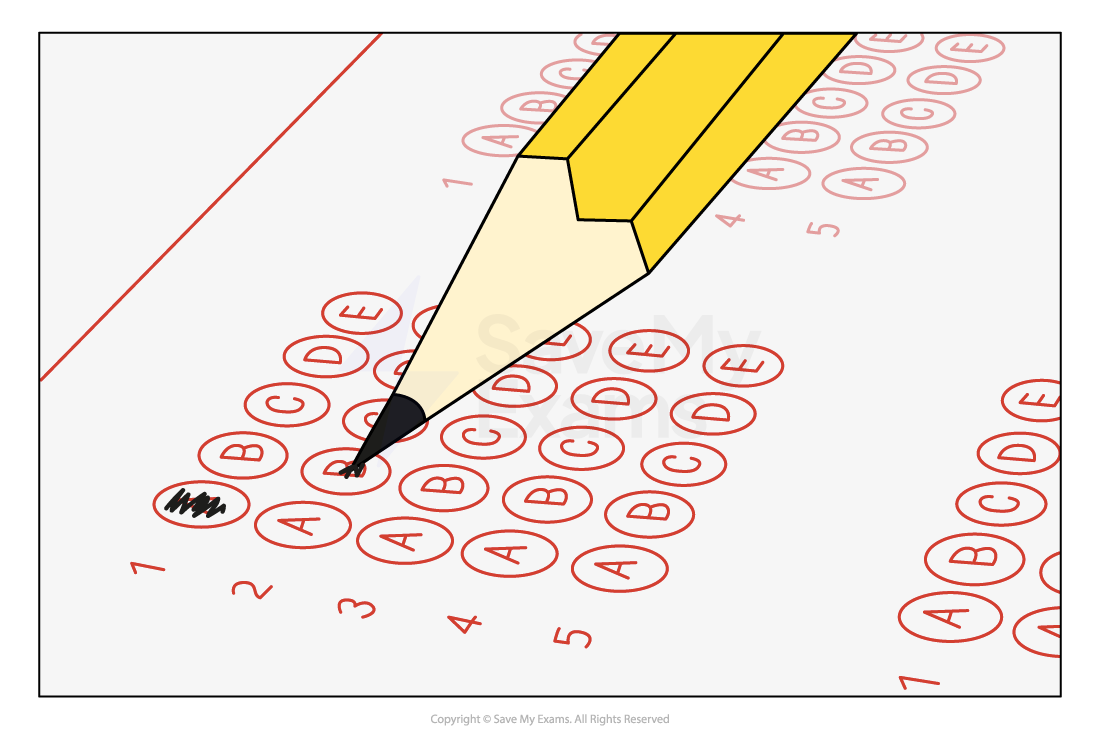
An OMR form being filled in
| Advantages | Disadvantages |
|---|---|
| - Fast and efficient data collection - Reduces manual entry errors | - Limited to predetermined responses - Sensitive to poor marking or smudging |
What is OCR?
-
Optical Character Recognition (OCR) converts printed or handwritten text into digital format
-
Useful for digitising documents
-
Assists in searching and editing text
-
Automated Number Plate Recognition (ANPR) is an example of OCR
- For example, reading number plates and controlled entry and exit at airport parking
| Advantages | Disadvantages |
|---|---|
| - No staff required - Faster, no need to stop and take tickets etc - Stops cars parking illegally, cannot enter without authorisation | - Privacy concerns as number plates are recorded - Number plates can be cloned - Dirty or broken number plates can not be read - Lack of staff could lead to vandalism |
RFID & NFC
What is RFID?
-
Radio Frequency Identification Devices (RFIDs) use radio waves to identify and track objects
-
Examples of where RFID can be used is:
- Stock tracking
- Passports
- Vehicles
- Contactless payment
-
RFID tags are made of a microchip and antenna and can be either:
- Passive- uses energy from the reader
- Active- has it's own power source
| Stock tracking | - Livestock tracking on a farm - Keeping track of animals - Location - Medical data - Active tags would be used due to the distance involved |
|---|---|
| Passports | - Passive chips in passports - Read by a reader to decrypt data stored on the chip - Personal details - Photo - Fingerprints |
| Vehicles | - Track progress on assembly line - Used on toll roads to automate payment and raise barriers - Entry and exit to carparks |
What is NFC?
-
Near field communication (NFC) is a subset of RFID which allows communication between two devices in very close proximity
-
NFC can be either:
- Passive- uses energy from the reader
- Active- has it's own power source
-
Smartphones use **active NFC to allow contactless payments **by tapping a smartphone on a reader
-
Smartphones can also** exchange data using NFC** by tapping together (usually back to back)
Worked Example A farmer has purchased a computerised feeding system for her goats. A goat has an RFID tag attached to its ear, which is recognised by the computer. The system uses a passive RFID tag. a. Describe how the RFID tag can be activated.
[3]
b. Describe how RFID technology will be used to give the correct feed to the animal.
[3]
Answers
a. three of:
Final answer: The RFID reader sends radio waves / signals to the RFID antenna in the tag [1] The tag sends radio wave/signal back to the reader [1] The radio waves move from the tag’s antenna to the microchip [1] A signal is generated and sent back to the RF system [1] The RF wave is detected by the reader which interprets the data [1]
b. three of:
Final answer: The goat passes the RFID reader [1] The RFID reader extracts data from the tag [1] The ID is compared with data stored in the database [1] The feed for the goat is then selected/identified / read from the database [1]
Was this revision note helpful?
Build on this topic