Reasons For the Bolsheviks' Seizure of Power (Cambridge International IGCSE History)
How was the October Revolution Different to Other Revolutions in Russia? - Timeline & Summary
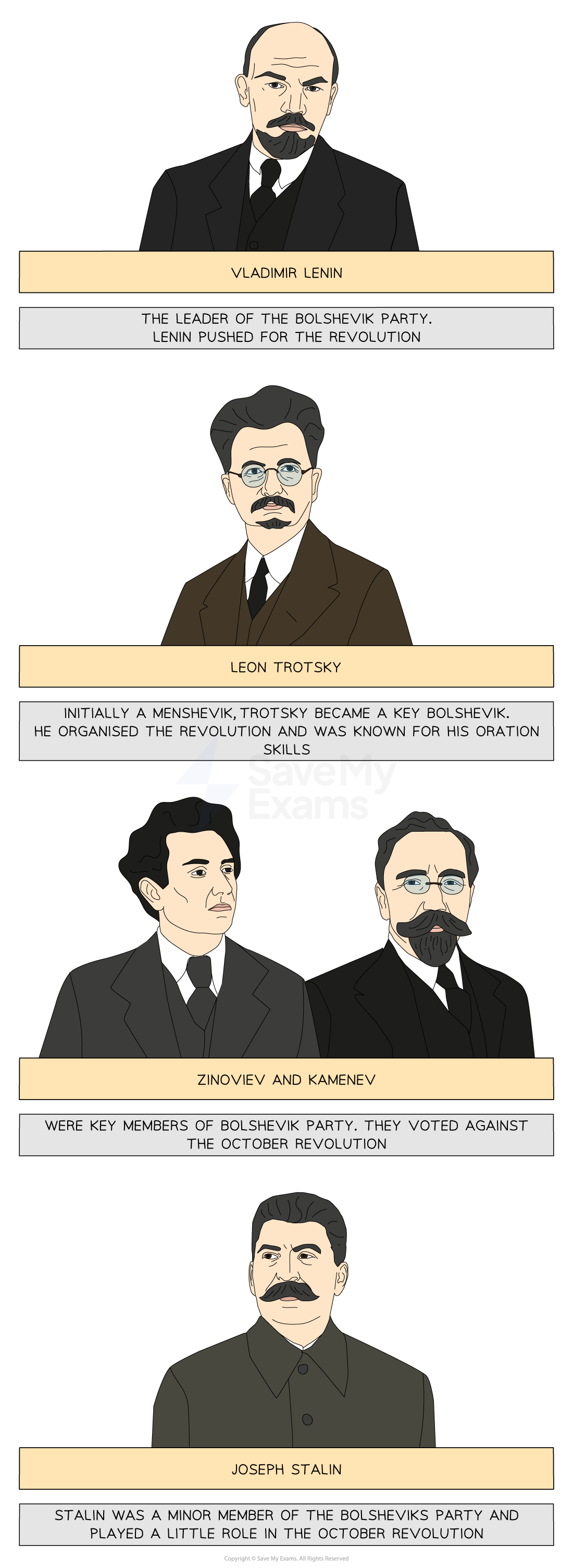
An illustration showing the key members of the Bolshevik Party
The October Revolution was very different to the revolutions in 1905 and March 1917. In 1928, the Bolsheviks commissioned Sergei Eisenstein to create a film about the October Revolution. The film, October, shows masses of people storming the gates of the Winter Palace under heavy gunfire. In reality, the gates of the Winter Palace were unguarded and open. The Bolsheviks faced little resistance from the remaining members of the Provisional Government. Historians consider the events of October 1917 a coup. As a result, the only popular revolution in Russia was in March 1917. This is because the events of 1905 did not result in the overthrow of the tsar.
Many Russians considered the October Revolution as a temporary change of government. Tsereteli, the leader of the Mensheviks, stated that the Bolsheviks' power would not last three weeks. At this point, the Bolsheviks were a small, extremist party. The Bolsheviks would end up establishing a dictatorship that remained in power for over 70 years.
Key Members of the Bolshevik Party
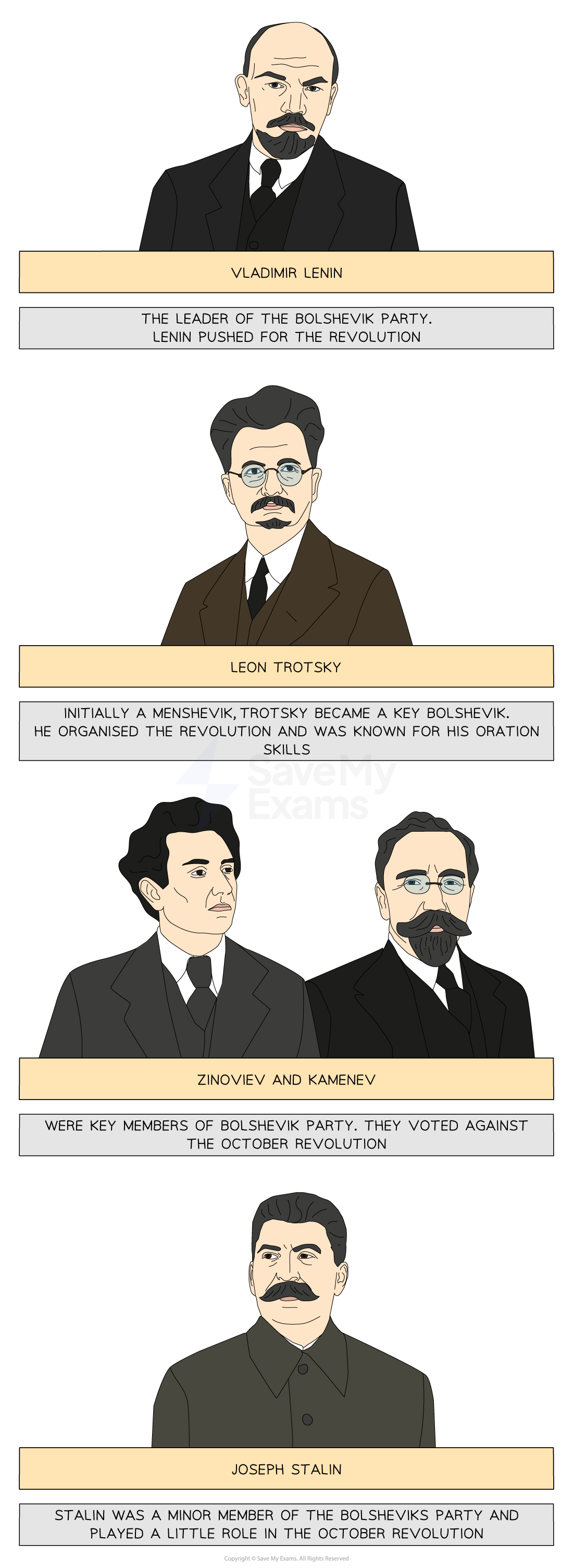
An illustration showing the key members of the Bolshevik Party
Exam Hint There were many more members of the Bolshevik Party. By early October, membership stood at 200,000. However, for your exam, try to remember these five key figures.
Return of Lenin and the April Thesis
-
The Tsarist government had exiled Lenin multiple times
- He was not in the country during the March Revolution
-
In April, Lenin returned to Russia
-
Germany funded his journey
- They believed that Lenin's presence in Russia would force Russia to surrender in the First World War
-
Lenin travelled on the 'sealed train'
- This means that Lenin travelled through countries without passport checks
-
-
When Lenin returned to Petrograd, he made a speech called the 'April Theses'
- This outlined his key policies:
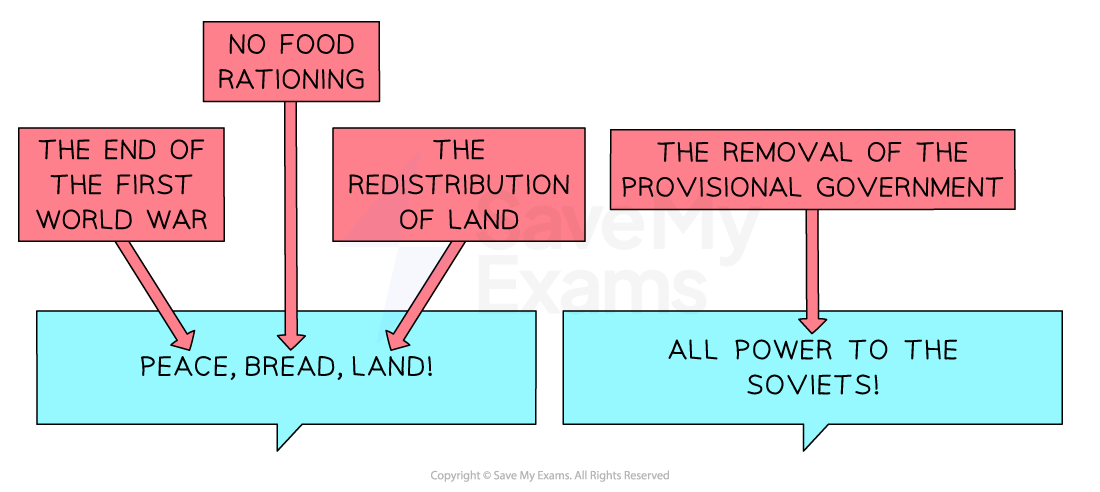
Lenin's key statements in his April Theses
-
The April Theses persuaded many workers to support the Bolsheviks
- The workers chanted these statements in the July Days
-
Support for the Bolsheviks declined after July
- Lenin did not support the July Days protest
- He fled from Russia again
Events in the October Revolution
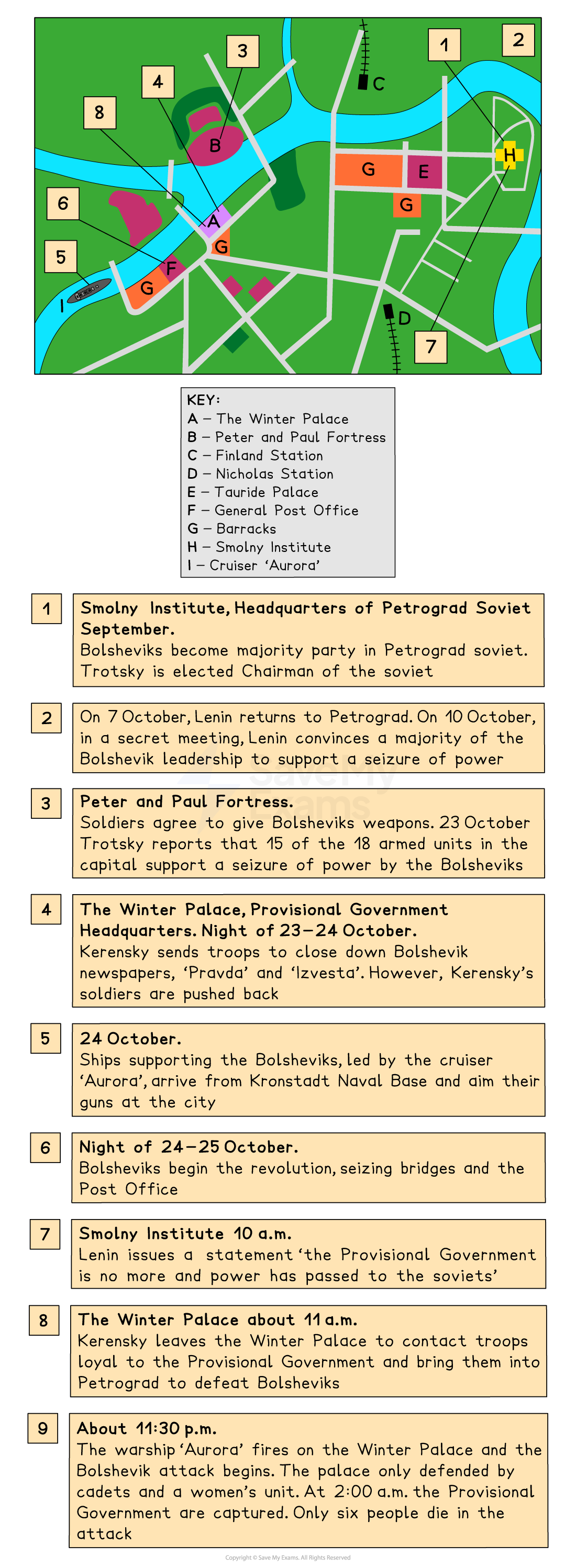
A map showing the events of the October Revolution
Worked Example Describe how the Bolsheviks took power on 6th–8th November 1917
4 marks
Final answer: Answer:
The Bolsheviks seized control of Petrograd (1). The Red Guards stormed the Winter Palace (1). Once inside the Winter Palace, the Bolsheviks arrested members of the government (1). Kerensky fled Petrograd (1).
Exam Hint This style of question does not require you to explain your answer. The Cambridge IGCSE gives you a point for each relevant piece of information that you write in your answer. Therefore, do not spend any additional time trying to describe or explain each reason. You should aim to complete the question in four minutes, one minute per point. This will give you one minute to read through your answer.
Outcomes of the October Revolution
-
The Provisional Government was no longer in charge of Petrograd
-
The Bolsheviks had control of Petrograd
- This was a key city in the Russian Empire
-
The Bolsheviks did not have control over the whole of Russia
- The empire was large
- The Bolsheviks had many enemies that did not want them to seize power
Was this revision note helpful?