The Impact of the Depression on the League of Nations (Cambridge International IGCSE History)
The Wall Street Crash
-
Throughout the 1920s,the USA experienced a boom in their economy
- Britain and France were repaying their wartime loans to the USA
- As a result, the USA had a* surplus of money in their economy
-
The USA’s economy was growing at such a rapid rate that, by October 1929, stockbrokers began to speculate that the market would decline
- Americans from all areas of society had bought shares in the 1920s. Working-class Americans could not afford for their share prices to drop too far
- Share prices began to fall
- Shareholders rushed to sell their shares before their value dropped too significantly
-
Between 24th and 30th October 1929, the USA’s economy collapsed
-
The worst day was ‘Black Thursday’
- People sold 13 million shares
- Prices plummeted due to the amount of shares available
-
Shares that were worth $20,000 on the morning of 24th October 1929 were worth $1,000 by the end of the day
-
By 30th October 1929, investors had lost $4 billion
-
-
This event is called the ‘Wall Street Crash’ as Wall Street is where the Stock Exchange is based in New York
Impact of the Depression
-
The Wall Street Crash caused a worldwide depression in the 1930s because:
-
The Dawes and Young Plans connected the US economy to European countries
- To save their economy, the US recalled all of their loans
- Germany’s economy could not cope without US intervention
-
Trade between countries slowed
- Leaders encouraged their populations to buy domestic products to boost employment
- Governments increased trade tariffs **for foreign products
- Reduced trade caused** more damage to worldwide economies
-
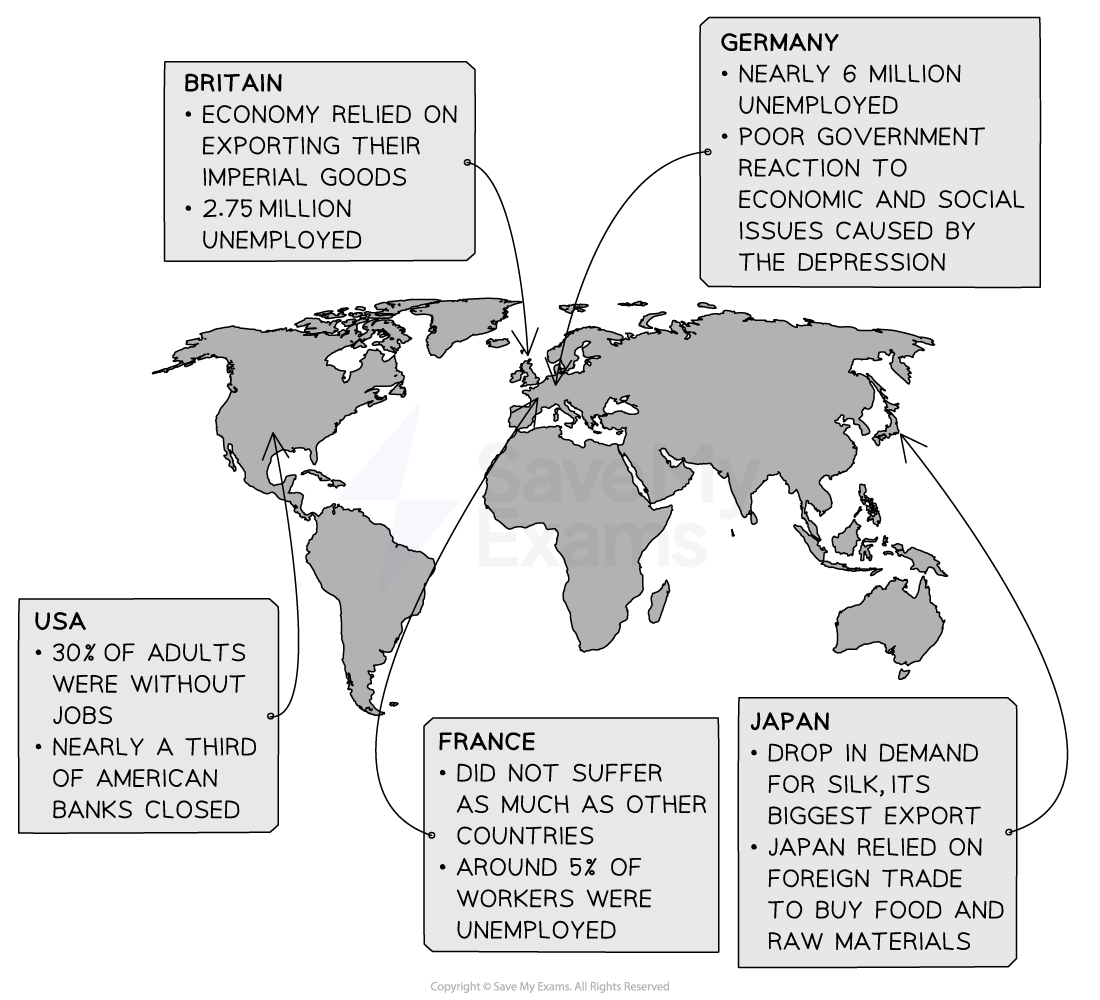
A map showing how the Great Depression impacted different nations across the world
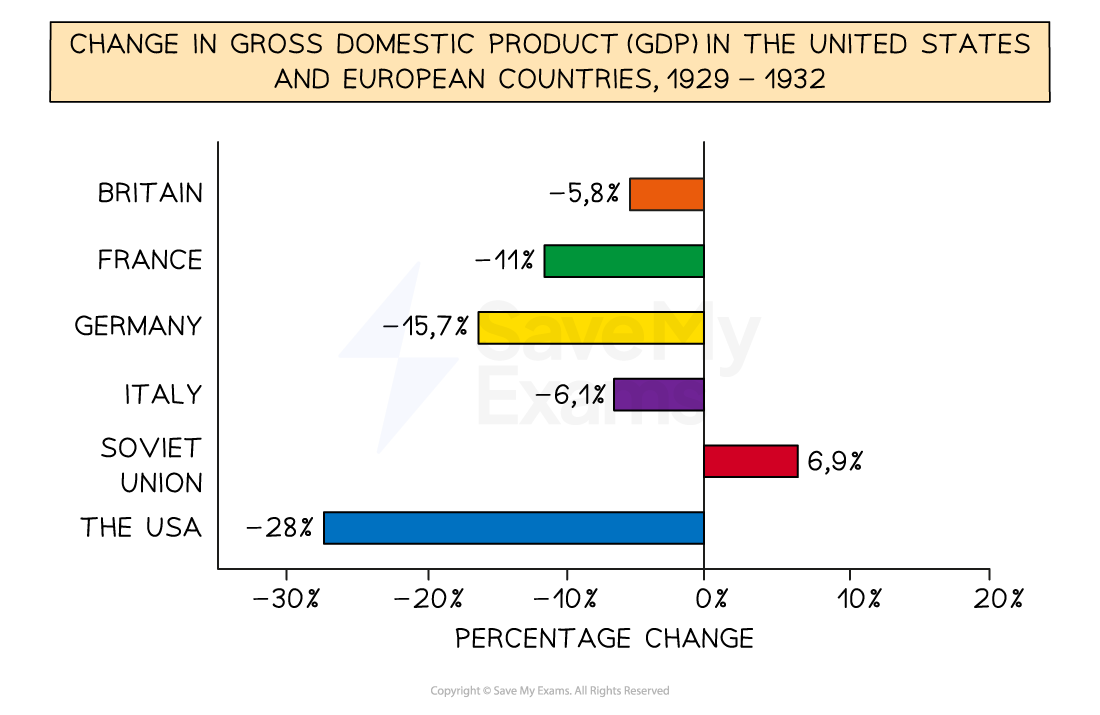
A graph showing the changes to global GDPs, 1929-1932
Extremism and Militarism
- Due to economic issues, many people began to turn against their governments
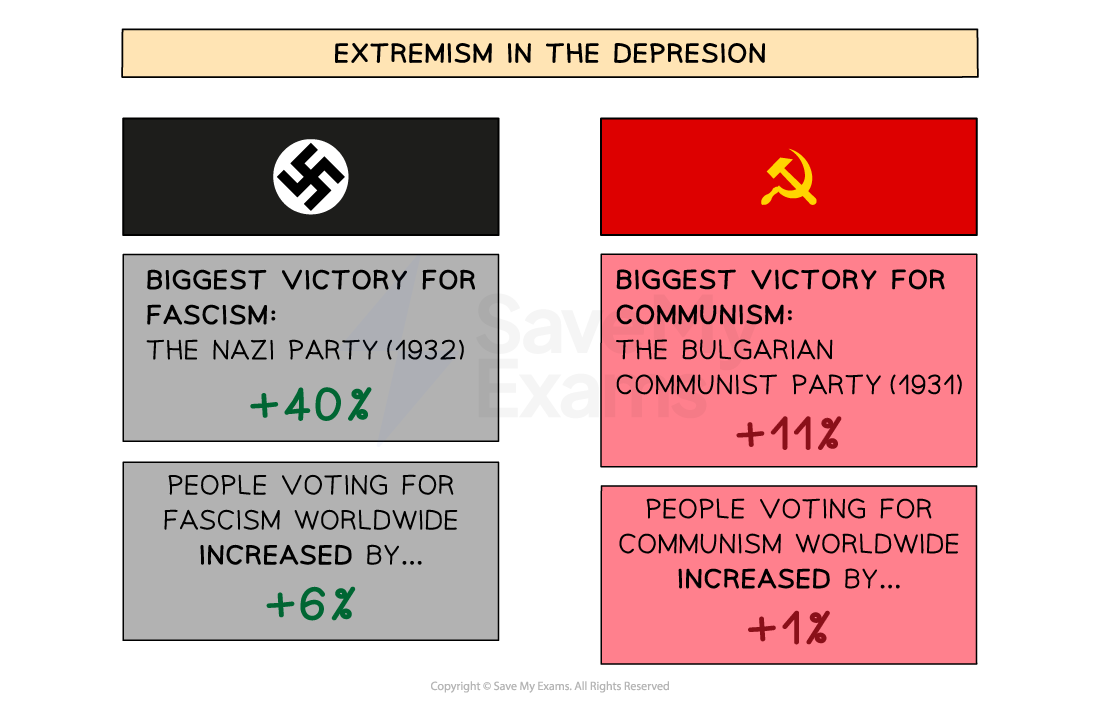
A graphic showing the increase in popularity of Fascism and Communism during the Great Depression
Why Did Extremism Increase in the 1930s?
-
People blamed their governments for the economic crash
-
Extremist parties offered alternatives to government policies during the Great Depression
-
The Nazi Party promised to reverse the Treaty of Versailles and make Germany strong again - A rise in dictatorships
-
By 1939, there were four key dictators in Europe:
- Mussolini (Italy, 1922)
- Stalin (USSR, 1924)
- Hitler (Germany, dictator by 1934)
- Franco (Spain, 1939)
-
Some populations believed a strong, autocratic leader could rebuild the economy better than a democratic government
-
Why was Extremism an Issue for the League of Nations in the 1930s?
-
Extremist parties promised their citizens radical solutions
-
Extremist leaders only cared about their own country
-
Fascism and communism are opposite opinions
- Fascist and communist dictators are less likely to work together
-
To prioritise their country, extremists adopted an aggressive foreign policy
- They had no respect or interest in the League of Nations
-
-
Non-extremist leaders began to ignore their duties to the League of Nations
- They prioritised **protecting their people **from the threats of communism and fascism
- They wanted to** strengthen their country** through nationalism
A Solution to the Great Depression - Militarism
-
Militarism is the belief that a country must have strong armed forces
-
Militarism distracted countries from the Depression because:
- It created employment in the rearmament businesses
- It made civilians feel proud of their country again
| Country | How did the country pursue militarism? |
|---|---|
| Italy | Rearmament An **expanded empire in the Mediterranean and Africa |
| Germany | Breaking the Treaty of Versailles’ military restrictions Creation of the** Luftwaffe ‘Guns, not Butter’ approach to the economy |
| Japan | An expanded empire to secure much-needed raw materials. The Japanese army wanted to restore national pride |
| Britain and France | Rearmament in the late 1930s in response to growing militarism |
Why was Militarism an Issue for the League of Nations in the 1930s?
-
Militarism went against the League’s core aim of disarmament
-
The League would have to stop aggressive actions from countries who:
- Threatened others using their large armed forces
- Invaded countries to expand empires
- Started wars
-
The League lacked the USA’s military force
-
France and Britain were unwilling to spend money to stop international aggression
- They were still recovering from the Great Depression
-
Countries knew that the League was weak in the 1930s
- A strong military would scare the League to rule in the country’s favour
-
Worked Example Explain why the Depression led to problems for the League of Nations
6 marks
Final answer: Partial answers:
One reason why the Depression caused problems for the League of Nations was an increase in extremism (1). The Depression caused extreme levels of unemployment in some countries, for example, nearly 6 million Germans were unemployed (1). Extremist parties began to win elections. This caused an issue for the League because, instead of working with other countries, extremist leaders became more aggressive and competitive (1).
Exam Hint In Paper One, ‘explain why’ questions are worth either six or ten marks. For full marks in this question, an examiner is looking for two fully explained reasons as to why the Depression caused issues for the League of Nations. Use the PEE structure in your answer:
- P - Make a point about the question
- E - Use evidence that supports the point that you have made
- E - Explain why this evidence caused problems for the League. Avoid repeating the point again. Explain how the social and economic consequences of the Depression resulted in aggressive and isolated countries
Rearmament and Unemployment
-
In Germany, the Nazis used rearmament to reduce unemployment
-
In 1933, Germany left the League of Nations over Europe’s refusal to disarm
- Hitler felt this gave him the right to rearm Germany
-
In 1935, Hitler introduced compulsory conscription
-
By 1938, Germany spent 20% of their GDP on rearmament
- This created millions of jobs for the unemployed
-
Impact of Rearmament to Nazi Germany
| Year | Unemployment |
|---|---|
| 1933 | 4,800,000 |
| 1934 | 2,700,000 |
| 1935 | 2,100,000 |
| 1936 | 1,500,000 |
| 1937 | 900,000 |
| 1938 | 500,000 |
| 1939 | 300,000 |
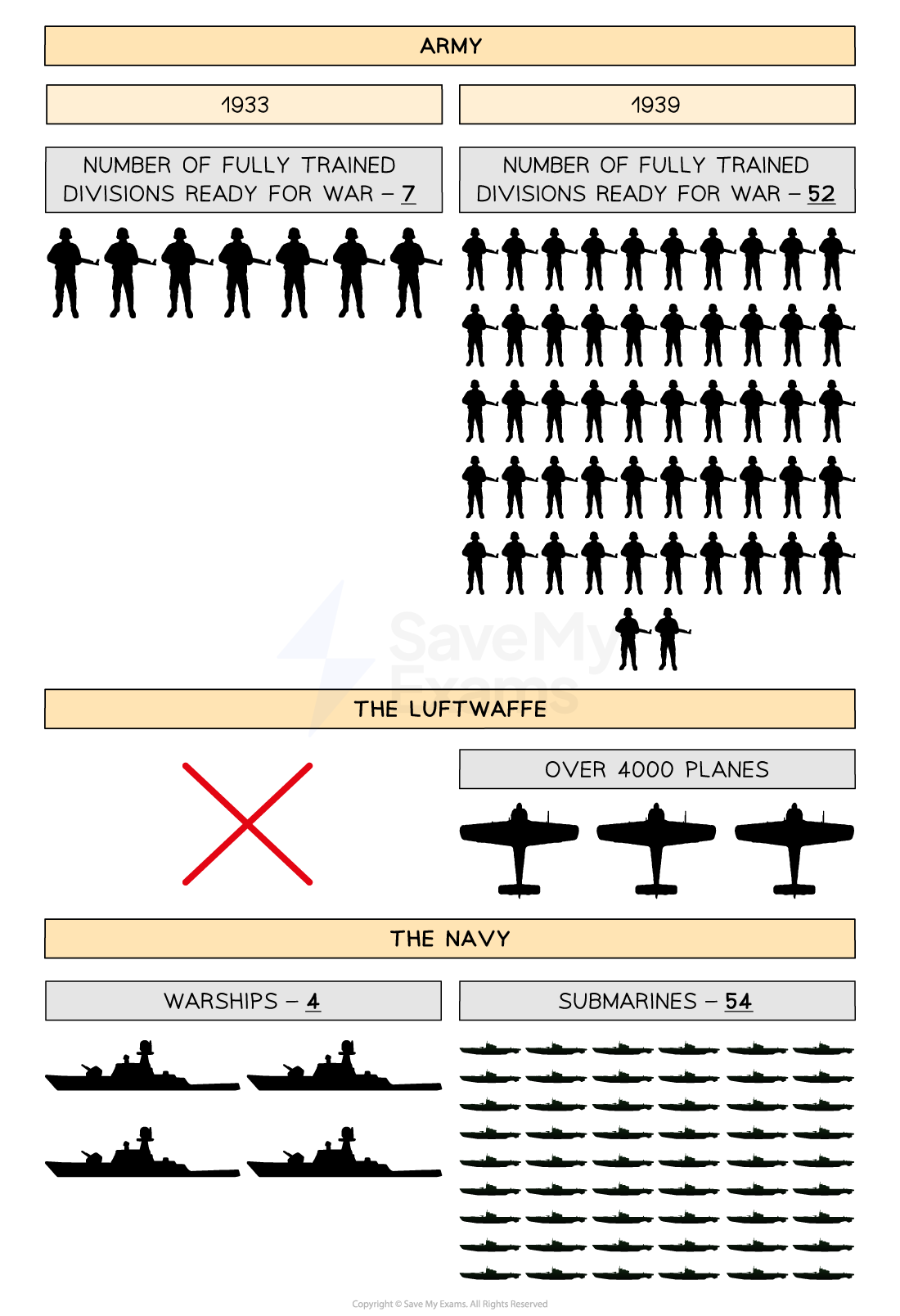
A diagram showing the expansion of Germany’s armed forces between 1933 and 1939
Was this revision note helpful?