The League of Nations Attempts at Peacekeeping in the 1920s (Cambridge International IGCSE History)
Aims and Methods of Peacekeeping
-
There were several border disputes after the Versailles Settlement
-
The end of the Ottoman and Austro-Hungarian empires caused the formation of new countries like Poland
- These new countries took land away from previously powerful countries like Germany and Austria
-
Where the Allies drew new boundaries, it caused international tensions
- Conflicts occurred in borderlands
- Some countries attempted to invade other countries for land
-
-
The League of Nations promised to protect members from border disputes
-
Article 10 of the Covenant insisted on ‘collective security’. This meant that:
- If an aggressive country attacked one League member, it attacked all members of the League
- The League of Nations could create a combined League army to defend the country from the aggressor
-
Collective security aims to:
- Make member countries feel safer
- Deter war
-
-
Other methods that the League of Nations could use for peacekeeping were:
- Moral condemnation: Use their influence to disapprove of an action
- **Trade sanctions: Impose trade boycotts on aggressive countries
- Compensation: Money paid to the innocent country from the aggressor as an apology for their actions
- Use the Conference of Ambassadors: An organisation that oversaw the Versailles Settlement. It had ambassadors from Britain, France and Japan that worked with the League to resolve disputes
- Plebiscites:** The population of a contested region decides who governs it
- Do nothing: The League did not interfere with some disputes. For example, the French invasion of the Ruhr
-
Overall, the League’s attempts to keep peace in Europe had mixed results
Vilna, 1920
Spec point —
S4.018
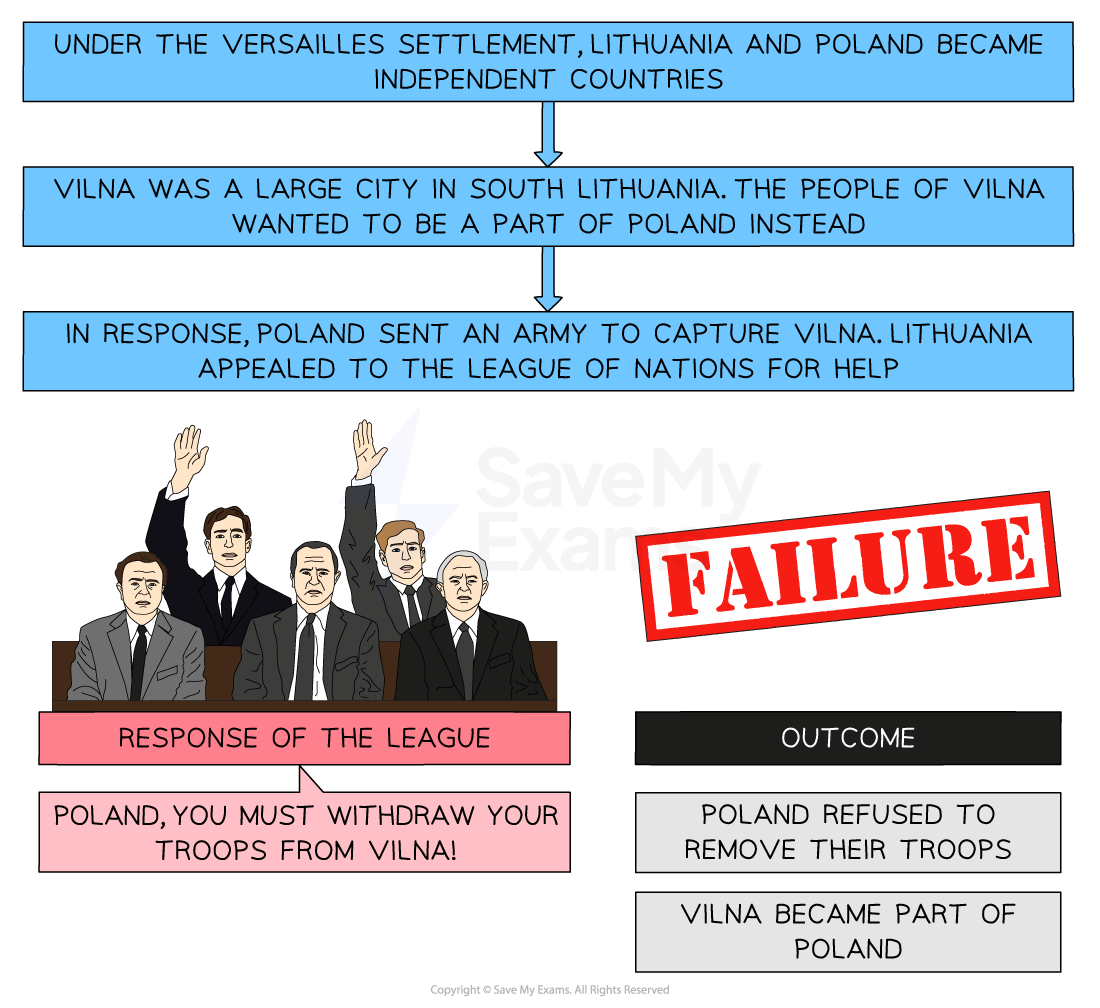
A flowchart showing the reasons for the Vilna dispute, the League’s reaction and the eventual outcome
Significance of the Vilna Dispute
-
It undermined the League’s power
- It was the first time that an invaded country requested the help of the League
- The League did not fulfil its pledge for collective security
-
It showed the reluctance of the permanent members to raise an army
-
France did not want to upset Poland
- They saw Poland as a potential ally
-
Britain did not want to act without the support of other members
-
Aaland Islands, 1920–1921
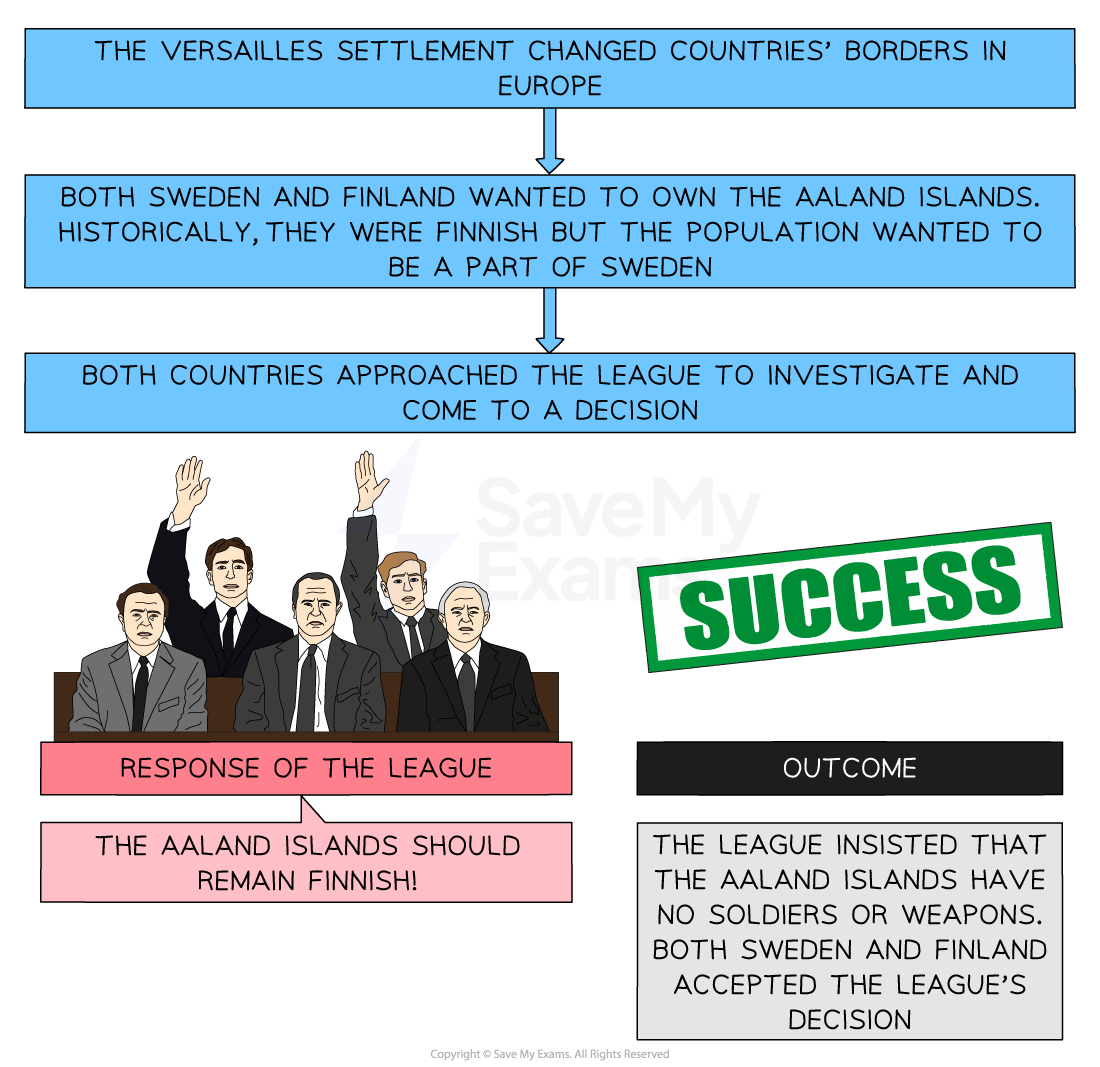
A flowchart showing the reasons for the Aaland Islands dispute, the League’s reaction and the eventual outcome
Significance of Aaland Islands Dispute
-
One of the biggest successes of the League of Nations
-
If both members respected the League of Nations, they:
- Would ask the League for help in their dispute
- Accept the League’s decision
Upper Silesia, 1921
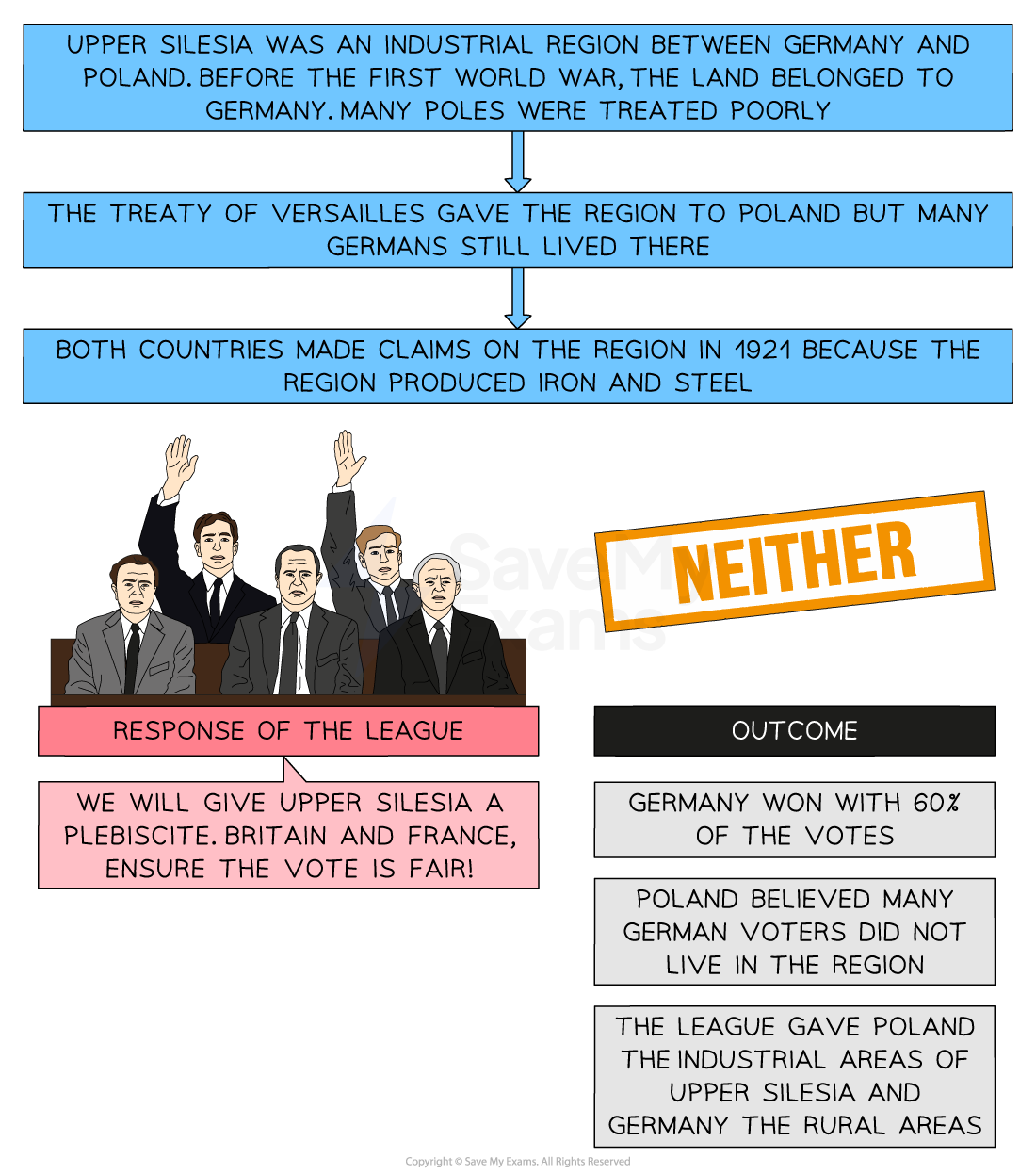
A flowchart showing the reasons for the Upper Silesia dispute, the League’s reaction and the eventual outcome
Significance of the Upper Silesia Dispute
-
Initially, the Upper Silesia dispute was a success for the League
- Both countries accepted its ruling
-
When the League’s solution ended in 1925, relations between Poland and Germany worsened
- Poland argued that half of the population of Upper Silesia was Polish yet they received only a third of the land
- Germany stated that the agreement took away a quarter of its coal mines
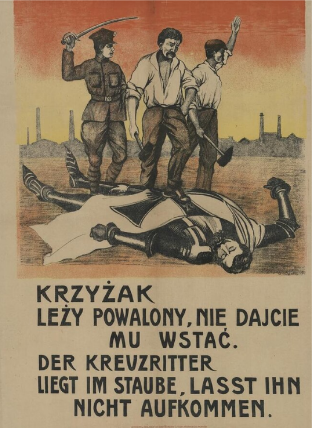
A Polish poster from the plebiscite in Upper Silesia. Workers are standing on a symbol of imperial Germany. The text is written in Polish and German and states “The Crusader is in the dust. Don’t let him rise”
Worked Example Why was there a crisis in 1921 in Upper Silesia?
6 marks
Final answer: Partial answer:
One reason why there was a crisis in Upper Silesia was that two countries claimed the area (1). Before the First World War, Upper Silesia was in Germany. However, Poles also lived in the area (1). This caused a crisis because Poland and Germany wanted to protect their citizens living in the area by bringing the area under their sole government (1).
Exam Hint In Paper One, ‘explain why’ questions are worth either six or ten marks. To achieve all marks for this question, an examiner is looking for two fully explained reasons as to why there was conflict in Upper Silesia. Use the PEE structure in your answer:
- P - Make a point about the question
- E - Use evidence that supports the point that you have made
- E - Explain why this evidence caused a crisis in Upper Silesia. Avoid repeating the point again. Explain how this factor caused an issue in Upper Silesia that needed the League’s interventions
Corfu, 1923
Spec point —
S4.020
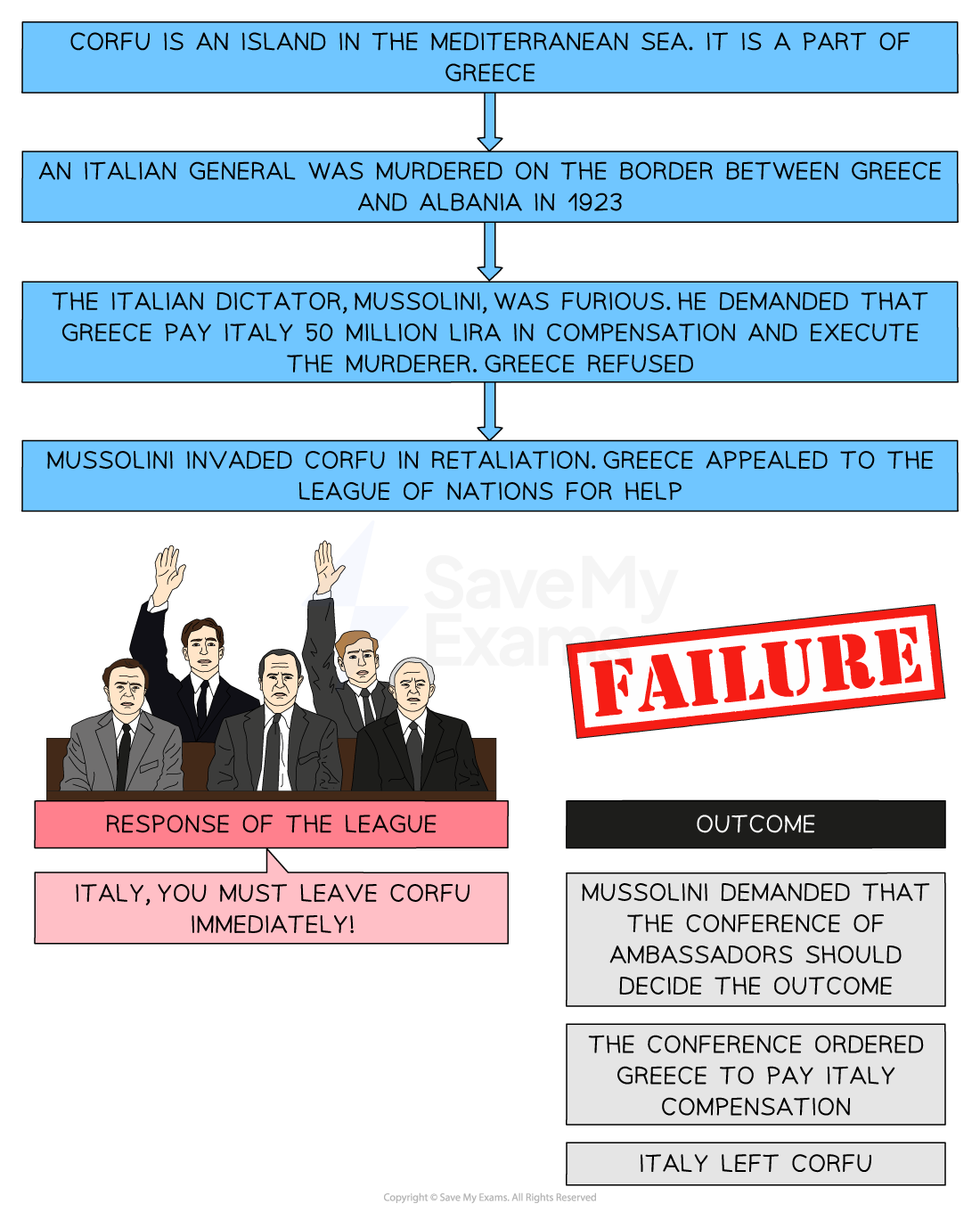
A flowchart showing the reasons for the Corfu Dispute, the League’s reaction and the eventual outcome
Significance of the Corfu Dispute
-
Without the USA, the League could not stand up to powerful countries like Italy
- Britain and France preferred not to get involved in the conflict
- Mussolini had successfully bullied the League into giving him what he wanted
- It set the standard by which other aggressive leaders could manipulate the League
-
It demonstrated that organisations like the Conference of Ambassadors could overturn the League’s decisions
Bulgaria, 1925
Spec point —
S4.021
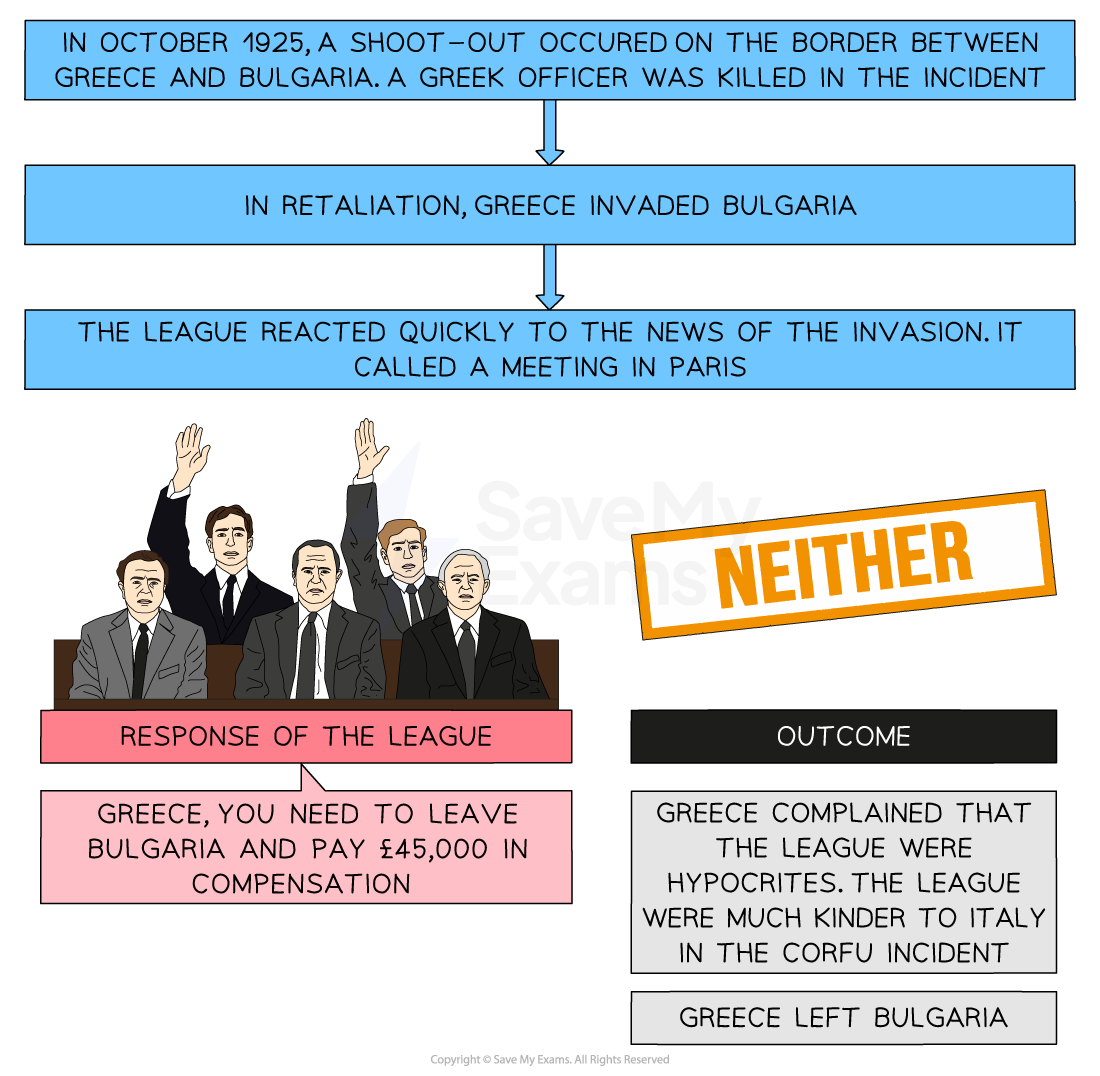
A flowchart showing the reasons for the Bulgaria Dispute, the League’s reaction and the eventual outcome
Significance of Bulgaria Dispute
-
It showed the inconsistencies of the League’s rulings
-
Both the Corfu and Bulgaria disputes:
- Involved the death of a military officer
- Resulted in an armed invasion of a country
-
The League did not punish Italy for invading Corfu, yet punished Greece for invading Bulgaria
-
-
The League was desperate not to antagonise certain countries that could start a war
-
As a result, the League did not rule fairly in all disputes
- This undermined their reputation as a peacekeeping force
-
Worked Example Study Sources A and B. How far do these two sources agree? Explain your answer using details from the sources.
8 marks
Source A: Adapted from Peter J. Yearwood’s Article Consistently with honour taken from the Journal of Contemporary History, 1986, referring to the Corfu crisis
The Italian occupation of Corfu on 31 August 1932 confronted the League of Nations with what was recognised as its first major test. Many people thought, both then and later, that the League failed this test and that this was also a failure for the policy of Great Britain, which had appeared as the strongest champion of the League during the crisis.
**Source B: **Adapted from E. Wright’s A Dictionary of World History (2.ed.), 2006
Following the bombardment by Italy in which 16 people were killed, Mussolini issued an ultimatum, demanding a heavy indemnity [compensation]. Greece appealed to the League of Nations, which referred the dispute to the Council of Ambassadors. The Council ordered Greece to pay 50 million lire. Under pressure from Britain and France, Italian troops withdrew. The outcome of the dispute raised serious doubts about the strength and efficiency of the League.Final answer: Partial answer:
Both sources agree that the League of Nations was weak in its decision-making regarding the Corfu incident (1). After Mussolini invaded Corfu in 1923, he forced the League to reverse its initial decision and rule that Italy should receive compensation from Greece (1). In Source A, Yearwood states that “the League failed this test.” Similarly, in Source B, Wright states that “the dispute raised serious doubts about the strength and efficiency of the League”(1). Therefore, both sources agree that the League was wrong to allow Mussolini to change its decision (1).
Exam Hint When answering this style of question on Paper Two, consider:
The event that the sources are discussing
- Spend five minutes reading each source
- Annotate the key events that each source mentions
- Write some knowledge about the key event in both sources
How the sources agree
- Find a quote in each source that agrees
- Add the quote to your answer using quotation marks
How the sources disagree
- Find a quote in each source that disagrees
- Add the quote to your answer using quotation marks
The main message of the author
- What is each’s authors opinion?
- Do the authors’ attitudes match or are they different?
Was this revision note helpful?