What's the area enclosed by and a tangent?
Question
Show that the gradient of the curve is zero at the point , and sketch the curve.
The tangent at cuts the curve again at . Calculate the area between the chord and the curve.
Suggestion
When curve sketching, good questions to ask include
-
What are the stationary points?
-
Where does the curve intercept the axes?
-
Are there any asymptotes?
-
How does the curve behave for large ?
What is the equation of the tangent?
How does this help us to find ?
Can we see on our sketch the area we want to find? What techniques do we have for finding areas?
Solution
Our plan is to differentiate to find the gradient of the curve. We begin by expanding
, giving
so
If you know the product and chain rules, you could find the derivative using those instead.
Thus when and when . At , ; at , .
So the gradient of the curve is zero at and also at .
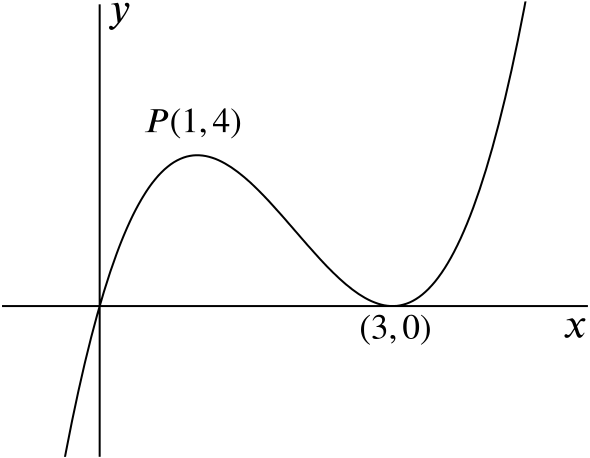
To sketch the curve, we note that the roots occur at and (with the latter being a double root, and so the curve touches the -axis here). The -intercept is .
The equation is a cubic with as the leading term. So as , , and as , .
So the stationary point at must be a maximum, and that at must be a minimum, giving
The tangent at cuts the curve again at . Calculate the areabetween the chord and the curve.
The tangent at has equation . This intersects the cubic again when We can expand this and rearrange to get We already know that is a double root of this equation (as the line touches the curve at ), so will be a factor. We can factorise to give so
We could have written this down immediately, since the factorisation must be for some , which will expand to for some and , and so must be to match the constant terms.
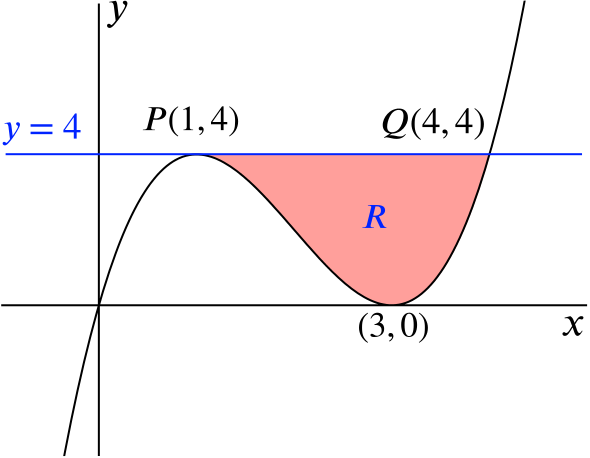
Thus the tangent at intersects the curve again at . We can now calculate the required area, indicated by on this sketch.
The area of
is equal to the area of the rectangle between
and the
-axis, which is
, minus the area under the curve between
and
, which is given by
Thus the area of is .