Solving Cubic Equations (Cambridge International IGCSE Further Maths)
Solving cubic equations
What is a cubic equation?
-
A cubic function is an polynomial of degree 3
- i.e. the highest power of is 3
-
A cubic equation can be written in the form
-
Solving a cubic equation involves factorising the cubic function first.
How do I factorise a cubic function?
- Factorising a cubic (function) combines the factor theorem with the method of polynomial division
- The example below shows the steps for factorising a cubic
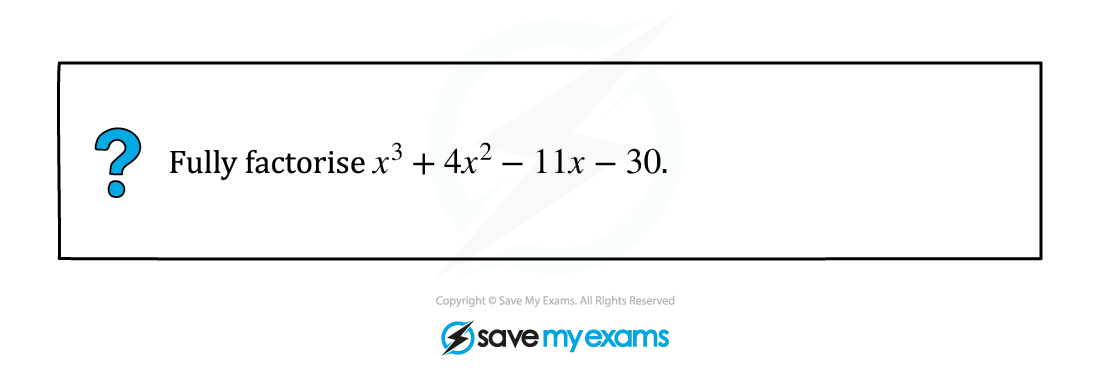
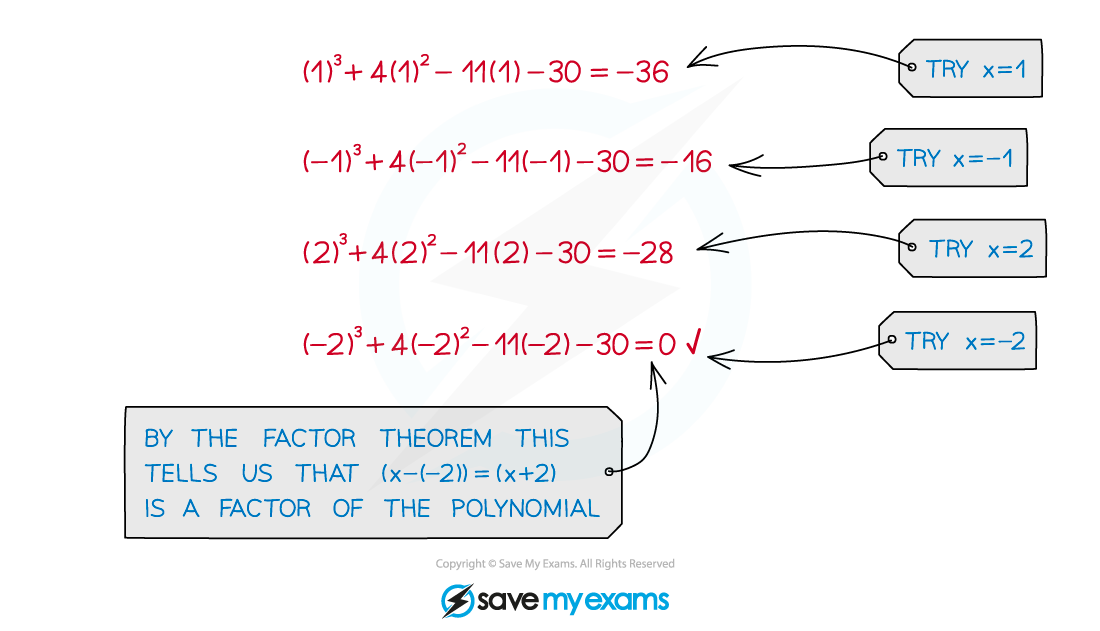
STEP 1 Use factor theorem. Find a value such that .
STEP 2 Use polynomial division. Divide by . (It is possible to do this step 'by inspection', see the worked example below)
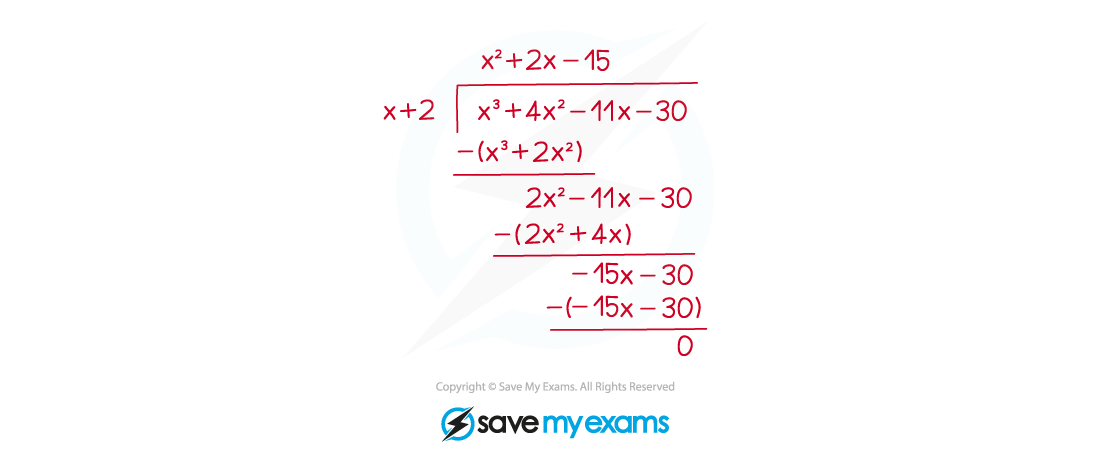
STEP 3 Use the result of your division to write .
STEP 4 If the quadratic can be factorised, do so. can then be written as the product of three linear factors. If the quadratic cannot be factorised, then the result from STEP 3 is the final factorisation.

How do I solve a cubic equation?
-
A cubic equation will have either 1, 2 or 3 (real) solutions
- (The cubic function will have either 1, 2 or 3 (real) roots)
-
Once the cubic function is factorised using the four steps above, there is one more step to carry out
STEP 5 Find the solutions to the cubic equation by making each factor equal to zero
-
For each linear factor,
-
-
so is a solution
-
This is the factor theorem!
-
For a quadratic factor,
-
-
use either the quadratic formula or completing the square(as it won't factorise)
- this will give two of the solutions to the cubic equation
-
if there are no solutions to the quadratic equation there are no solutions other than that from the linear factor
-
-
-
From the example above,
-
-
so the solutions to the cubic equation are
- and
-
-
Cubic equations can have equal (repeated) solutions
- e.g. has two (equal and real) roots, (repeated) and
- e.g. has three (equal and real) roots,
Exam Hint
When (i.e. there is no constant term) then is a factor of the cubic function, and so is a solution
This is a special case of factor theorem, where
- spotting the factor of means there is no need to test values
Take out a factor of and a quadratic function will remain
Deal with the quadratic in any of the usual ways
Worked Example a) Solve the cubic equation .
STEP 1 - use factor theorem with
is a factor of
STEP 2 - polynomial division () or 'by inspection' By inspection ...
('cubic' ÷ 'linear' = 'quadratic')
(because the * is generated only from )*
(because the constant term is generated only from )
Equate coefficients of (or ) terms to find ,
STEP 3
STEP 4 - the quadratic does not factorise
STEP 5 - Use the factors to find the solutions
(using the quadratic formula)
Final answer: The solutions toareand.
Was this revision note helpful?