Intersection of Two Circles (Cambridge International IGCSE Further Maths)
Intersection of two circles
What is meant by the intersection of two circles?
-
Two circles may intersect once (touch), twice (cross), or not at all
-
Touching circles may be referred to as tangent to each other
- they would have a common tangent line
-
How do I determine if two circles intersect or not?
-
Find the distance, , between the centres of the two circles
-
This can be found using Pythagoras' theorem
- For centres and ,
-
-
The radii of the two circles, and , where are also needed
-
If then the circles intersect twice
-
If or then the circles intersect once
-
If or then the circles do not intersect
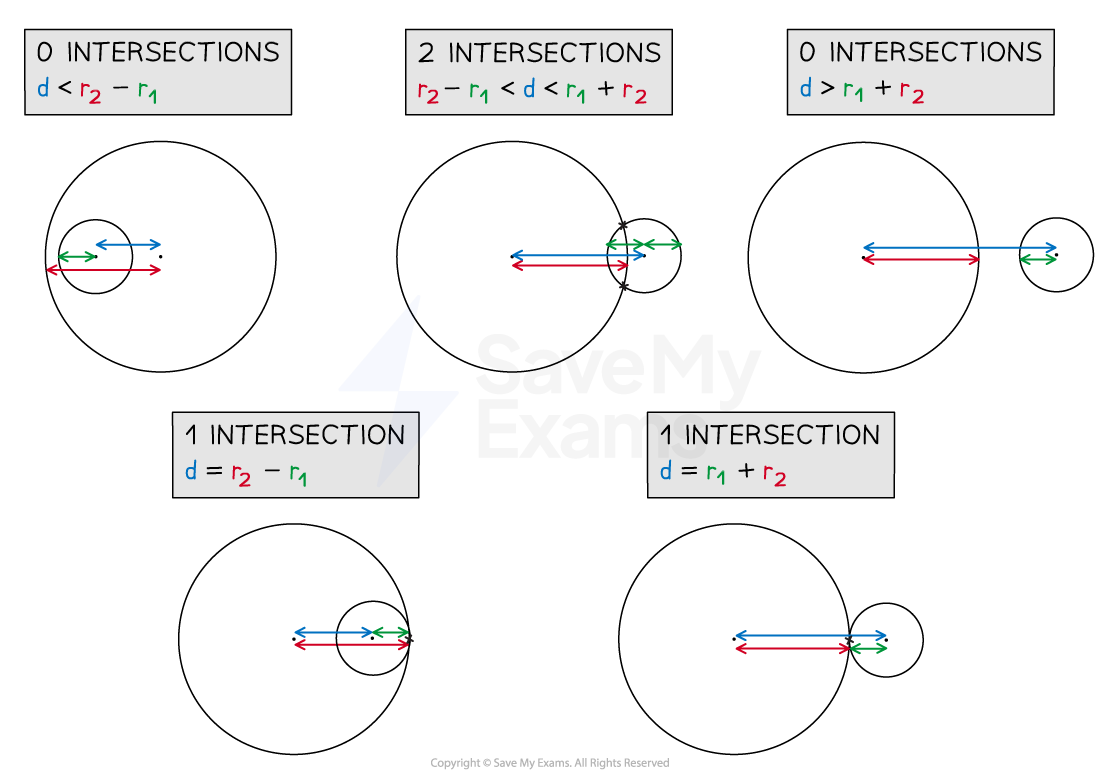
- Rather than trying to remember those formulae, try to understand the logic behind each situation
How do I find the coordinates of the point(s) of intersection of two circles?
-
Once it has been determined that the circles do intersect at least once, the following process can be used to determine the coordinates of any intersections
-
STEP 1 Rearrange both circle equations so that one side is zero
-
STEP 2 Put the circle equations equal to each other (i.e. solve simultaneously!)
-
STEP 3 Expand/rearrange/simplify into a linear equation
- The and terms will cancel, leaving an equation of the form or (These are 'diagonal line', 'vertical line' and 'horizontal line') The intersection(s) will lie on this line
-
STEP 4 Substitute the linear equation into either of the circle equations Solving this equation will lead to either the -coordinate(s) or -coordinate(s) of the intersection(s)
-
STEP 5 Substitute the (or ) coordinates into either circle equation to find the corresponding (or ) coordinates This step will not be needed in the case of the linear equation being of the form or
Exam Hint
Even if not given, or asked for, a sketch of the circles can help visualise their positions relative to each other
- You can then see if your final answers make sense with your sketch
Worked Example a) Determine the number of intersections between the circles with equations and .
has centre and radius .
has centre and radius .
Using a sketch may help you to 'see' that .
Compare with the sum and difference of and .
Final answer: The circles intersect twice
b) Determine the coordinates of any intersections between the circles with equations and .
STEP 1 - Rearrange both equations so zero is on one side
STEP 2 - Put the equations equal to each other
STEP 3 - Expand and rearrange until in linear form
STEP 4 - Substitute into either circle equation
STEP 5 - Not required in this case
Final answer: The intersections of the two circles have coordinates (1, 1) and (1,-1)
Equation of Common Chord
What is a common chord?
-
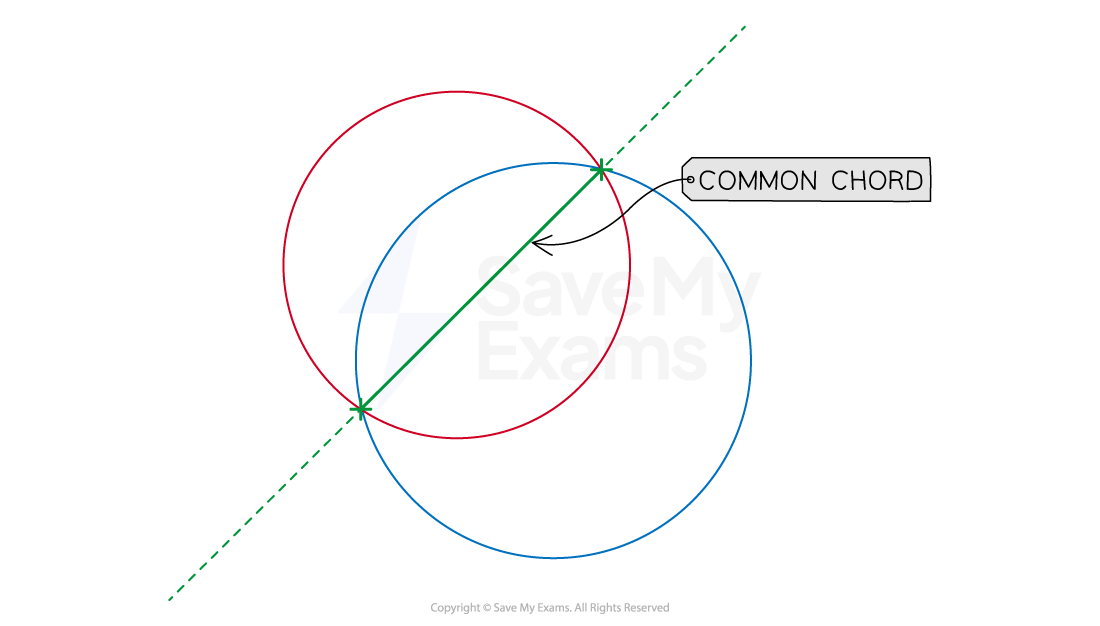
For circles that intersect twice the common chord is the line that joins the points of intersection
-
This line is a chord in both circles
- Circles that intersect once (touch) have a common tangent
How do I find the equation of a common chord?
-
As a common chord is a straight line, its equation will be of the form unless
- it is a horizontal line, in which case its equation will be of the form
- it is a vertical line, in which case its equation will be of the form
-
Depending on the known information, there are two ways to find the equation of the common chord
-
If the equations of the circles are known
- Equate the equations and rearrange the equation into one of the three forms above
- For example, So the equation of the common chord is
-
If the points of intersection are known
-
Use the method of finding the equation of a straight line from two known points
-
If the intersection points are and then the equation of the common chord would be
- is the gradient and it can be easier to work this out first, separately
-
-
Worked Example Two circles intersect at the points with coordinates and .
Find the equation of the common chord of the two circles.
The points of intersection are known. Use the method of finding the equation of a straight line from two known points.
First find the gradient,
Apply to get the equation of the common chord.
Final answer: The equation of the common chord is
Was this revision note helpful?