Laws of Logarithms (Cambridge International IGCSE Further Maths)
Laws of logarithms
What are the laws of logarithms?
-
Laws of logarithms allow you to simplify and manipulate expressions involving logarithms
- The laws of logarithms are equivalent to the laws of indices
-
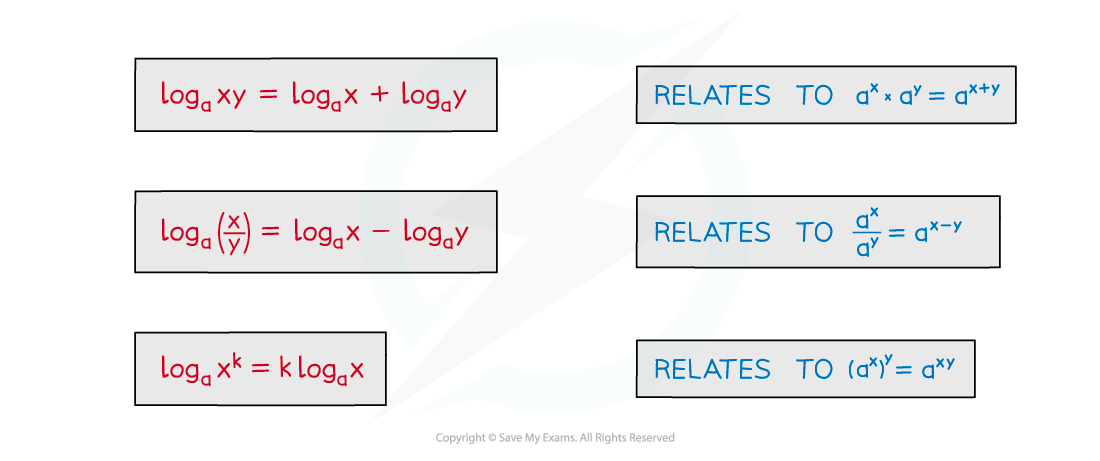
The laws you need to know are, given :
-
- This relates to
-
- This relates to
-
- This relates to
-
-
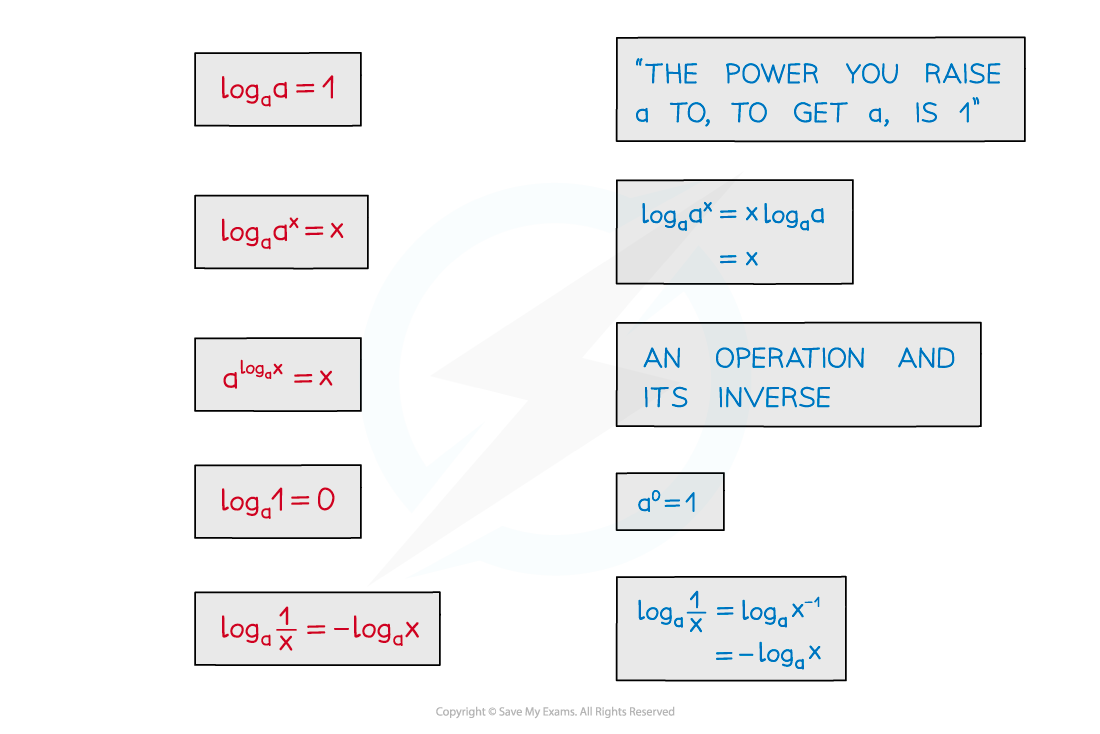
There are also some particular results these lead to
-
Beware…
- …
-
These results apply to too
-
Two particularly useful results are
-
How do I use the laws of logarithms?
-
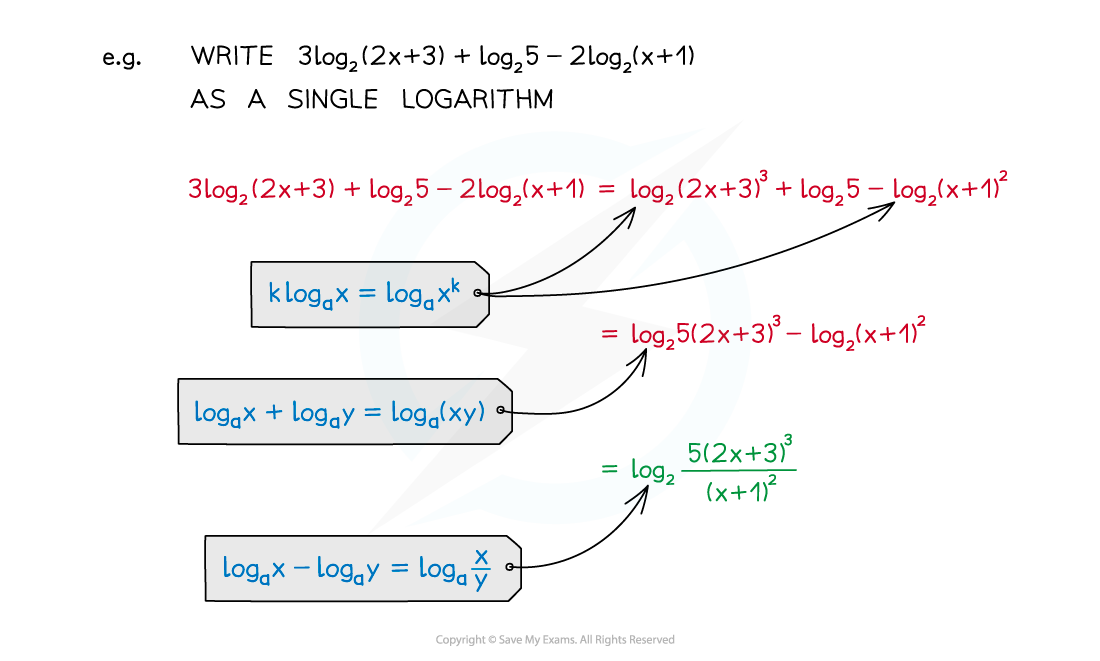
Laws of logarithms can be used to …
- … simplify expressions
- … solve logarithmic equations
- … solve exponential equations
Exam Hint
Remember to check whether your solutions are valid
- log (x+k) is only defined if x > -k
- You will lose marks if you forget to reject invalid solutions
Worked Example a) Write the expression in the form , where .
Using the law we can rewrite as .
Using the law :
- *
b) Hence, or otherwise, solve .
Rewrite the equation using the expression found in part (a).
:
Using the index law ::
- *
Using the law :
Compare the two sides.
- *
Change of Base
How do I change the base of a logarithm?
- The formula for changing the base of a logarithm is
- The value you choose for b does not matter, however if you do not have a calculator, you can choose b such that the problem will be possible to solve
Why change the base of a logarithm?
-
The laws of logarithms can only be used if the logs have the same base
- If a problem involves logarithms with different bases, you can change the base of the logarithm and then apply the laws of logarithms
-
Changing the base of a logarithm can be particularly useful if you need to evaluate a log problem without a calculator
- Choose the base such that you would know how to solve the problem from the equivalent exponent
-
This formula had more use when calculators were less advanced
-
Some old calculators only had a button for logarithm of base 10
-
To calculate on these calculators you would have to enter
-
-
The formula can be useful when evaluating a logarithm where the two numbers are powers of a common number
-
The formula can be useful when you are solving equations and two logarithms have different bases
-
For example, if you have and within the same equation
- You can rewrite as which simplifies to
- Or you can rewrite as which simplifies to
-
-
The formula also allows you to derive and use a formula for switching the numbers:
- Using the fact that
Exam Hint
- It is very rare that you will need to use the change of base formula
- Only use it when the bases of the logarithms are different
Worked Example By choosing a suitable value for b, use the change of base law to find the value of without using a calculator.
Note that 8 and 32 are both powers of 2, where 8 = 23 and 32 = 25.
*Therefore we can choose b = 2 in the change of base formula. *
:
If 23= 8 then log2 8 = 3 and if 25= 32 then log2 32 = 5.
- *
Was this revision note helpful?