13 marksmedium
(a)
Solve the equation .
18 questions · 78 marks · ≈ 78 min
Solve the equation .
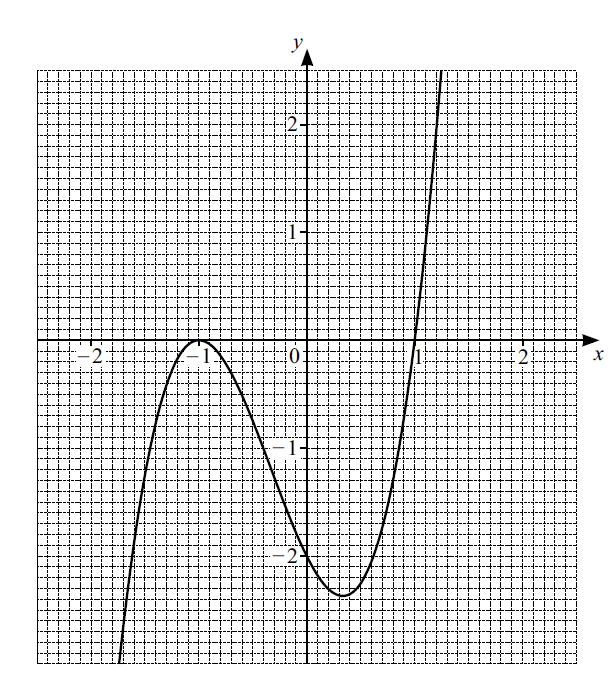
The diagram shows the graph of . Use the graph to solve the inequality .
On the axes, sketch the graph of , stating the intercepts with the coordinate axes.
Extract:
On the axes, sketch the graph of y = 5(x+1)(3x-2)(x-2), stating the intercepts with the coordinate axes.
From the mark scheme: The graph is cubic. Solve 5(x+1)(3x-2)(x-2) = 0 to find where the curve will cross the x axis. x = -1, x = 2/3, x = 2 Substitute x = 0 into y = 5(x+1)(3x-2)(x-2) to find where the curve will cross the y axis. y = 5(1)(-2)(-2) y = 20
Hence find the values of for which .
On the axes below sketch the graph of , showing the coordinates of the points where the curve intersects the coordinate axes.
Extract:
On the axes below sketch the graph of y = -3(x-2)(x-4)(x+1), showing the coordinates of the points where the curve intersects the coordinate axes.
The graph will be a negative cubic since -3 × x × x × x = -3x³.
The graph crosses the x-axis when y = 0: 0 = -3(x-2)(x-4)(x+1) Either x-2 = 0, x-4 = 0 or x+1 = 0 So x = 2, x = 4 or x = -1
The graph crosses the y-axis when x = 0: y = -3(0-2)(0-4)(0+1) y = -24
The intercepts are: (2, 0), (4, 0), (-1, 0) and (0, -24)
Hence find the values of for which .
On the axes below, sketch the graph of , showing the coordinates of the points where the graph meets the coordinate axes.
Extract:
On the axes below, sketch the graph of y = |5x - 7|, showing the coordinates of the points where the graph meets the coordinate axes.
The line y = 5x - 7 would have y-intercept (0, -7) and would intersect the x-axis at (7/5, 0)
We need to sketch y = |5x - 7| which means that all the y values are made positive. This means the part of the graph that goes below the x-axis gets reflected in the x-axis.
The final graph is a correct V shape with vertex on positive x-axis at coordinate (7/5, 0) and y-intercept at coordinate (0, 7).
Solve .
On the axes below, sketch the graph of , showing the coordinates of the points where the graph meets the coordinate axes.
Extract:
On the axes below, sketch the graph of y = -(x+2)(x-1)(x-6), showing the coordinates of the points where the graph meets the coordinate axes.
Find where the graph intersects the x axis by substituting in y = 0 0 = -(x+2)(x-1)(x-6) x = -2 x = 1 x = 6
Find the y intercept by substituting in x = 0 y = -(2)(-1)(-6) y = -12
The shape of the graph will be an inverted cubic.
Hence solve .
Solve the following equation.
Solve the inequality .
On the axes below, sketch the graph of showing the coordinates of the points where the curve meets the axes.
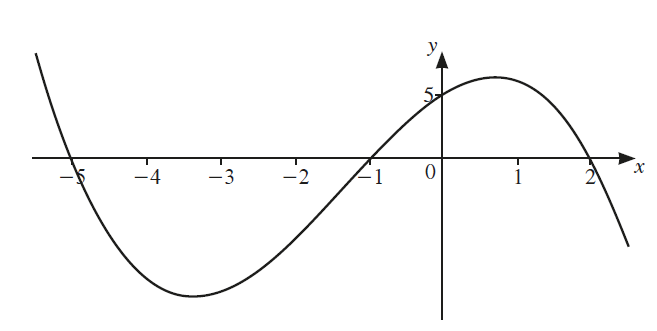
The diagram shows the graph of , where is a cubic polynomial. Find .
Extract:
The diagram shows the graph of y = f(x), where f(x) is a cubic polynomial.
Write down the values of such that .
On the axes below, sketch the graph of , stating the intercepts on the coordinate axes.
Extract:
On the axes below, sketch the graph of y = (x-2)(x+1)(3-x), stating the intercepts on the coordinate axes.
If we expand the brackets of the equation, the highest power of x we would get would be x cubed. Therefore, the graph is cubic. Since one of the x in the brackets is negative, we will have an inverted cubic shape.
Solve (x-2)(x+1)(3-x) = 0 to find where the curve will cross the x axis. x = 2, x = -1, x = 3
Substitute x = 0 into y = (x-2)(x+1)(3-x) to find where the curve will cross the y axis. y = (-2)(1)(3) y = -6
Hence write down the values of such that .
Solve .
The graph where intersects the -axis at the points , and where .
Find the constants , and .
The curve has a local maximum point at and a local minimum point at .
Find the value of for which the equation has exactly 5 distinct solutions.
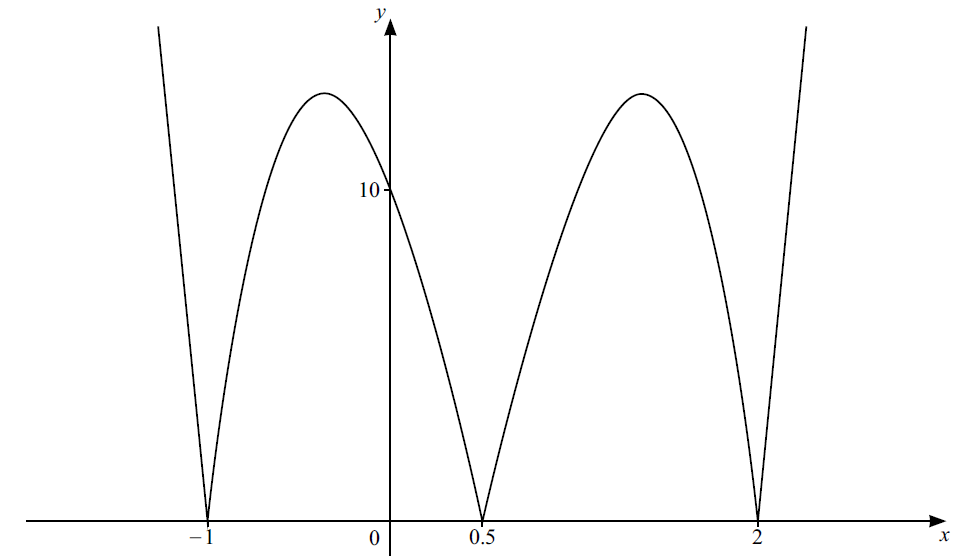
The diagram shows the graph of , where is a cubic function. Find the possible expressions for in factorised form.
The diagram shows the graph of a cubic curve .
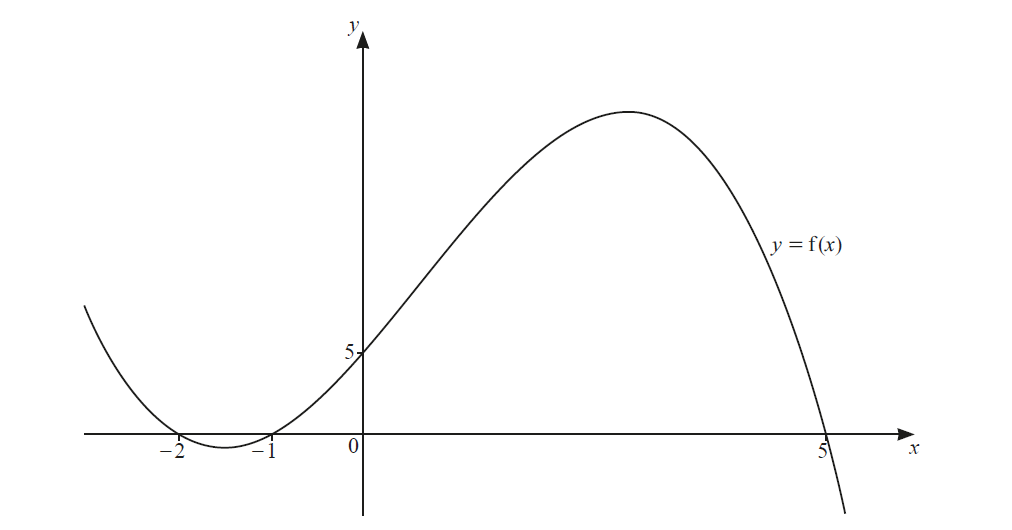
Find an expression for .
Extract:
The diagram shows the graph of a cubic curve.
The graph crosses the x axis at the roots of the equation: x = -2, x = -1, x = 5
f(x) = -1/2(x + 2)(x + 1)(x - 5)
Solve .
Write in the form , where and are constants.
Extract:
Write 2x² + 3x - 4 in the form a(x + b)² + c, where a, b and c are constants.
Answer: 2(x + 3/4)² - 41/8
Hence write down the coordinates of the stationary point on the curve .
Extract:
2(x + 3/4)² - 41/8
On the axes below, sketch the graph of , showing the exact values of the intercepts of the curve with the coordinate axes.
Extract:
The minimum point on the curve y = 2x² + 3x - 4 is (-3/4, -41/8).
The graph of y = |2x² + 3x - 4| is a parabola where everything below the x-axis is reflected above the x-axis. The x-intercepts are ((-3 + √41)/4, 0) and ((-3 - √41)/4, 0), and the y-intercept is (0, 4).
Find the value of for which has exactly 3 values of .
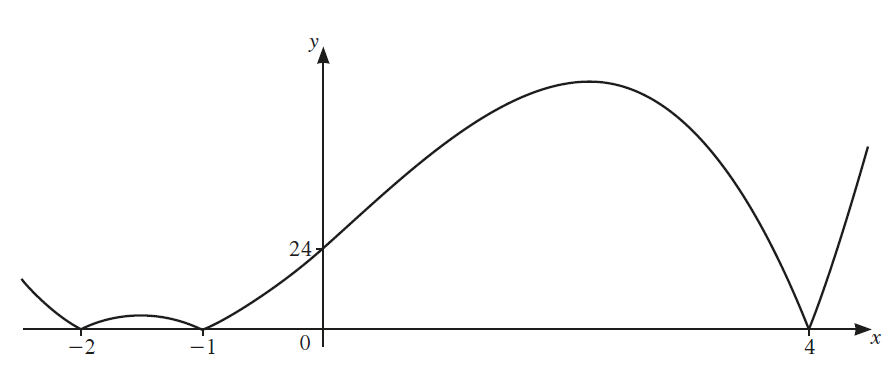
The diagram shows the graph of , where is a cubic function. Find the two possible expressions for .
Solve the inequality .