Tropical Cyclone Formation (Cambridge International IGCSE Environmental Management)
What conditions are needed for tropical cyclone formation?
- Tropical cyclones are among the most powerful natural hazards on Earth
- Understanding how they form, how they affect people, and how we can manage their impacts is important
What's the difference between hurricanes, cyclones, and typhoons?
-
They all describe the same type of storm, but the name varies by region
-
They are known as:
- Typhoons in the South China Sea and the western Pacific Ocean
- Hurricanes in the Gulf of Mexico, the Caribbean Sea and the west coast of Mexico
- Cyclones in the Bay of Bengal, the Indian Ocean and northern Australia
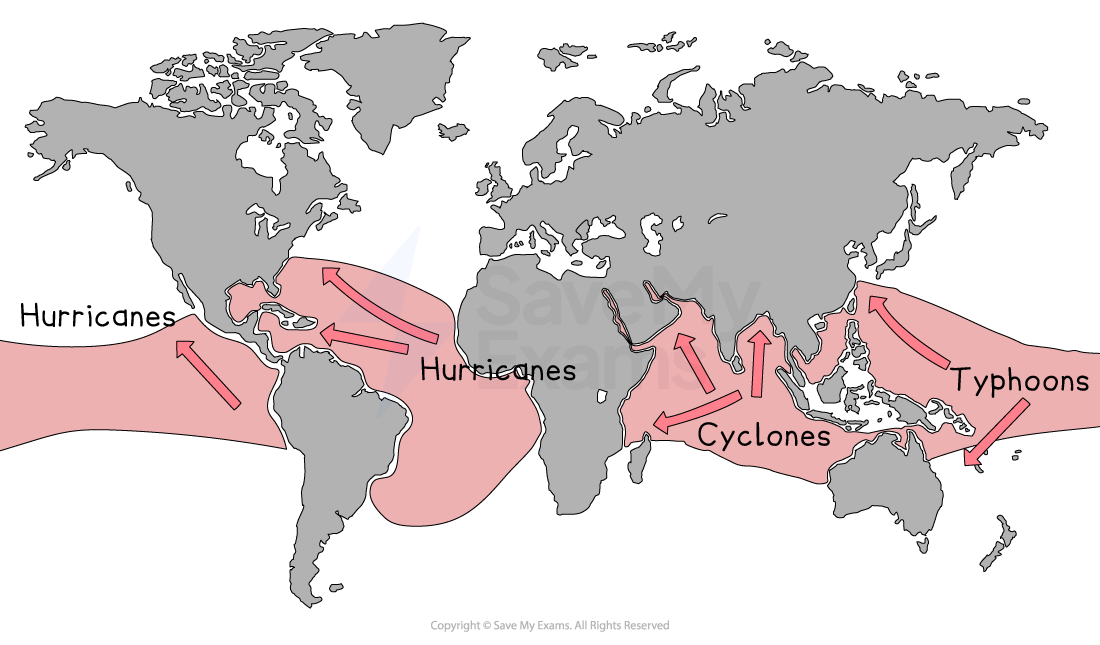
Distribution of tropical storms
Development of tropical cyclones
-
Tropical cyclones are rotating, intense low-pressure systems (below 950mb)
-
They need specific conditions to form
-
Form between 5° and 30° latitude north or south of the Equator
- Cyclones require the Coriolis effect to spin, which is too weak at the Equator
- Therefore, they form away from the Equator, usually between 5° and 30° latitude
- They do not form at higher latitudes because the water is too cold
-
Ocean temperature of at least 27 °C
- Warm water is essential because it provides the heat energy needed to drive the storm
- Ocean temperatures must be in excess of 27°C
- Warm water evaporates rapidly, adding heat and moisture to the rising air
- This fuels towering cumulonimbus clouds and intense rainfall
- Warm water = more evaporation = more latent heat = stronger cyclone
-
Ocean depth of at least 60 m
- Warm water must extend to at least 60 metres in depth
- Deep warmth ensures the storm continues to gain energy without mixing with cooler water from below
- Shallow warm layers are quickly disrupted by strong winds
-
-
Tropical cyclones begin when tropical oceans are at their warmest, which is usually late summer (Nov-April in the southern hemisphere and June-Nov in the northern hemisphere)
- The Pacific Ocean sees the largest number of tropical storms, followed by the Indian Ocean, and lastly, the Atlantic
- Tropical storms in the western Pacific are the strongest
Impacts of tropical cyclones
-
Cyclones affect large areas because they combine high winds, intense rainfall, storm surges, and flooding
-
Damage to buildings and infrastructure
- Roofs ripped off; buildings collapse
- Power lines, roads, bridges and communication networks are destroyed
-
Loss of crops
- Crops flattened by wind or drowned by floodwater
- Saltwater storm surges ruin farmland
-
Loss of livestock and habitats
- Animals drowned or injured
- Forests uprooted; coastal ecosystems damaged
-
Evacuation of people and livestock
- Millions may be moved to safer areas
- Displacement disrupts daily life and livelihoods
-
Flooding
- Torrential rain, overflowing rivers and storm surges cause widespread flooding
- Urban drainage may be overwhelmed
-
Landslides
- Heavy rainfall saturates slopes, triggering landslides
- Buries homes, roads and farmland
-
Contamination of drinking-water supplies
- Floodwater mixes sewage with clean water
- Saline intrusion from storm surges pollutes wells and aquifers
-
Water-related disease
- Outbreaks of cholera, dysentery, giardia and other infections
- Standing water encourages mosquito breeding
-
Financial losses
- Huge repair costs for transport networks, homes, utilities and businesses
- Loss of agricultural production and tourism
- Long-term economic disruption
-
Human health
- Injuries and deaths from collapsing structures and debris
- Psychological stress and trauma after disaster
- Poor shelter conditions increase sickness
Was this revision note helpful?
Build on this topic