Question 1 Model Answer: Speech (Cambridge International IGCSE English Language)
This revision note is for exams in 2026. If you are sitting your exam from 2027, please switch to the 'First exams 2027' syllabus edition.
Question 1 Model Answer: Speech
For this task, you will be asked to produce a piece of writing in a particular format, based on the opinions, ideas and information you are presented with in one or two reading passages. You may be asked to write in one of three possible formats (genres):
- A letter
- A speech
- An article
The following guide will demonstrate how to answer Question 1 in the format of a speech. The task itself is taken from a past exam paper.
Addressing the reading assessment objectives
Up to 15 marks are available in this task for your ability to evaluate both the explicit and implied ideas, opinions and attitudes expressed in one or two texts, and assimilate them to write a developed and sophisticated response.
Let’s take a look at how you do this, using the following Question 1 example:
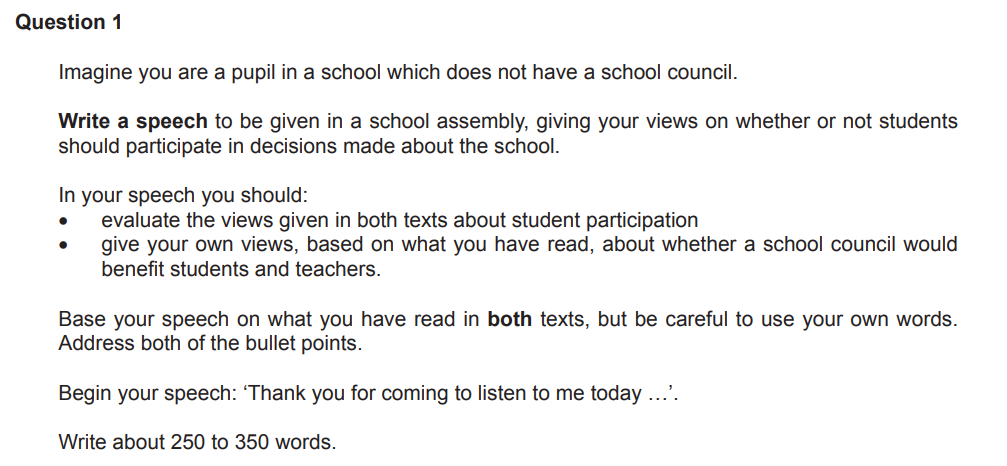
Your response here has to be based on the ideas, opinions and attitudes contained in the following two texts:
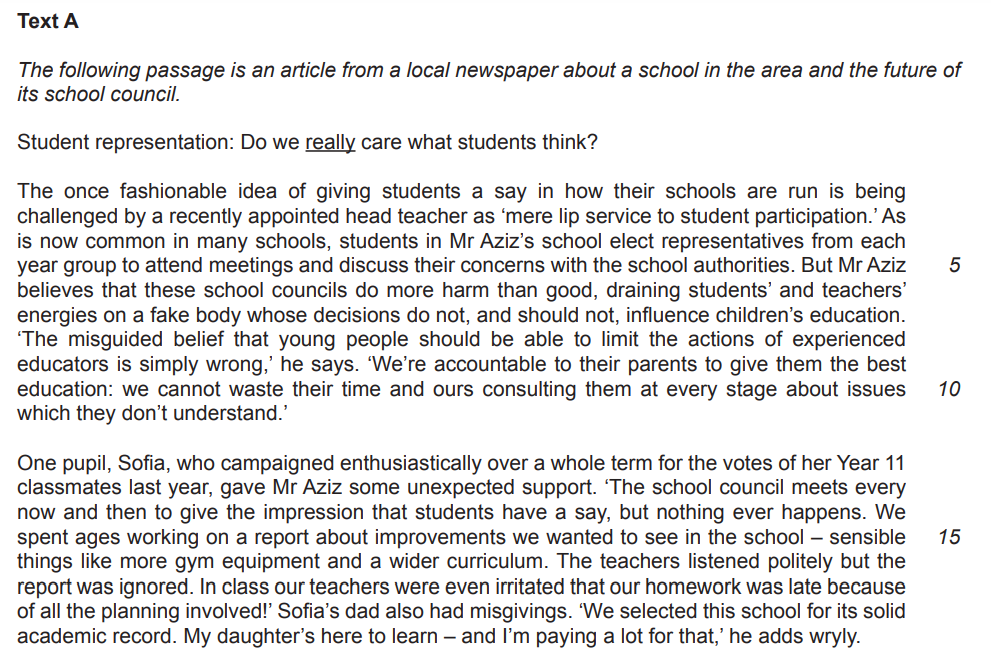
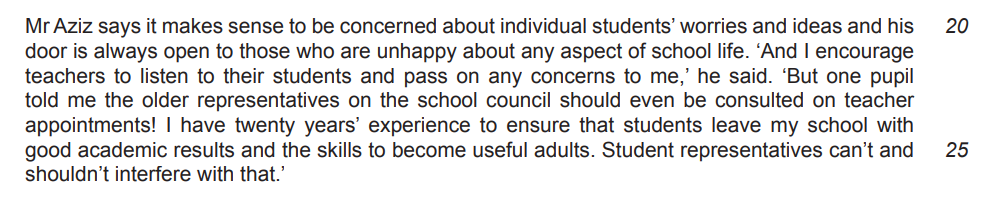
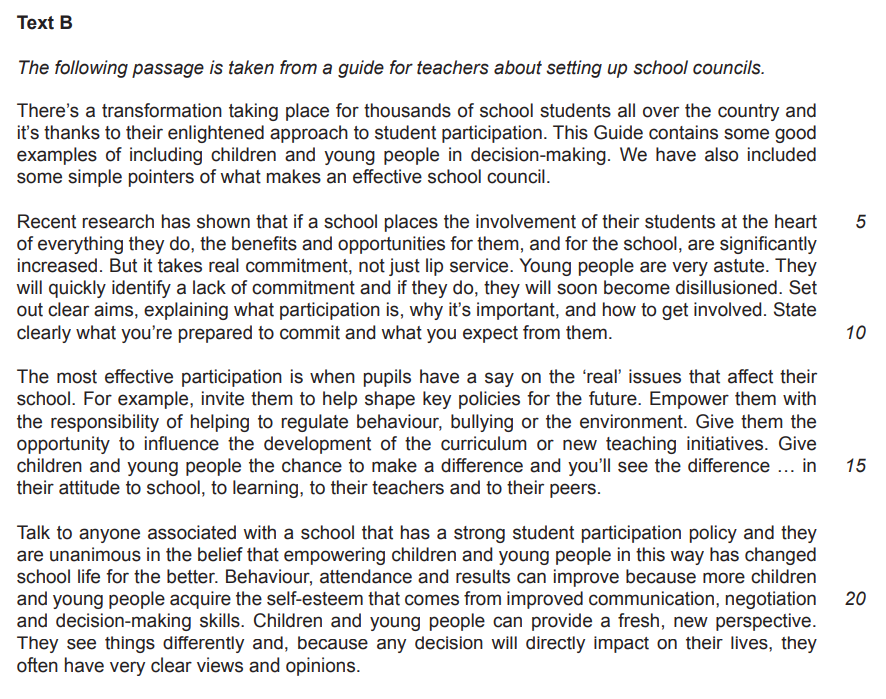
After carefully reading the task, you should read the texts and highlight the ideas and opinions that could inform your writing. Your response might use the following ideas from these texts:
Text A:
- Student representation was “once fashionable”, but it may just be a passing fad
- School councils take up too much time and energy from schools and teachers when they have more important things to be getting on with
- If student representation is fake or just to tick a box, then it has no substance, especially if views and ideas are not acted upon
- Teachers are accountable to parents and should put education first
- Even some students are disillusioned with the idea of student representation when nothing is acted upon, especially given the time and effort involved
- Experienced teachers should make decisions, not children - trust should be placed in the people appointed to run the school and deliver the education
Text B:
- An “enlightened” approach is needed to make school councils work and it takes real commitment
- Student participation is very popular and well regarded
- Student participation works when children are involved in “real” issues
- Students can take responsibility for difficult problems such as behaviour or bullying
- Participation can make a difference to students’ attitudes to school
- Attendance and results are improved by participation
- Students can learn important skills such as negotiation, communication and decision-making
- Students can have a fresh eye on issues
- Decisions made may have a major impact on them, so students are motivated to participate
Planning your response
Once you have read the text(s), identified relevant opinions, ideas and attitudes and bullet-pointed these in your own words, you should then spend five minutes planning your written response. In your plan:
- Decide on your “voice” and point of view
- Write a statement that summarises your point of view, based on your reading
- Note down which points you can develop that support your point of view in your first paragraph
- Decide whether you are going to make a counter-argument, and note down which points you can develop to support this
- Return to your main argument, ensuring that you have included ideas and opinions from both texts (if more than one)
- Note down the points you can make to address the second bullet point in the task
- Note down how you are going to start and finish your response, ensuring that it establishes the correct style and tone
Speech model answer
The following model answer demonstrates a top-mark response to the above task:
Worked Example Thank you for coming to listen to me today. I am here to argue that students must participate in decisions about our school. As you are aware, we currently do not have a school council, which I believe denies us the vital opportunity to influence how our community is run.
However, participation must be meaningful. The effectiveness of a council depends entirely on how well it is managed. If a school pays lip service to student feedback without acting on it, the exercise is pointless. If representatives invest time only to be ignored, they will inevitably feel disillusioned and powerless. We need a voice that is actually heard.
I appreciate that parents and teachers may feel education should come first, leaving ‘big decisions’ to the professionals. Yet, this view is short-sighted. As the people who spend the most time here, we should be empowered to make informed decisions about our environment. Being young does not render us incapable of providing intelligent, constructive feedback.
Furthermore, representation brings tangible benefits. It makes students feel valued and develops crucial life skills like negotiation and decision-making — assets for our CVs. Students can also offer fresh perspectives on challenging issues like bullying. Evidence suggests that when students are entrusted with responsibility, it leads to better attitudes, improved attendance, and higher results.
Having critiqued the teachers' guide on setting up councils, I worry it underestimates the significant time commitment required. We must be realistic: effective participation requires hard work. We need a council that has a genuine say on real issues, not just a token gesture. Ultimately, we deserve to be trusted with the responsibility of shaping our own education.
Thank you for listening.
Commentary
- The speech starts as instructed and demonstrates an understanding of the task, its purpose and intended audience
- The introduction establishes a clear voice and point of view
- Ideas and opinions from both texts are implied in the response
- The response uses conventions of a speech, such as inclusive pronouns and direct address, to connect to the audience
- The argument is sustained throughout
- Spelling, grammar and punctuation are accurate
Exam Hint The suggested word count for this task is a guide, and you are not penalised for writing under or over 250-350 words. However, writing too little can mean that your answer does not have enough development or detail. Writing too much can mean that you go off topic and lose focus, which again can be self-penalising. It is therefore a good idea to stick as closely as you can to the word count guidance.
You can find further guidance on suggested word counts for CIE here.
Summary
-
Remember to read the question carefully and highlight:
- What you are writing, who your audience is and why you are writing
- The focus of each bullet point
-
Read the text(s) and highlight the relevant information that could be developed in your answer
-
Bullet-point this information in your own words
-
Plan your writing, focusing on one main idea or opinion per paragraph
-
Address each bullet point in order:
- Make sure you cover all of the bullet points as equally as possible
-
Decide on the voice and style you want to create and maintain that in your answer
-
Do not just repeat details from the text(s):
- You need to evaluate and develop the ideas, opinions and attitudes in the text(s) - you are not summarising them
Persuasive Theory
 |  |  |
|---|
| Emotional (Pathos) | Authoritative (Ethos)* | Logical (Logos) | |||
|---|---|---|---|---|---|
| Argument based on emotions and beliefs | Argument based on trust and authority | Argument based on facts and reason |
Was this revision note helpful?
Build on this topic