Question 1 Directed Writing: How to Write a Letter (Cambridge International IGCSE English Language)
This revision note is for exams in 2026. If you are sitting your exam from 2027, please switch to the 'First exams 2027' syllabus edition.
Paper 2: Question 1 Directed Writing: How to Write a Letter
Question 1 Directed Writing: How to Write a Letter
One of the three formats that you may be asked to write in for Question 1 is a letter. This may be an informal letter, to a friend or relative, or a formal one. You will be given the intended audience for your letter and the reason why you are writing in the task instructions. The arguments you put forward in your letter should be based on what you have read in the reading passages given, and your writing marks will come from your ability to vary your writing to suit the purpose, audience and form of the task, as well as how you structure your response.
The following guides will detail how to structure your response in the style of two different types of letter, an informal letter and a formal letter.
Informal letter
An informal letter will be written to someone you know well, such as a friend or a relative. You may be asked to offer your ideas and opinions as advice, or to weigh up the pros and cons of something. It is important to remember that, although you are writing to a relative or friend, this is an exam and you are not actually writing a letter to that person. Therefore, do not use abbreviations or slang, such as “OMG!”.
| Informal letter |
|---|
| In an informal letter you should: - Start with “Dear” and use the first name of the person you are writing to - Include a warm and friendly opening, such as: - “It was good to hear from you,” or “Sorry I have not replied sooner; I have been so busy revising for my exams.” - Tell them why you are writing the letter: - The reason will be given to you in the task instructions - Paragraphs should be clear and well sequenced, using appropriate connectives - Use topic sentences to begin each paragraph, and then develop that point appropriately and in detail - Do not try to include multiple, different arguments in one paragraph - Use the bullet points in the task to structure your letter - You can sign off your letter more informally: - Try “Best wishes,” or “Hope to see you soon.” |
The level of informality in this style of letter comes from keeping your tone light and adding personal details. However, you still need to use accurate spelling, with a variety of sentences and punctuation used for effect.
Exam Hint Always write with your intended audience in mind. Address them directly throughout your writing, mention their specific concerns and ensure you develop your points in a way which would convince your specific reader.
Formal letter
A formal letter will be written to somebody in authority, such as a headteacher, a manager or the editor of a newspaper. You will still be asked to put forward your point of view, ideas and opinions, based on what you have read in the text(s), but your tone and language should be adapted to suit the intended audience and purpose of writing. There are some typical conventions of a formal letter that you can use, but be careful not to spend too much time on irrelevant formatting details.
| Formal letter |
|---|
| A formal letter should: - Include a date - Use the correct salutation: - If you do not know the name of the person you are writing to, then use “Dear Sir/Madam” - You can use “Dear Editor” if writing in response to an article or letter seen in a newspaper or magazine - If you do not know the name of the person you are writing to, use “Yours faithfully,” at the end - If you are given the name of the person, then start with “Dear [name]” and end with “Yours sincerely,” - Your introduction should state what you are writing about, why you are writing and what your opinion is: - Make this relevant to the purpose of the task - Instead of using “I am writing because…”, use the wording of the task instructions - For example: “I am writing to give my opinion about…” - Paragraphs should be clear and well sequenced, using appropriate connectives - Use topic sentences to begin each paragraph, and then develop that point appropriately and in detail - Do not try to include multiple, different arguments in one paragraph |
A formal letter layout should look something like this:
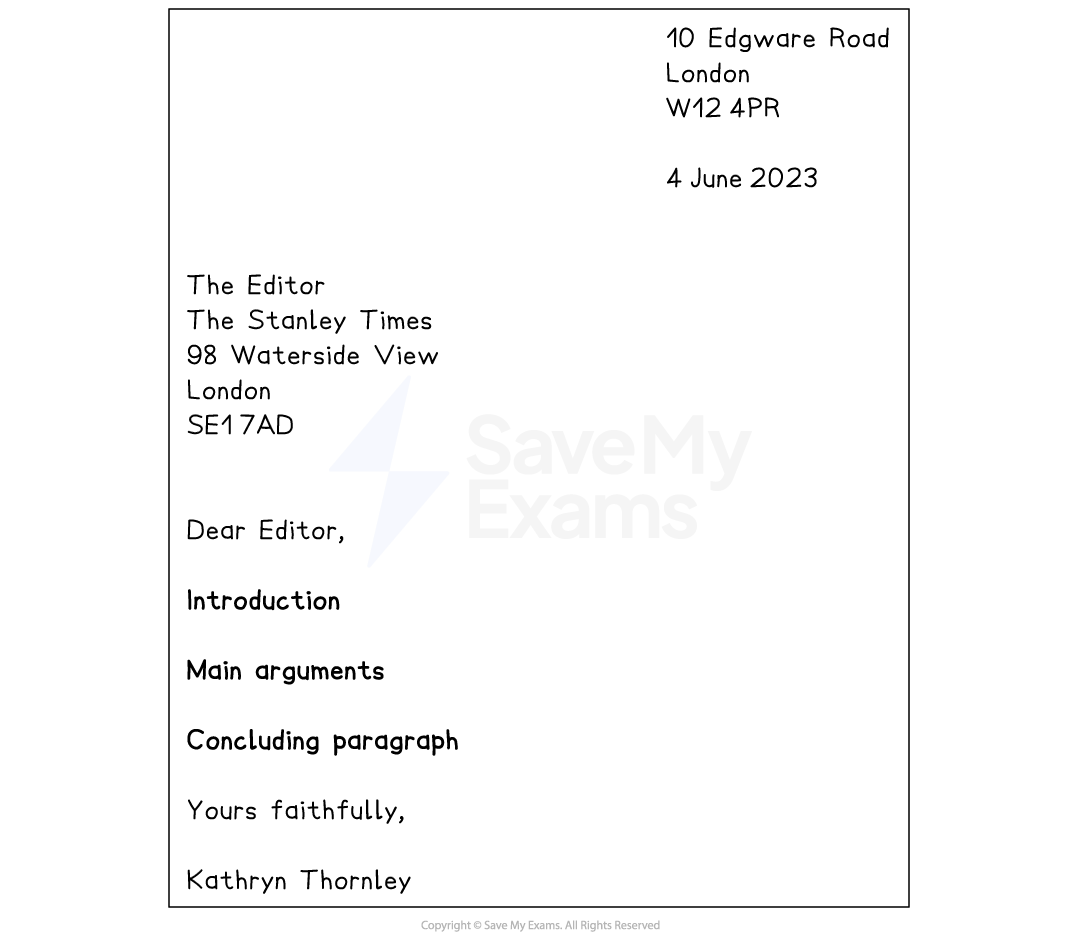
Exam Hint While writing in the correct form as instructed is important in this question, you only need to adhere to the basic conventions of a letter, article or speech. Spending too much time on perfecting the layout of the letter, or making up an address for the top of the letter, only detracts from your writing and will not gain you any extra marks. Remember, it is more important that you adapt your style, language and tone to suit the intended audience and purpose, and that you construct a well-structured and coherent piece of writing, than waste time on the layout of your response.
For more information about writing a letter in the exam, please see our letter model answer.
Was this revision note helpful?
Build on this topic