Deficits & Surpluses (Cambridge International IGCSE Economics)
Current account deficits and surpluses
-
A current account deficit occurs when the value of imports exceeds the value of exports
- This means the country is spending more on foreign goods, services and income transfers than it is earning
Causes of current account deficits
1. Relatively low productivity
-
When a country’s firms are less efficient, their production costs are higher than firms in other countries
- This makes exports more expensive and less competitive in global markets
- For example, in the early 2010s, Greece struggled with low productivity, contributing to its large trade deficit and debt crisis
2. Relatively high exchange rate
-
A strong currency makes exports more expensive to foreign buyers and imports cheaper for domestic consumers
- As a result, export sales fall and imports rise
3. Relatively high inflation
-
Higher domestic inflation increases the prices of goods and services to foreigners
- Exported goods become more expensive than those from countries with lower inflation, causing demand to fall
- At the same time, domestic consumers may switch to cheaper foreign goods, raising imports
- For example, in the early 2000s, Zimbabwe experienced hyperinflation, destroying export competitiveness and leading to a reliance on imported essentials
4. Rapid economic growth
-
When household incomes rise quickly, people tend to buy more goods and services — including foreign products
- This increase in import spending can worsen the current account balance.
-
For example, in India, periods of rapid growth have often been accompanied by widening trade deficits due to surging demand for imported oil, electronics and luxury goods
5. Non-price factors (e.g. poor quality or design)
-
Even if a product is affordable, poor quality or outdated design can lead to falling export sales
-
Domestic consumers may also prefer to buy higher-quality imports
- For example, some developing economies struggle to increase exports due to inconsistent product quality while importing higher-quality goods from countries like Germany or Japan
Causes of current account surpluses
-
A current account surplus occurs when the value of exports exceeds the value of imports
- This suggests the country is a net earner from trade and income flows
| Relatively high productivity | Relatively low value of the country’s currency | Relatively low rate of inflation |
|---|---|---|
| - High productivity decreases costs - Exporting firms with high productivity may find themselves at a price and cost advantage in overseas markets, which will increase competitiveness and the level of exports | - Currency depreciation makes a country's exports less expensive relative to other nations - Foreign buyers increase their purchases and the level of exports rises - Similarly, currency depreciation makes imports more expensive - Domestic consumers may switch demand to locally produced products and the level of imports falls | - A relatively low rate of inflation makes a country's exports less expensive than other nations - Foreign buyers increase their purchases and the level of exports rises, improving the balance on the Current Account |
Consequences of deficits and surpluses
-
In the global economy, trade is a net-sum game
- The total value of global exports equals the total value of global imports
-
This means that when one country runs a Current Account surplus, another must be running a Current Account deficit
Consequences of a Current Account deficit
1. Increasing unemployment
-
A fall in demand for domestically produced goods and services leads to lower output
- As a result, fewer workers are needed, and unemployment rises
2. Slower economic growth or recession
-
Exports are a major component of real GDP
- A sustained fall in exports can slow down economic growth or even push the economy into recession
3. Lower standards of living
-
With falling growth and rising unemployment, wages may fall and households will have less to spend
- This leads to a decline in living standards
4. Increased borrowing
- Persistent deficits, especially those caused by high import levels, may force a country to borrow more to fund its spending on foreign goods and services
5. Depreciating exchange rate
-
A weaker current account leads to depreciation of the national currency
- While this can eventually boost exports, it also makes imports more expensive, raising the risk of cost-push inflation
Consequences of a Current Account surplus
| Consequence | Explanation |
|---|---|
| Rising employment | - Higher demand for exports increases production, creating more jobs |
| Economic growth | - Export growth boosts GDP and overall national income |
| Higher living standards | - More jobs and rising incomes improve household spending and well-being |
| Demand-pull inflation | - Increased demand in the economy can cause prices to rise |
| Appreciating currency | - Strong export performance increases demand for the currency, raising its value |
| Cheaper imports | - A stronger currency makes imports more affordable, encouraging more consumption |
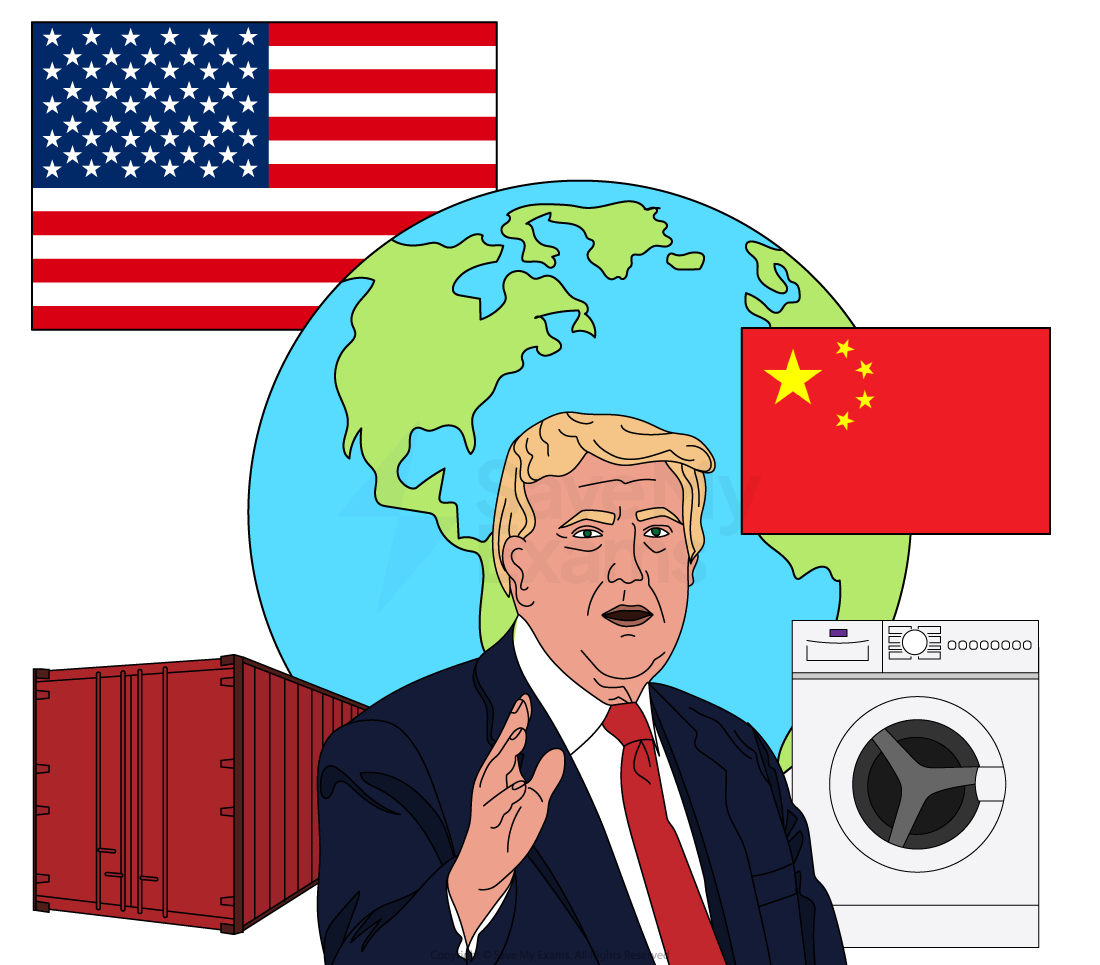
Case Study The United States Current Account Deficit and Policy Response under President Trump
The United States has run a current account deficit for decades, meaning it imports more goods, services, and income than it exports.
In 2023, the US current account deficit was over $900 billion, largely due to high imports of consumer goods, energy products, and capital equipment.
This deficit has been driven by:
- Strong consumer demand for foreign goods
- A strong dollar making imports cheaper and exports more expensive
- Low national savings and high levels of government and consumer spending
- Offshoring of US production to lower-cost economies, particularly China and Mexico
Trump's Actions
Under his first term as president (2017–2021), Donald Trump attempted to reduce the trade deficit using a mix of protectionist and nationalist economic policies under the banner of "America First"
These included:
Tariffs on Chinese imports
- Introduced tariffs on steel, aluminium, and hundreds of billions of dollars’ worth of Chinese goods to protect domestic industries and reduce imports
Withdrawal from trade agreements
- Pulled the US out of the Trans-Pacific Partnership (TPP) and renegotiated NAFTA into the USMCA to prioritise American jobs and manufacturing
Tax cuts and deregulation
- Reduced corporation taxes to attract domestic investment and incentivise US-based businesses to boost production
Pressure on companies to reshore
- Publicly criticised firms outsourcing jobs and encouraged manufacturing to return to US soil
Outcome
- The trade deficit with China narrowed slightly in 2019, but the overall Current Account deficit remained large, due to strong consumer demand and higher imports from other countries like Vietnam and Mexico
- Some US manufacturing sectors (e.g. steel) saw short-term boosts in production and employment
- Tariffs led to higher prices for consumers and US firms relying on imported inputs, particularly in the automotive and technology industries
- The US dollar remained strong, keeping imports attractive and limiting export competitiveness
- There was limited long-term impact on reducing the deficit, as structural factors, such as the dollar’s global reserve status and low domestic saving, persisted
Was this revision note helpful?
Build on this topic