Understanding the Mixed Economic System (Cambridge International IGCSE Economics)
Characteristics of a mixed economic system
-
Any economic system needs to decide how to answer the three fundamental economic questions
- What to produce? More weapons for the military or more schools to educate children?
- Who to produce for? Only those who can afford to pay for it? Or for everyone in society?
- How to produce it? Should more labour be used, or should the economy focus on using technology instead?
-
A mixed economic system is a blend of a market and planned economy
-
Individuals, firms and the government own factors of production and distribute goods or services
-
In reality, almost every country in the world operates as a mixed economic system
-
Some countries have more government intervention than others
- e.g. China has more intervention than the USA
-
The higher the level of government intervention, the more the economy will lean towards operating like a planned economy
-
Why do governments intervene?
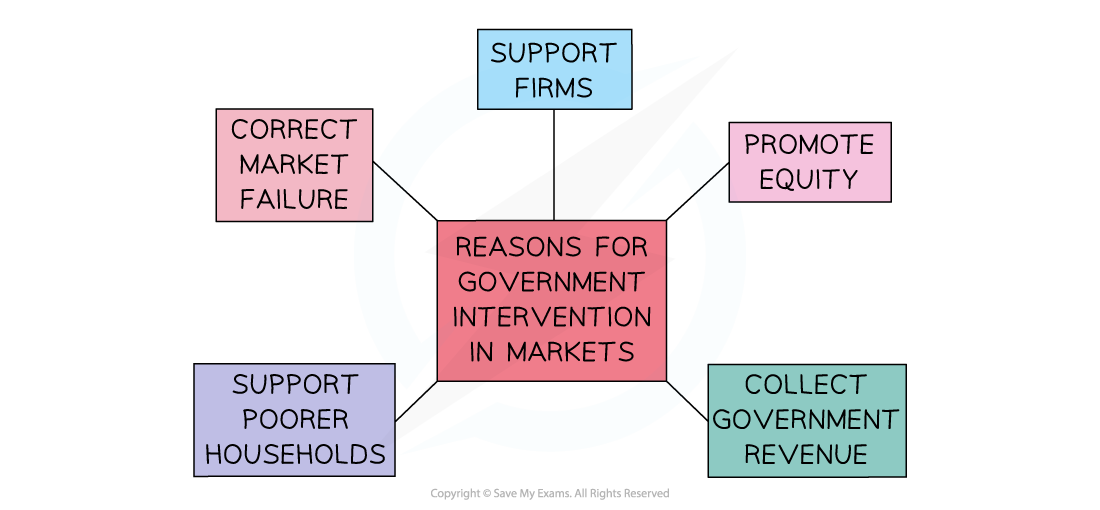
*A diagram showing several reasons for government intervention in mixed economic systems *
To correct market failure
-
In many markets there is a less than optimal allocation of resources from society's point of view
- In maximising their self-interest, firms and individuals will not self-correct this misallocation of resources and there is a role for the government
- Governments often achieve this by influencing the level of production or consumption
To earn government revenue
-
Governments need money to provide essential services and public and merit goods
- Revenue is raised through intervention such as taxation, privatisation, sale of licenses (e.g. 5G licenses), and the sale of goods/services
To promote equity
- To reduce the opportunity gap between the rich and poor
To support firms
- In a global economy, governments choose to support key industries to help them remain competitive
To support poorer households
-
Poverty has multiple impacts on both the individual and the economy
- Intervention seeks to redistribute income (tax the rich and give to the poor) so as to reduce the impact of poverty
Arguments for and against the mixed economic system
Spec point —
2.10.2· "Arguments for and against the mixed economic system: • advantages of the mixed economic system • disadvantages of the mixed economic system"
Arguments for and against the mixed economic system
-
The majority of economies in the world operate as a mixed economic system
-
The extent to which they are mixed varies
- Some lean more towards the free market
- Other lean more towards a planned economy
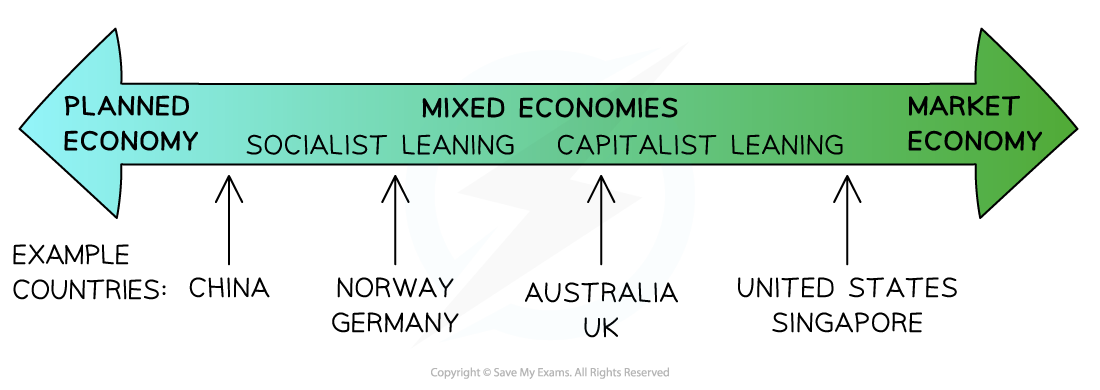
The spectrum of economic systems and where certain economies fall based on the degree of government intervention
- North Korea is a planned economy
- The United States, Japan and Singapore are mixed economies but have less government intervention than Norway, Germany or China
Evaluating mixed economies
| Advantages | Disadvantages |
|---|---|
| - Efficient resource allocation - The private sector responds to consumer demand, encouraging innovation and competition - Government addresses market failure - Public goods (e.g. street lighting) and merit goods (e.g. education) are provided where the market would under-provide - Reduces inequality - Governments can redistribute income through taxation and welfare to protect vulnerable groups - Protects consumers and the environment - Laws and regulations can reduce external costs and ensure product safety | - Government failure is possible - Decisions by the state may be inefficient or influenced by politics rather than economics - Higher taxes - To fund public services and welfare, taxes may be high, which can discourage work and investment - Bureaucracy and inefficiency - Public sector organisations may lack profit incentives and become wasteful or slow to respond to change - Risk of reduced innovation - Excessive regulation may limit risk-taking and creativity in the private sector |
Was this revision note helpful?
Build on this topic