Causes & Consequences of Market Failure (Cambridge International IGCSE Economics)
Causes of market failure
Spec point —
2.9.3· "causes relating to public goods, merit goods, demerit goods, external costs and external benefits, abuse of monopoly power; ""implications of misallocation of resources in relation to: – the over-consumption of demerit goods and goods with external costs – the under-consumption of merit goods and goods with external benefits – the non-provision of public goods – restricted supply causing higher prices under a monopoly Note: demand and supply diagrams relating to market failure are not required. """
Causes of market failure
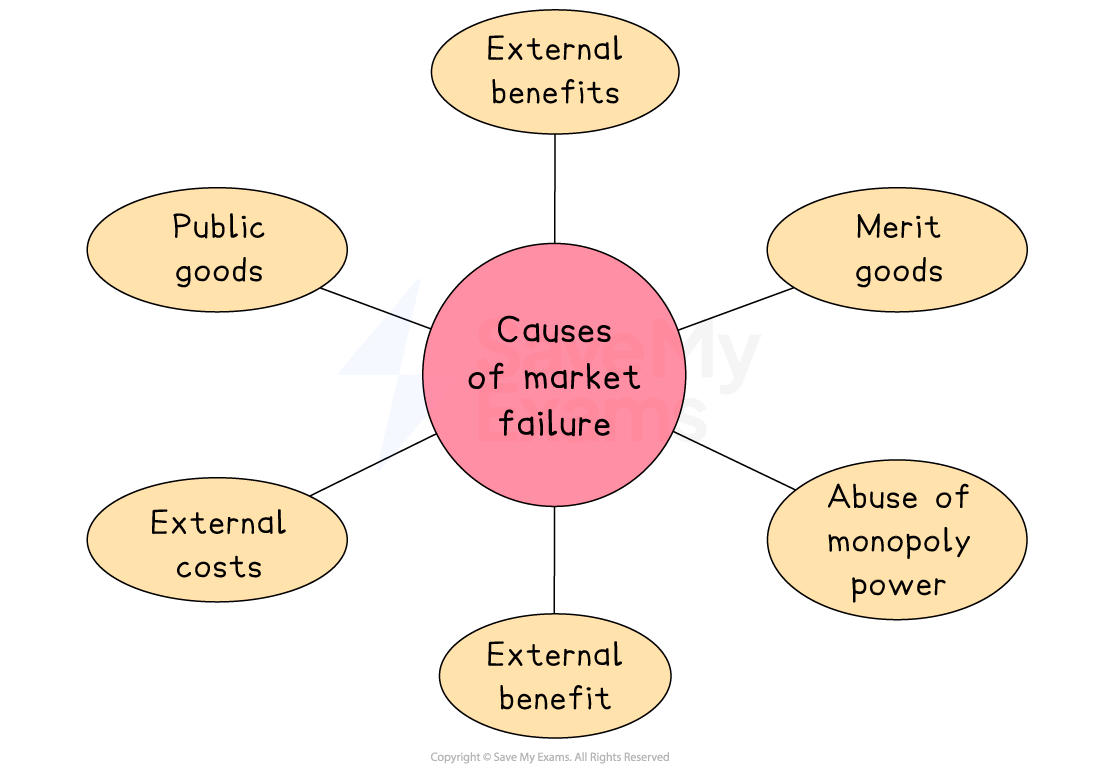
- Market Failure occurs when free market activity results in a less than optimum allocation of resources from the point of view of society
Causes of market failure
Demerit goods
-
These are goods that are over-consumed because individuals underestimate how harmful they are to themselves
-
The focus is on the individual’s misjudgement of private harm
-
These goods are often addictive
- For example, gambling, alcohol, drugs, sugary foods and drinks
-
| Consequences |
|---|
| - Overuse leads to increased pressure on public healthcare and social services - Rising social costs from crime, addiction, or long-term illness - Lost economic productivity due to poor health or absenteeism |
Merit goods
-
These are goods that are beneficial to society but consumers under-consume them as they do not fully recognise the private benefits
-
Consumers make poor decisions due to lack of information or short-term thinking
- For example. vaccinations, education, electric cars
-
| Consequences |
|---|
| - Lower public health or educational outcomes - Slower economic growth due to underinvestment in human capital - Widening inequality — especially for low-income households |
Public goods
-
Public goods are beneficial to society but would be underprovided by a free market
-
Public goods are goods that are:
- Non-excludable: you can't stop someone from using them
- Non-rivalrous: one person’s use doesn’t reduce availability for others
-
Due to the above two factors, there is little opportunity for sellers to make profits from providing these goods and services
- Examples include national defence, parks, libraries and lighthouses
| Consequences |
|---|
| - Little – or no – provision in a free market - Reduced safety, infrastructure, or national welfare - Public goods become dependent on taxation and government budgets |
Abuse of monopoly power
- The development of monopoly markets is a natural outcome of a market system
- Firms seek to eliminate competition by buying out competitors and increasing their ownership of factors of production
- With less competition, firms can raise prices, reduce the choice available to consumers, or limit the supply
| Consequences |
|---|
| - Consumers pay more and get less value for money - Some consumers are unable to benefit from the good or service - Fewer choices (less competition) and lower-quality goods or services - Resources are not used in the most efficient way for society |
External costs and benefits
-
Externalities occur when there is an external cost or external benefit on a third party not involved in the economic transaction
- The price mechanism in a free market ignores these externalities
-
If these external costs/benefits were acknowledged, then the price and output in the market would be different
| Consequences |
|---|
| - Overproduction of goods with external costs (e.g. factory waste) - Underproduction of goods with external benefits (e.g. vaccinations) - Misallocation of resources, reducing social welfare |
Summarising some key differences
Spec point — "implications of misallocation of resources in relation to: – the over-consumption of demerit goods and goods with external costs – the under-consumption of merit goods and goods with external benefits – the non-provision of public goods – restricted supply causing higher prices under a monopoly Note: demand and supply diagrams relating to market failure are not required. "
Summarising some key differences
The difference between merit goods and external benefits
- Many merit goods also create external benefits, so they are common causes of market failure. But they are not identical:
| Merit goods | External benefits (positive externalities) | |
|---|---|---|
| Definition | - Goods under-consumed because individuals undervalue their benefits | - Benefits that are received by third parties not involved in the transaction |
| Cause of market failure | - People make poor decisions due to lack of information or short-term thinking | - The full benefit of a good is not reflected in the market price |
| Key issue | - Under-consumption due to misjudged private benefit | - Under-production or under-consumption due to unpriced social benefit |
| May include | - Education, vaccinations, healthy food | - Public transport, planting trees, community art |
| Do they always overlap? | - Not always — not all merit goods have external benefits | - Not always — not all external benefits come from merit goods |
The difference between demerit goods and external costs
- Many demerit goods also create external costs, so they are common causes of market failure. But they are not identical:
| Demerit goods | External costs (negative externalities) | |
|---|---|---|
| Focus | - Private harm underestimated by consumer | - Harm to third parties (society) |
| Cause of market failure | - Poor decision-making by individuals | - Costs not reflected in the market price |
| May include | - Cigarettes, alcohol, sugary drinks | - Pollution from factories, traffic congestion, noise |
| Do they always overlap? | - Not always | - Not always |
Was this revision note helpful?
Build on this topic