Calculation & Determinants of PED (Cambridge International IGCSE Economics)
Introducing price elasticity of demand
Spec point —
2.6.1· Definition of PED; Calculation of PED
-
The law of demand states that when there is an increase in price, there will be a fall in quantity demanded
- Economists are interested by how much the quantity demanded will fall
-
Price elasticity of demand reveals how responsive the change in quantity demanded is to a change in price
- The responsiveness is different for different types of products
Calculation of PED
- PED can be calculated using the following formula:
- To calculate a % change, use the following formula:
Worked Example A firm raises the price of one of its products from £10 to £15. Its sales fall from 100 to 40 units per day. Calculate the PED of this product
Step 1: Calculate the % change in QD
**$% \Delta \text{QD} = \frac{40 - 100}{100} \times 100
% \Delta \text{QD} = - 60 %$** (1 mark)
Step 2: Calculate the % change in P
$% \Delta \mathrm{P} = \frac{15 - 10}{10} \mathrm{x} 100
% \Delta \mathrm{P} = 50 %$ (1 mark)
Step 3: Insert the above values in the PED formula
$\text{PED} = \frac{% \Delta \text{in} QD}{% \Delta \text{in} \mathrm{P} }
\text{PED} = \frac{- 60}{ 50}
\text{PED} = - 1.2 $ (2 marks)
The PED value will always be negative so economists will often ignore the sign and present the answer as 1.2
Drawing and interpreting PED values
Spec point — "Drawing and interpreting PED values: perfectly inelastic, inelastic, unitary, elastic, perfectly elastic; Drawing and interpreting demand curve diagrams to show different PED"
Drawing and interpreting PED values
- The results of the price elasticity of demand calculation tell us how responsive consumers are to a change in price
1. Price elastic demand
- The value of PED: 1 → ∞
- The percentage change in quantity demanded is more than proportional to the percentage change in price
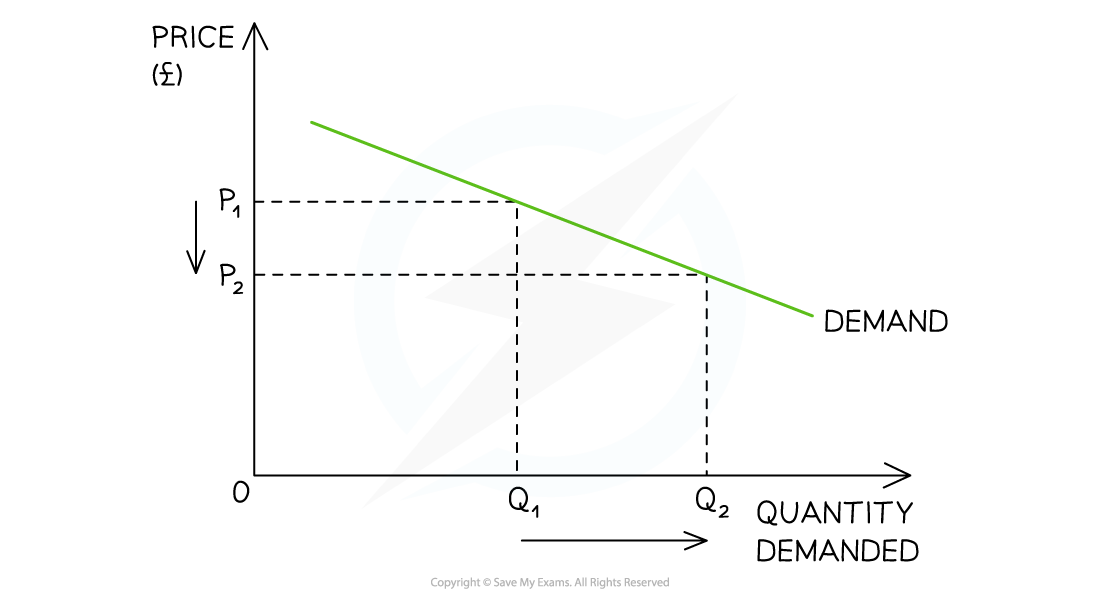
Consumers are very responsive to price changes
-
Consumers are very responsive to price changes
- For example, a small price cut on airline tickets in Malaysia can lead to a large rise in bookings
2. Price inelastic demand
- The value of PED: 0 → 1
- The percentage change in quantity demanded is less than proportional to the percentage change in price
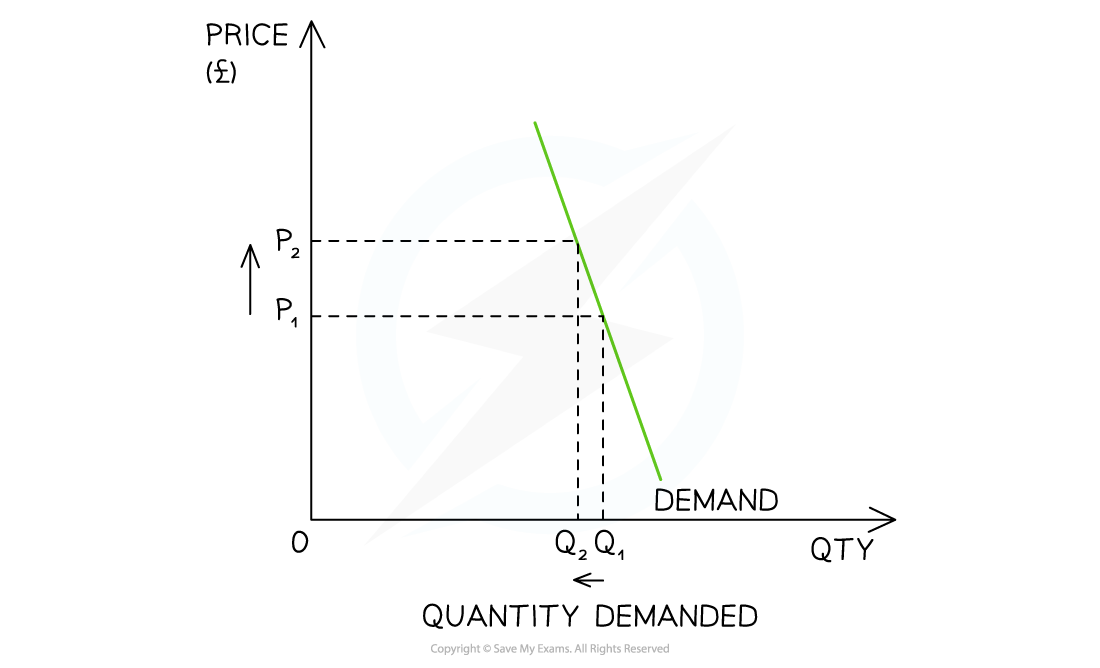
Price inelastic demand
-
Consumers are relatively unresponsive to price changes
- They may consider the product to be a necessity
-
For example, cigarette sales in Indonesia fall only slightly when prices rise – demand is inelastic
3. Perfectly elastic demand
- The value of PED: ∞
- The quantity demanded will fall to zero with any percentage change in price (highly theoretical elasticity)
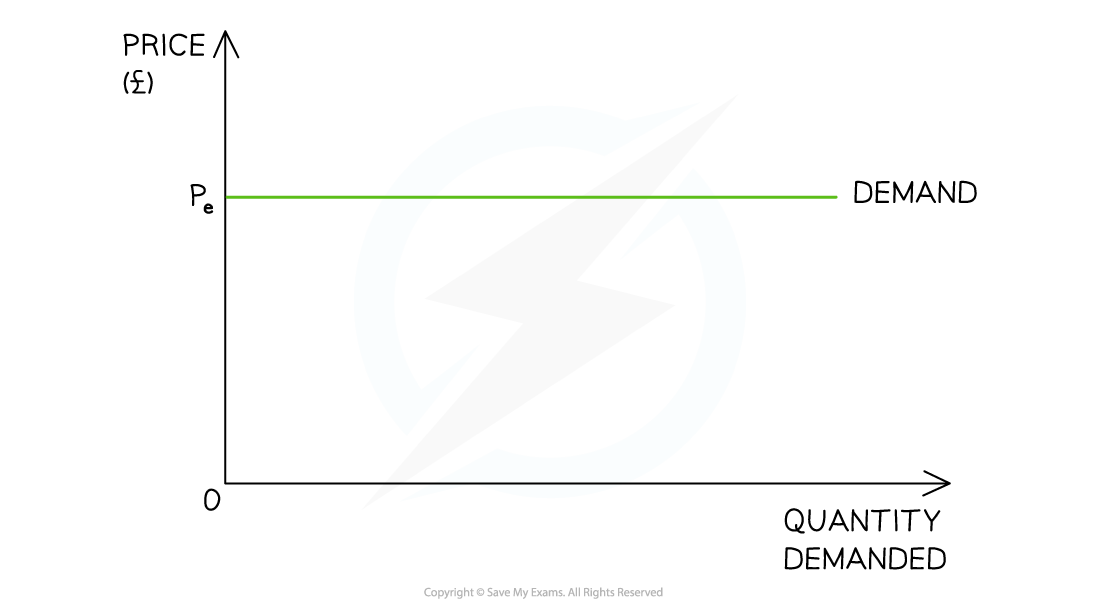
Perfectly elastic demand
- Buyers will only purchase at one price, and any change causes demand to drop to zero
- For example, on global stock markets, traders may only buy a share at a specific price, not higher
4. Perfectly inelastic demand
- The value of PED: 0
- The quantity demanded is completely unresponsive to a change in price (very theoretical value)
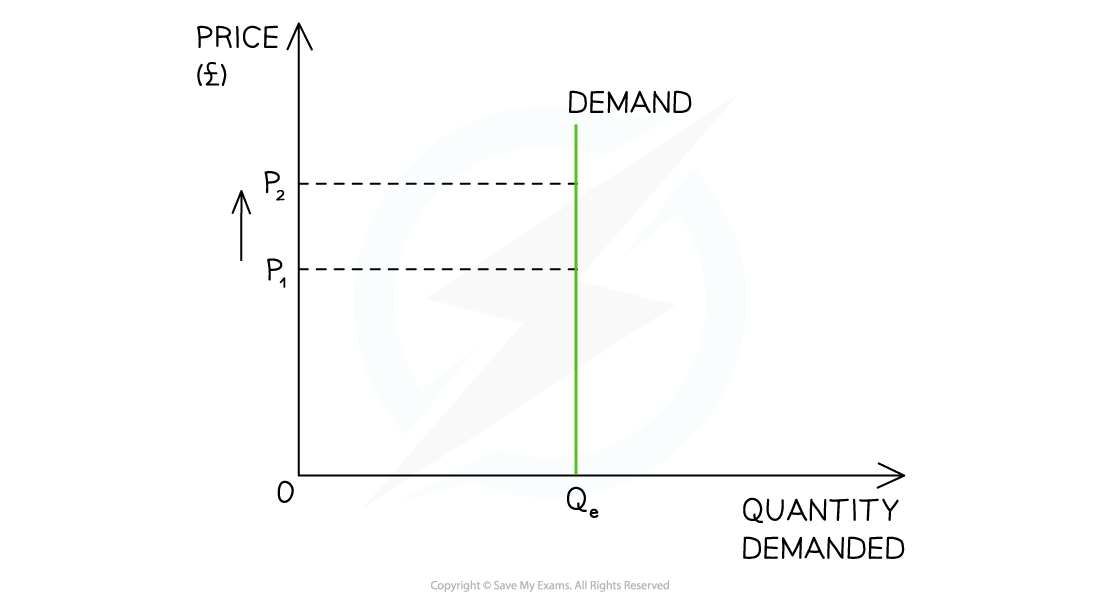
Consumers are entirely unresponsive to a change in price
- For example, a patient needing life-saving insulin in India will buy it regardless of price
5. Unitary elasticity
- The value of PED: 1
- The percentage change in quantity demanded is exactly equal to the percentage change in price
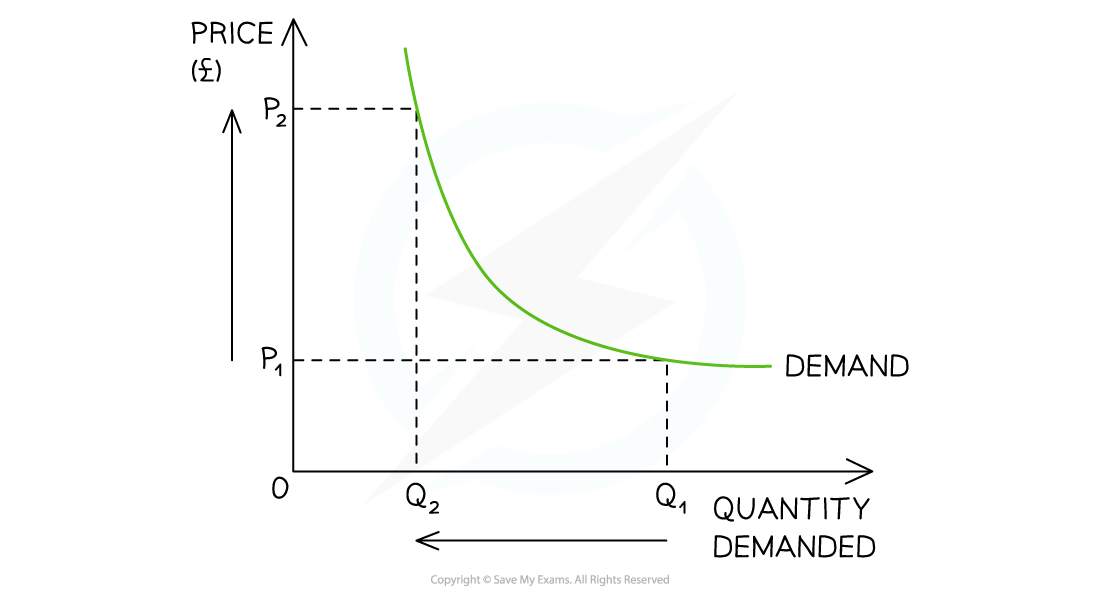
Consumer respond proportionally to any price changes
- A 5% rise in the price of a basic mobile plan in Egypt causes a 5% drop in subscriptions
The determinants of PED
Spec point —
2.6.3· main influences on whether demand is elastic or inelastic
- Some products are more responsive to changes in prices than other products
- The factors that determine responsiveness are called the determinants of PED and include
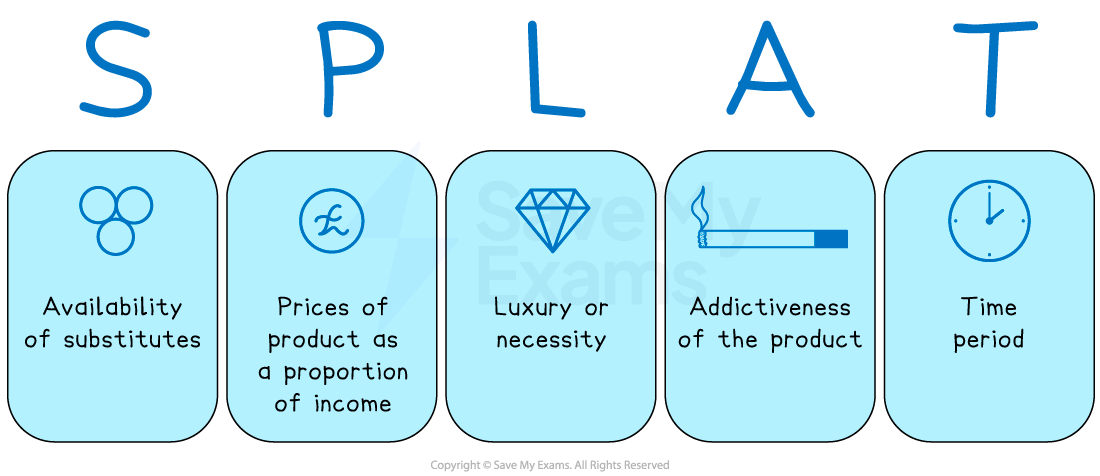
SPLAT - An acronym to help recall the determinants of PED
S – Availability of substitutes
- Good availability of substitutes results in a higher value of PED (relatively elastic)
P – Price of product as a proportion of income
- The lower the proportion of income the price represents, the lower the PED value will be
- Consumers are less responsive to price changes on cheap products (relatively inelastic)
L – Luxury or necessity
- Luxury goods are more elastic because they are not essential, while necessities are more inelastic because consumers have no choice but to buy them.
A - Addictiveness of the product
- Addictiveness turns products into necessities, resulting in a low value of PED (relatively inelastic)
T – Time period
- In the short term, consumers are less responsive to price increases, resulting in a low value of PED(relatively inelastic)
- Over a longer period of time, consumers may feel the price increase more and will then look for substitutes, resulting in a higher value of PED (relatively elastic)
Was this revision note helpful?