Macroeconomic Aims (Cambridge International IGCSE Economics)
An introduction to macroeconomic aims
Spec point — An introduction to macroeconomic aims
-
The macroeconomic aims of government are the main long-term objectives they strive to achieve to promote a healthy and sustainable economy
-
They include:
-
Economic growth
- Increasing the total output of goods and services over time
-
Full employment / low unemployment
- Ensuring that as many people as possible who are willing and able to work have jobs
-
Stable prices / low inflation
- Keeping the general level of prices steady to protect purchasing power
-
Balance of payments stability
- Maintaining a healthy trade and financial position with the rest of the world
-
Redistribution of income
- Reducing excessive inequalities in income and wealth
-
Environmental sustainability
- Supporting growth that preserves natural resources and protects the environment
-
Economic growth
Spec point — reasons behind the choice of aims and the criteria that governments may set for meeting each aim
-
Economic growth is a central macroeconomic aim of most governments
-
Many developed nations have an annual target growth rate of 2-3%
- This is considered to be sustainable growth
- Growth at this rate is less likely to cause excessive demand pull inflation
-
Politicians often use it as a metric of the effectiveness of their policies and leadership
-
Economic growth has positive impacts on confidence, consumption, investment, employment, incomes, living standards and government budgets
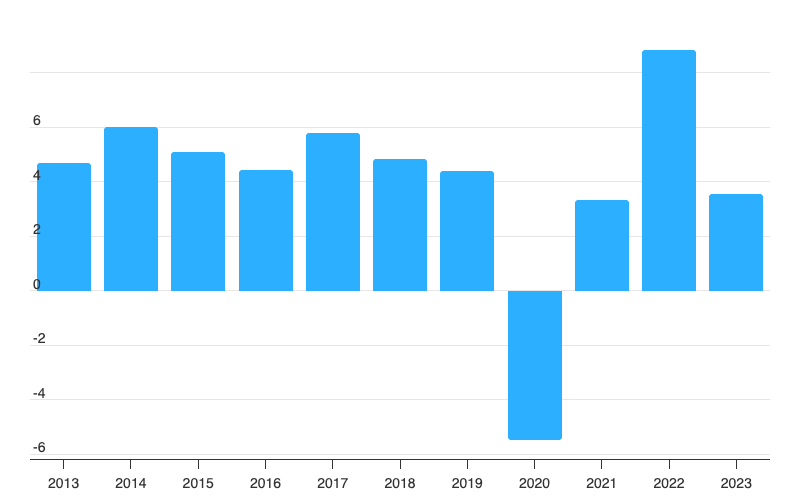
Malaysia's GDP growth rate 2013 - 2023
Source: Macrotrends
Explaining Malaysia's growth trends 2013 - 2023
| 2014 - 2016 | 2017 - 2019 | 2020 | 2022 |
|---|---|---|---|
| - Economic growth was increasing each year, but at a decreasing rate | - Growth increased significantly in 2017, but the following two years saw the rate of growth falling again | - As with all economies during the Covid-19 lockdowns, Malaysia experienced significant recession and a fall from +4.2% growth to - 5.8% growth | - As with most economies, Malaysia saw a significant rebound in economic growth (over 8%) during 2022 |
Low unemployment
Spec point — Low unemployment
-
Someone is considered to be unemployed if they do not have a job and are actively seeking one
-
The target unemployment rate often depends on the size of the economy
- E.g. India finds a rate of 6.5% good, whereas Singapore aims for it to be under 2%
-
The closer an economy is to the **full employment level **of labour, the better (more efficiently) it is using its human resources
-
Within the broader** unemployment rate**, there is an increased emphasis on the unemployment rate within different sections of the population
-
For example,youth unemployment, ethnic/racial unemployment by group
- In 2021, black unemployment in the USA was 8.7% and white unemployment was 4.7%
-
-
Unemployment tends to be inversely proportional to real GDP growth
- When real GDP increases, unemployment falls
- When real GDP decreases, unemployment rises
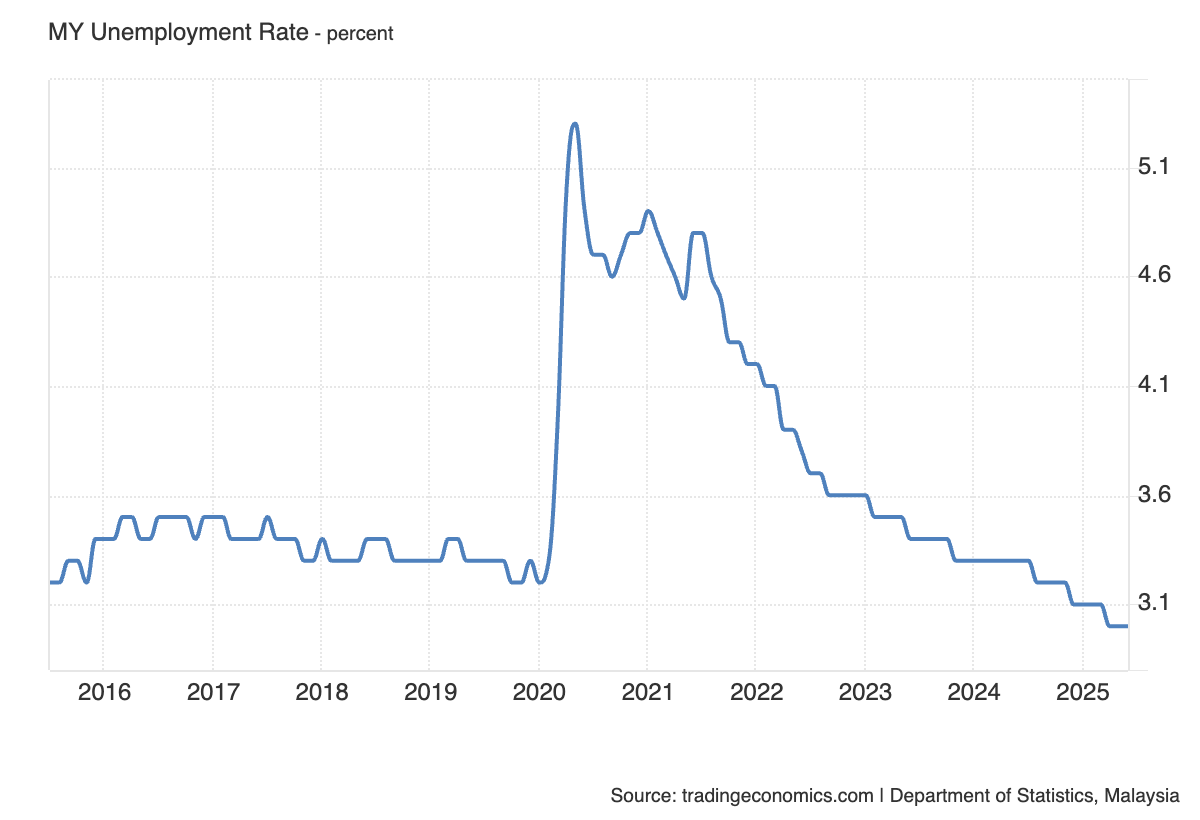
Malaysia's unemployment rate from 2015 - 2025
Source: Trading Economics
Chart analysis
-
2016–2019:
- The unemployment rate remained stable at around 3.3–3.5%, indicating a steady labour market
-
Early 2020:
- Slight dip before a sharp spike to over 5% — most likely due to the economic disruption caused by the Covid-19 pandemic and lockdown measures
-
2021–2022:
- Gradual but uneven decline in unemployment, with small fluctuations suggesting partial recovery and intermittent economic disruptions
-
2022–2025:
- Continuous and steady decline, reaching around 3.1% in 2025, indicating strong post-pandemic recovery and possible job creation from economic reopening
-
Overall trend:
- Long-term stability before pandemic → sharp short-term shock → gradual recovery → return to pre-pandemic unemployment levels
Low and stable rate of inflation
Spec point — Low and stable rate of inflation
-
Most economies have a target inflation rate of 2% using the Consumer Price Index (CPI)
-
A low rate of inflation is desirable, as it is a symptom of economic growth
-
The different causes of inflation (cost-push or demand-pull) require different policy responses from the government
- Demand-side policies ease demand-pull inflation
- Supply-side policies ease cost-push inflation
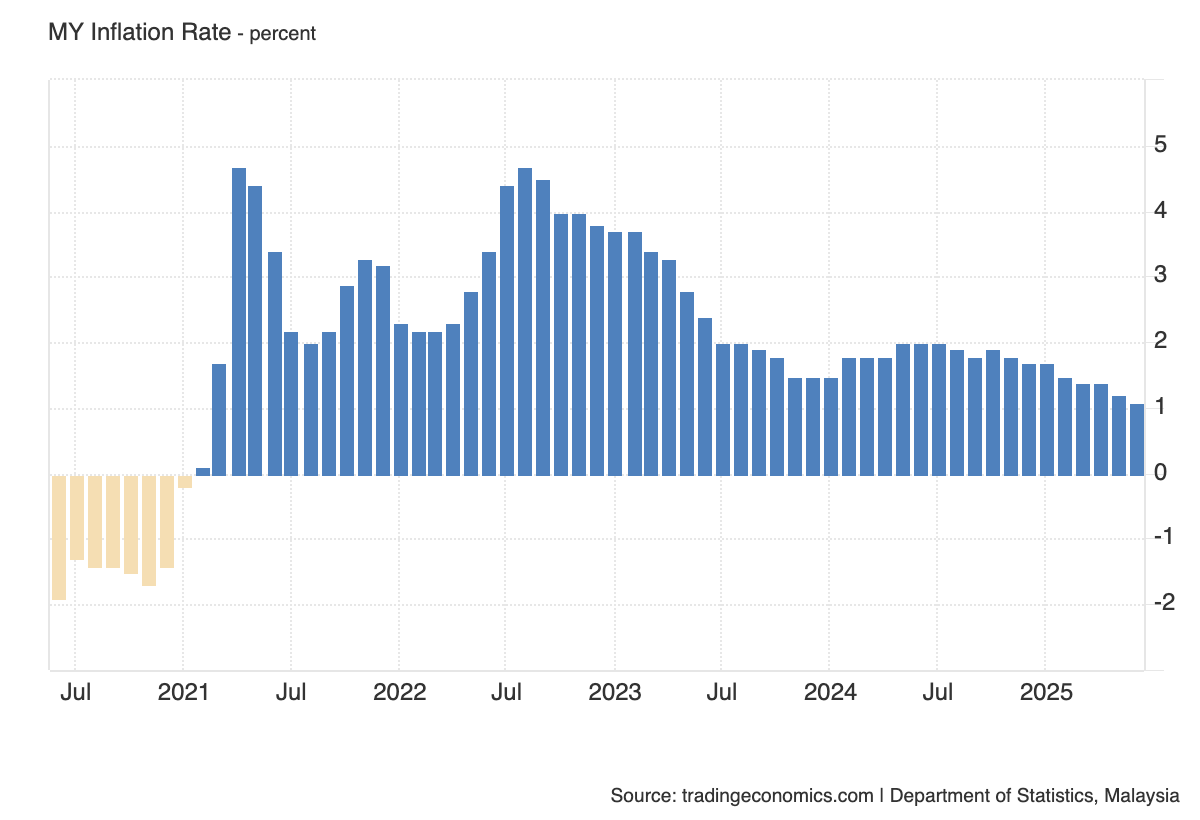
Malaysia's rate of inflation 2020 - 2025
Source: Trading Economics
-
Malaysia experienced a continual deviation from the target of 2% between July 2021 and July 2023
- An inflation rate in July 2022 of 4-5% was considered to be unstable, eroding household purchasing power
-
A low and stable rate of inflation is important, as it
- Allows firms to confidently plan for future investment
- Offers price stability to consumers
Balance of payments stability on the current account
Spec point — Balance of payments stability on the current account
-
The Balance of Payments (BoP) for a country is a record of all the financial transactions that occur between it and the rest of the world
- The current account focuses mainly on the financial transactions related to exports and imports of goods and services
-
Governments aim for Balance of Payments equilibrium on the Current Account
-
If exports > imports it will create a current account surplus
-
If imports > exports, it will create a current account deficit
- Each one of these conditions has advantages and disadvantages associated with it
- However, a current account deficit is more problematic in the long-run than a surplus
-
Malaysia's current account position 2016 to 2024
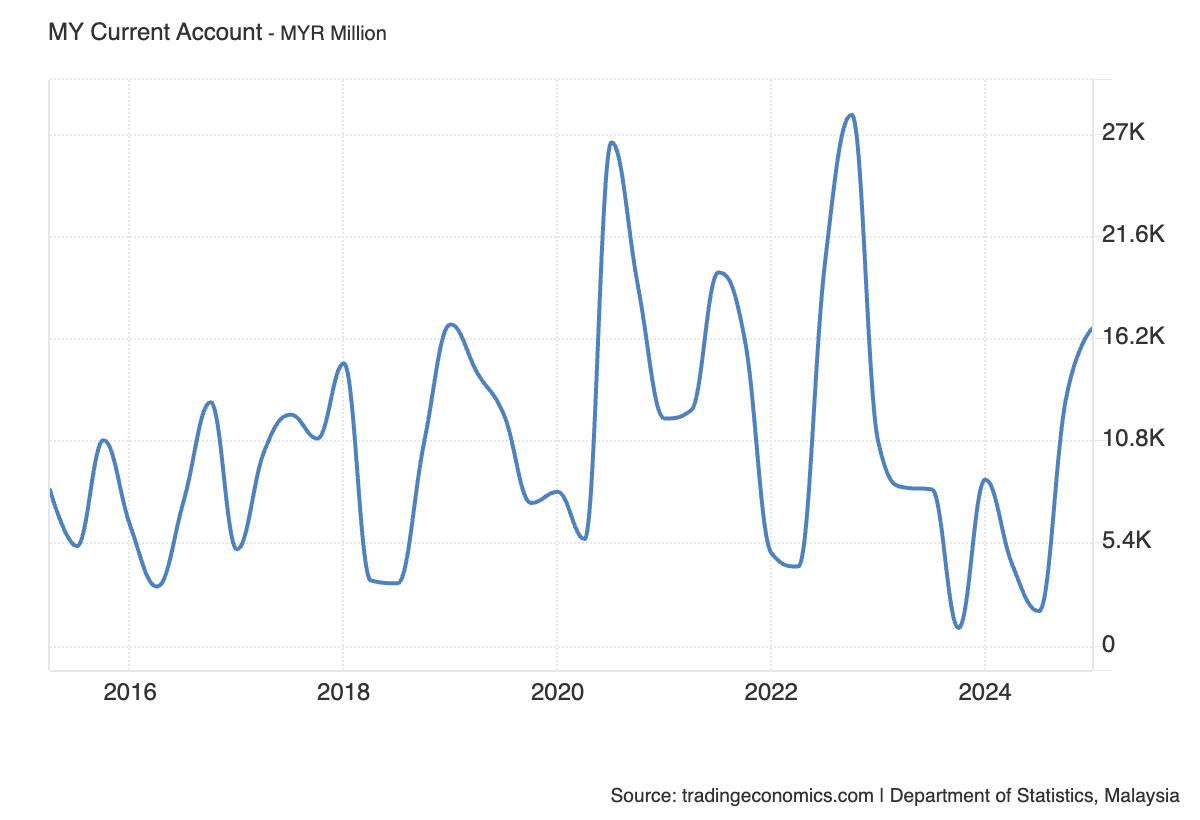
Malaysia has run a surplus on its current account between 2016 - 2024
Source: Trading Economics
Chart analysis
-
General trend:
- The current account balance has shown regular fluctuations, reflecting seasonal trade patterns and changes in global demand for Malaysia’s exports
- Overall, Malaysia has maintained a surplus for most of the period, meaning it exports more goods, services, and capital than it imports
-
2016–2019:
- Moderate surpluses with a repeating up-and-down cycle
-
2020:
- Strong increase in surplus early in the year, likely due to reduced imports during the COVID-19 pandemic and resilient export demand for certain products such as electronics and medical gloves
-
2021–2022:
- Sharp peaks, with one of the highest surpluses in the observed period, likely boosted by high commodity prices (e.g. palm oil) and strong electronics exports
- Followed by significant drops, indicating volatility from global market shifts and possible import rebounds
-
2023–2024:
- Marked decline in the surplus, with some quarters approaching very low or near-zero balances, possibly due to falling commodity prices, weaker export demand or higher imports as domestic demand recovered
-
Late 2024:
- Strong rebound in the current account surplus, signalling a recovery in export performance or a reduction in imports
The redistribution of income
Spec point — Redistribution of income
-
The redistribution of income aims to reduce income inequality in an economy
- High levels of income inequality can create social unrest which may ultimately lead to revolutions
- Perfect income equality is not desirable, as it removes the incentive to work and study
-
Governments aim to redistribute income by taxing the wealthy and providing welfare payments to the poor
-
Unchecked capitalism has a natural outcome of high income inequality
- The wealthy are able to keep buying factors of production
- The concentration of ownership becomes more and more narrow, with fewer individuals owning the bulk of the world's wealth
-
There is a need for governments to intervene to maintain acceptable levels of income inequality
-
Absolute poverty is usually worse in developing countries. However, in a developed economy such as Germany, a 1% increase in income inequality can push a lot more households into relative poverty
Environmental sustainability
Spec point — Environmental sustainability
-
Environmental sustainability aims to ensure that economic growth and development do not deplete natural resources or cause long-term damage to the environment
- Perfect environmental preservation is not possible, as some resource use is inevitable in any economy, but the aim is to keep resource consumption within levels that the planet can naturally replenish
-
Unchecked industrial activity can lead to pollution, resource depletion and climate change, all of which can harm future generations
- Environmental degradation often disproportionately affects poorer countries, which may lack the infrastructure or governance to mitigate the effects of, for example, rising sea levels or extreme weather events
-
Governments aim to protect the environment through legislation, regulation and incentives
- For example, setting emissions limits, taxing pollution or subsidising renewable energy
-
Unchecked capitalism has a natural outcome of overusing common resources as firms and individuals pursue short-term profit without considering long-term environmental costs
-
There is a clear need for governments to intervene to protect biodiversity, reduce greenhouse gas emissions and promote sustainable consumption and production patterns
Was this revision note helpful?