Production & Productivity (Cambridge International IGCSE Economics)
The difference between production and productivity
Spec point — The difference between production and productivity
-
The terms 'production' and 'productivity' are fundamentally different
-
Production is the act of adding value to the factors of production to create goods and services, e.g., using tomatoes and basil to create a soup
- It is the process of factor conversion into goods/services
- It is a measure of output, e.g., 3 cans of soup
-
Productivity is a measure of efficiency that calculates the amount of outputs produced per unit of input
- It calculates how efficiently resources are being used in the creation of goods/services and provides a metric for comparison, e.g., after training, workers proved to be 27% more efficient in their productivity
- It is a measure of efficiency, e.g. 3 cans produced per worker
Influences on production and productivity
Spec point — Influences on production and productivity
Influences on production
-
Production is often influenced by the state of the economy
- During a recession production falls
- During a boom period, production increases
-
As production is dependent on the demand for goods/services, any change to any of the conditions of demand will result in changes to production
-
As production is also dependent on the supply of the factors of production, any change to any of the conditions of supply will result in changes to production
Influences on productivity
- Higher productivity is important for firms and economy for the following reasons:
- It lowers costs and improves a firm's national and international ability to compete
- It allows firms to produce more output with the same input, which puts it in a position to generate increased economies of scale
- Firms can generate higher profits
- Higher profits may mean that the firms can pay their workers more
- Higher profits may mean that the government revenue from corporation tax will increase
- An improved ability to compete in international markets will help to generate economic growth
The Influences on productivity growth
| Influence | Explanation |
|---|---|
| Innovation | - Process innovation boosts efficiency (e.g. Ford’s moving production line) - Product innovation creates faster, smarter products (e.g., driverless taxis cut costs) |
| Investment | - Spending on capital (e.g., machines) makes workers faster and more efficient - Outdated capital slows workers down - Low interest rates encourage firms to invest |
| Training | - Skilled workers work faster and better and make fewer mistakes - Training boosts efficiency, whether on-the-job or formal |
| Competition | - Rivalry forces firms to improve productivity to stay ahead - Monopolies may get lazy and inefficient due to lack of pressure |
| Entrepreneurial freedom | - When it's easy to start and grow businesses, competition rises - More firms = more pressure to innovate and improve productivity |
Effects of changes in investment on productivity
1. Increased investment → higher productivity
-
When firms or governments invest more, particularly in capital goods, productivity tends to rise. Here’s how:
-
Better machinery and technology
- Investment in modern equipment and automation allows firms to produce more output with the same amount of labour
-
Improved infrastructure
- Government investment in transport, power or digital infrastructure can reduce delays, improve connectivity and raise the productivity of entire industries
-
Training and human capital
- Investment in training programmes and education raises worker skill levels, enabling them to perform tasks more efficiently
-
2. Falling investment → slower productivity growth or decline
-
When investment falls, especially over a prolonged period, it can have negative effects:
-
Aging capital stock
- Outdated or worn-out machinery leads to lower efficiency, more breakdowns, and higher repair costs
-
Skills gap
- Without training investment, workers may lack the skills needed for new technologies or methods
- Firms that cut investment in R&D risk falling behind rivals in productivity and product quality
-
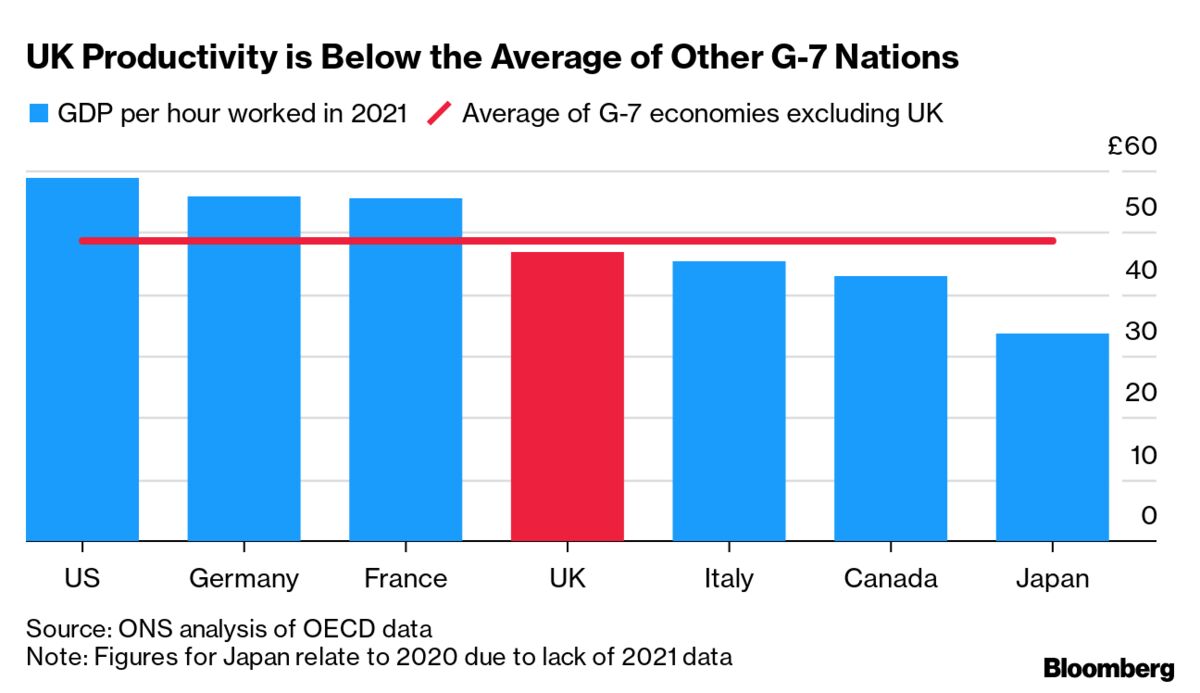
Case Study UK’s Productivity Slowdown Driven by Weak Investment
Background
- Chronic under-investment in both capital equipment and workforce skills has significantly contributed to the UK’s slow productivity growth, especially compared to peers like France, Germany, and the U.S
Source: Bloomberg
Key Impacts
- The **15-year stagnation *in labour productivity is largely attributed to firms limiting investment in machinery, technology, and staff development
- As a result, workers have less access to modern tools and training, which hinders efficiency and productivity improvements
Additional factors
- The UK’s low** capital investment , both public and private, has kept the country consistently in the bottom 25% of OECD nations *for investment share, undermining long-term economic performance
- Brexit-related uncertainty also discouraged business dynamism and investment levels, which further delayed productivity gains
Was this revision note helpful?
Build on this topic