Costs & Revenue (Cambridge International IGCSE Economics)
Different Types of Costs
Spec point —
3.7.1· Total cost (TC), average total cost (ATC), fixed cost (FC), variable cost (VC), average fixed cost (AFC), average variable cost (AVC). Note: marginal cost is not required. Definition, drawing and interpretation of diagrams that show how changes in output affect costs of production.
- In preparing goods/services for sale, firms incur a range of costs. These costs can be be broken into different categories
- Fixed costs (FC) are costs that do not change as the level of output changes
-
These have to be paid whether output is zero or 5000
- E.g. Building rent, management salaries, insurance, bank loan repayments etc.
- Variable costs (VC) are costs that vary directly with output
-
These increase as output increases and vice versa
- E.g. raw material costs, wages of workers directly involved in production
- Total costs (TC) are the sum of the fixed + total variable costs
Cost Calculations
Spec point —
3.7.1· Calculation of TC, ATC, FC, VC, AFC and AVC.
- Based on the above definitions, we can calculate several different types of costs
Cost Calculations Using the Above Formulas Where VC Is $60
| Output (Q) | TFC | TVC =\ 60 \mathrm{x} \mathrm{Q}$ | TC = | AFC = | AVC = | AC = |
|---|---|---|---|---|---|---|
| 0 | 200 | - | 200 | - | - | - |
| 1 | 200 | 60 | 260 | 200 | 60 | 260 |
| 2 | 200 | 120 | 320 | 100 | 60 | 160 |
| 3 | 200 | 180 | 380 | 66.67 | 60 | 126.67 |
| 4 | 200 | 240 | 440 | 50 | 60 | 110 |
| 5 | 200 | 300 | 500 | 40 | 60 | 100 |
| 6 | 200 | 360 | 560 | 33.34 | 60 | 93.33 |
| 7 | 200 | 420 | 620 | 28.58 | 60 | 88.57 |
| 8 | 200 | 480 | 680 | 25 | 60 | 85 |
Diagrammatic Representation of Costs
Spec point —
3.7.1· Diagrammatic Representation Of Costs
Sketches Which Represent the Different Costs of a Firm
| Type of Cost | Diagram | Explanation |
|---|---|---|
| Fixed Cost (FC) | 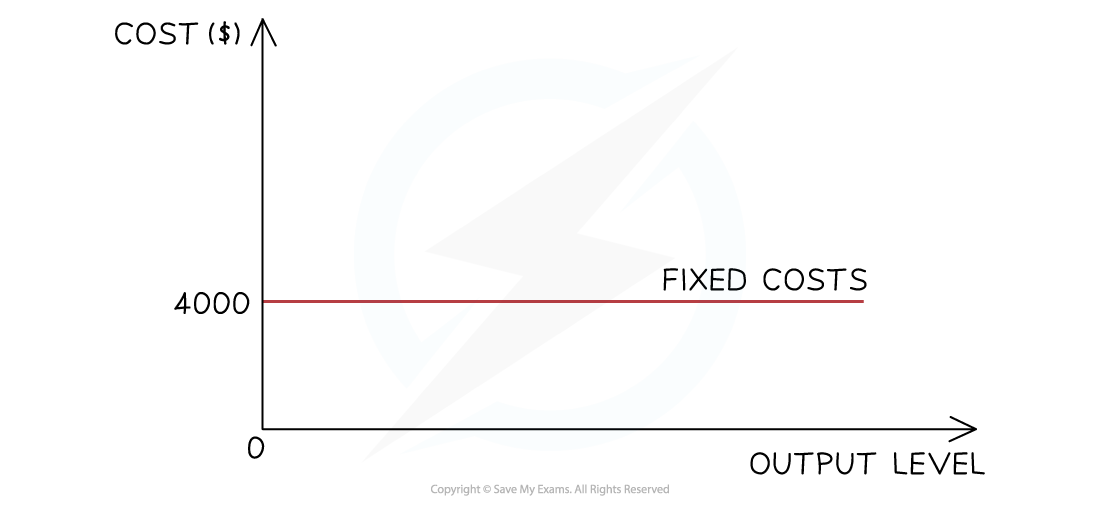 | - The firm has to pay its fixed costs which do not change, irrespective if the output is 0 or 100,000 units - The fixed costs for this firm are $4,000 |
| Variable Cost (VC) | 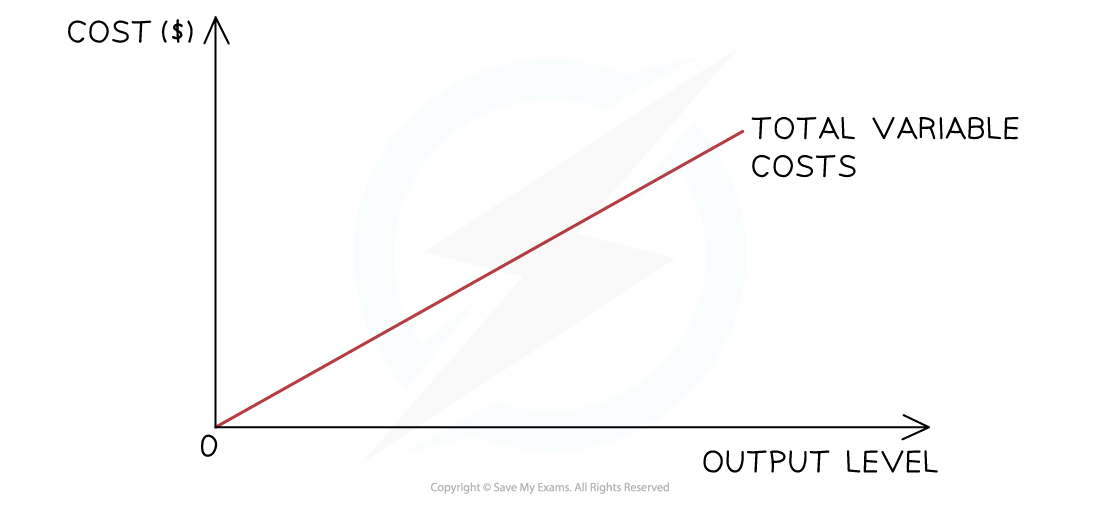 | - The variable costs initially rise proportionally with output, as shown in the diagram - At some point the firm will benefit from a purchasing economy of scale and the rise will no longer be proportional |
| Total Cost (TC) | 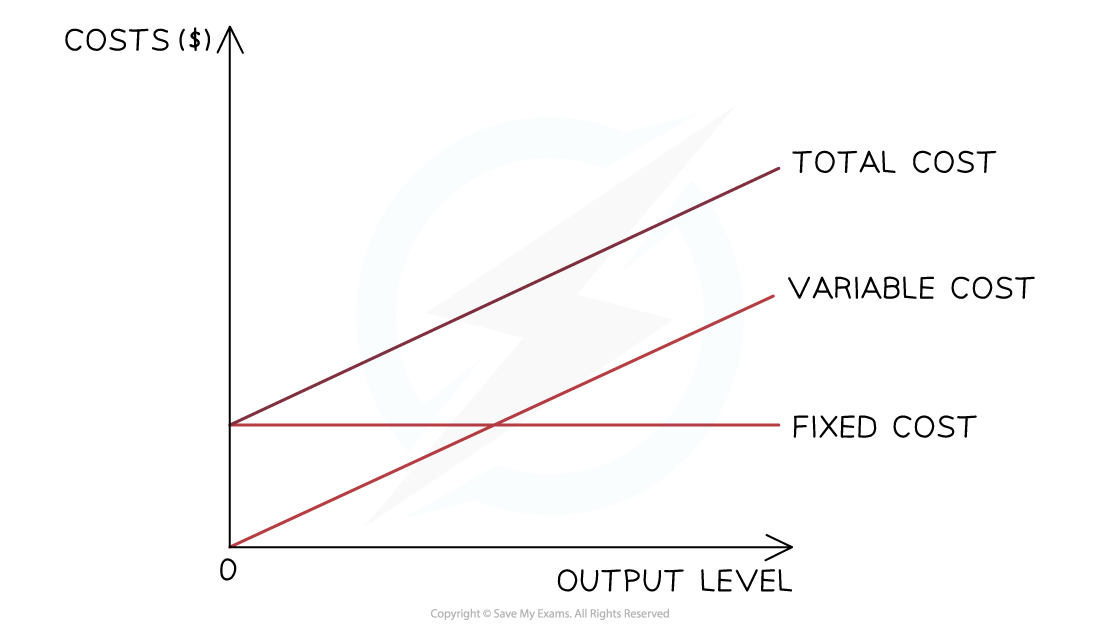 | - The total cost is the sum of the variable and fixed costs - The total costs cannot be 0 as all firms have some level of fixed costs |
| Average Fixed Cost (AFC) | 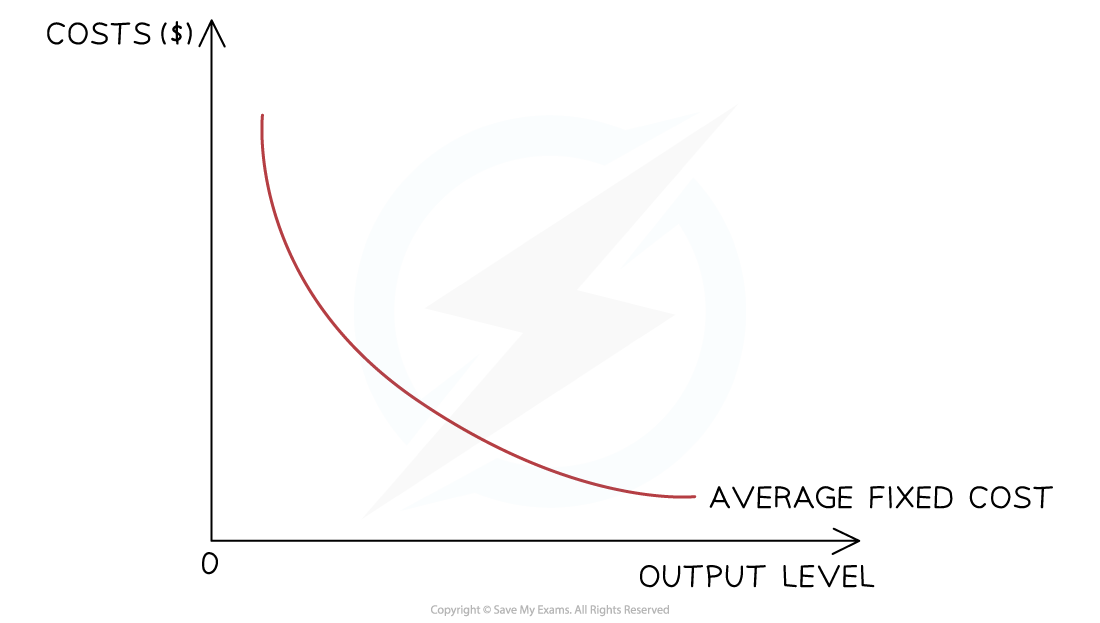 | - If the fixed costs of a firm are $1,000 and it produces 1 unit of output, then its AFC is $1,000 ($1,000/1) - If the firm increases its output to 1000 units, then the **AFC is $1 per unit **($1000/1,000) - The more units a firm produces, the lower its AFC will be - This is one reasons why large levels of output help to increase the profit per unit |
| Average Total Cost (AC) | 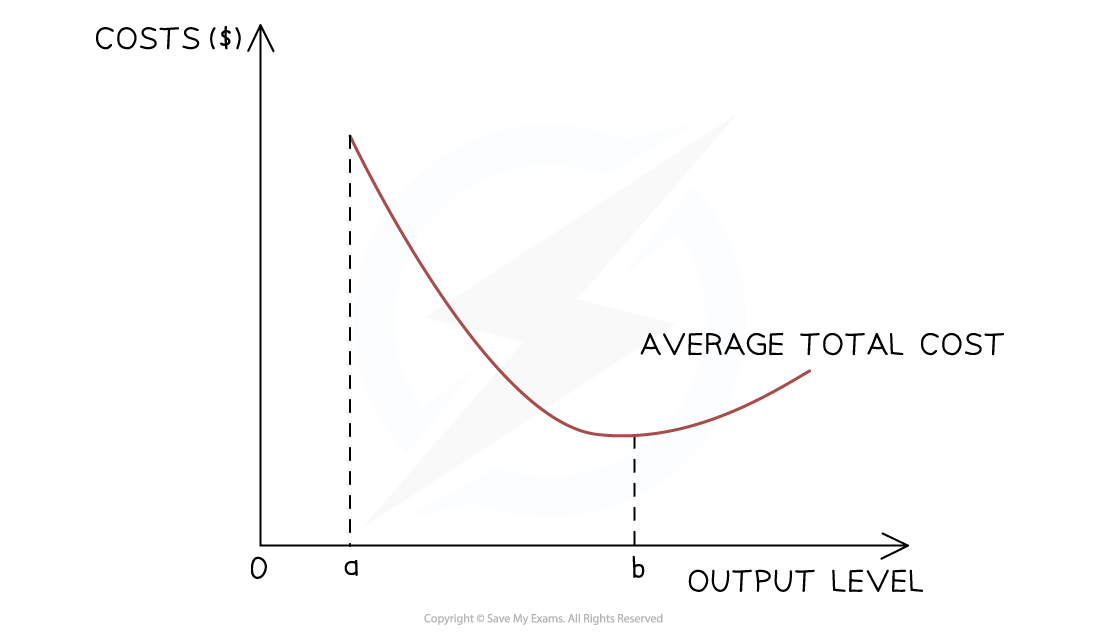 | - As a firm grows, it is able to increases its scale of output generating efficiencies that lower its average total costs (AC) of production - These efficiencies are called economies of scale - As a firm continues increasing its scale of output, it will reach a point where its average total costs (AC) will start to increase - The reasons for the increase in the average costs are called diseconomies of scale |
Exam Hint MCQ frequently tests your knowledge of these curves by presenting you with 4 unlabelled diagrams and, for example, asking you to identify which sketch demonstrates the average fixed costs of the firm.
Different Types of Revenue
Spec point —
3.7.1· Total revenue (TR) and average revenue (AR). Note: marginal revenue is not required. Calculation of TR and AR. The influence of sales on revenue.
- Total revenue is the total value of all sales a firm incurs
- Average revenue is the overall revenue per unit
An Example of Revenue Calculations
| P ($) | Q | **TR ** | **AR ** |
|---|---|---|---|
| 8 | 1 | 8 | 8 |
| 7 | 2 | 14 | 7 |
| 6 | 3 | 18 | 6 |
| 5 | 4 | 20 | 5 |
| 4 | 5 | 20 | 4 |
| 3 | 6 | 18 | 3 |
| 2 | 7 | 14 | 2 |
| 1 | 8 | 8 | 1 |
- Average revenue information is especially useful to a firm selling multiple products (e.g. supermarkets) or a firm that sells the same item at different prices (e.g. rail tickets are usually priced differently for different types of commuters e.g. pensioners)
Was this revision note helpful?