Wage Determination (Cambridge International IGCSE Economics)
Factors that Influence the Demand for Labour
Spec point —
3.3.2· The influences of demand and supply, relative bargaining power and government policy, including minimum wage. Definition, drawing and interpretation of diagrams that illustrate the effects of changes in demand and supply in the labour market.
-
The labour market is composed of sellers of labour (households) and buyers of labour (firms)
- Workers supply their labour and firms demand labour
-
The demand for labour is a derived demand
-
This means that it depends on the demand for goods/services
- If demand for goods/services increases then the demand for labour will increase - and vice versa
-
Factors That Influence the Demand for Labour
| The price of the product being produced | The demand for the final product |
|---|---|
| - If the selling price of the product increases, then the firm will be incentivised to supply more and the firm's demand for labour will increase | - As demand for labour is a derived demand, when an economy is booming then demand for most goods/services will be high - and the demand for labour will be high - Conversely, when an economy is in a recession demand for most goods/services will be lower - and the demand for labour will be lower |
| The ability to substitute capital (machinery) for labour | The productivity of labour |
| - Firms will constantly evaluate if it will be possible and more cost effective to switch production from using labour to capital (machinery) - If it is more cost effective, then demand for labour will fall | - If the productivity of labour increases (possibly through training) this will lower average costs and firms will likely demand more labour |
Factors Influencing the Supply of Labour
Spec point —
3.3.2· The influences of demand and supply, relative bargaining power and government policy, including minimum wage. Definition, drawing and interpretation of diagrams that illustrate the effects of changes in demand and supply in the labour market.
- There are numerous factors that influence the amount of labour supplied to a particular industry
Factors Influencing the Supply of Labour
| Training period | Wages in other occupations | Changes in migration policy |
|---|---|---|
| - Long training periods (and their cost) act as a barrier to entry and exclude many households from offering labour in certain markets | - Comparative wage rates in substitute labour markets strongly influence the supply of labour e.g. it is getting harder to recruit economics teachers as the private sector offers higher wages for their skills | - Policies that increase the net migration rate increase the supply of labour to certain industries e.g. in 2022, 36% of Singapore's labour force were migrants |
| Income tax levels | Working conditions | Trade union power |
| - At a certain level, income taxes become a disincentive to households offering their labour. - The assumption is that as income tax increases, labour supply decreases - and vice versa | - The working conditions and non-wage benefits can act as strong incentive in certain industries e.g. tech companies are well known for their laid-back work environment and wide range of benefits e.g. on-site childcare and restaurants | - Trade unions can increase the supply of labour to certain industries as workers consider the benefits of belonging to the union e.g. higher wages and a safer working environment |
| Level of welfare benefits | Social trends | |
| - The higher the level of welfare benefits, the lower the incentive for low-skilled labour to offer their labour - and vice versa | - Social trends include any major changes within society and can influence the supply of labour to certain industries e.g. work from home during Covid resulted in significant changes to the labour market and not all workers returned to work when economies opened up again |
Diagrammatic Analysis of the Labour Market
Spec point —
3.3.2· The influences of demand and supply, relative bargaining power and government policy, including minimum wage. Definition, drawing and interpretation of diagrams that illustrate the effects of changes in demand and supply in the labour market.
-
The labour market is a type of factor market
-
Factor markets follow exactly the same rules as product markets
- They are affected by changes to price, demand and supply
- They are affected by the **price elasticity of demand and supply. **
-
Labour market equilibrium occurs where the demand for labour (DL) is equal to the supply of labour (SL)
- The DL is the demand by firms for workers - firms demand more labour as the wage rate decreases which results in a downward sloping demand curve
- The SL is the supply of labour by workers - workers supply more labour as the wage rate increases which results in an upward sloping supply curve
-
Individual firms are price takers in the labour market as they have to accept the wage rate that workers are being paid in the industry
- If they offer a lower wage, they will likely struggle to recruit workers
- If they offer a higher wage there will be a large number of workers applying to work there
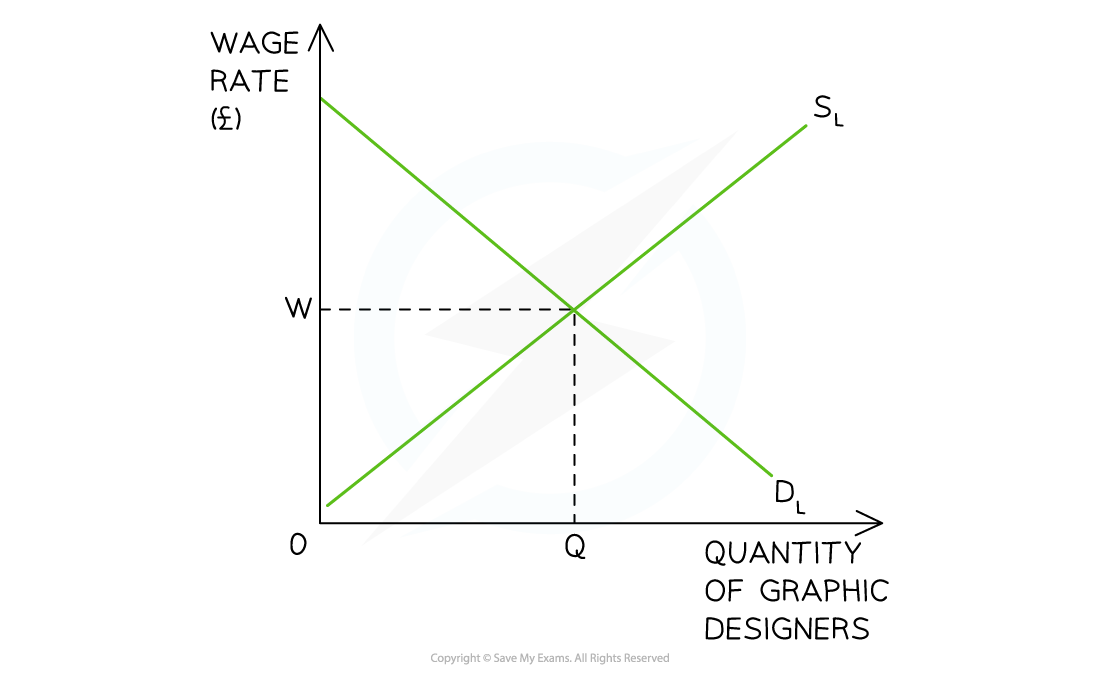
In the labour market for graphic designers, the equilibrium wage rate is W and the equilibrium quantity is Q. At this point the DL = SL
Diagram analysis
- The market for graphic designers is in equilibrium where DL= SL
- The equilibrium wage is W and the quantity of labour is Q
- There is no excess supply of labour
- There is no excess demand for labour
Analysing the PED and PES of Labour
Spec point —
3.3.2· The influences of demand and supply, relative bargaining power and government policy, including minimum wage.
Price inelastic demand and supply
- Consider the labour market for NBA basketball players
- In 2022, LeBron James received a salary of $45m
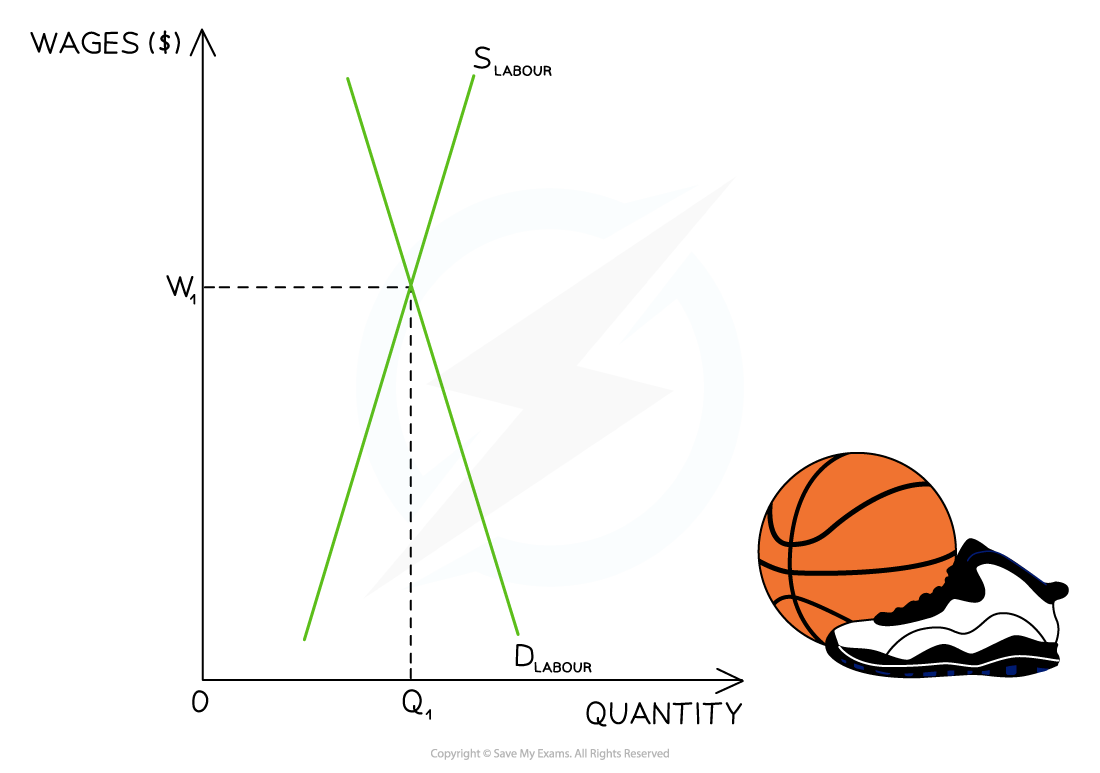
The impact of inelastic demand and supply in the labour market
Diagram analysis
-
DL is the demand for labour from the basketball clubs
-
SL is the supply of labour by the basketball players
-
The demand for highly skilled players is very price inelastic
- Clubs want the very best players, almost irrespective of what they cost
-
The supply of highly skilled players is also very price inelastic
- A significant increase in price will have little impact on the quantity of labour supplied in the market as it takes years to develop LeBron James type skills
-
The market equilibrium is found at W1Q1 - a high price and relatively low quantity
Price elastic demand and supply
- Consider the labour market for labourers on a building site
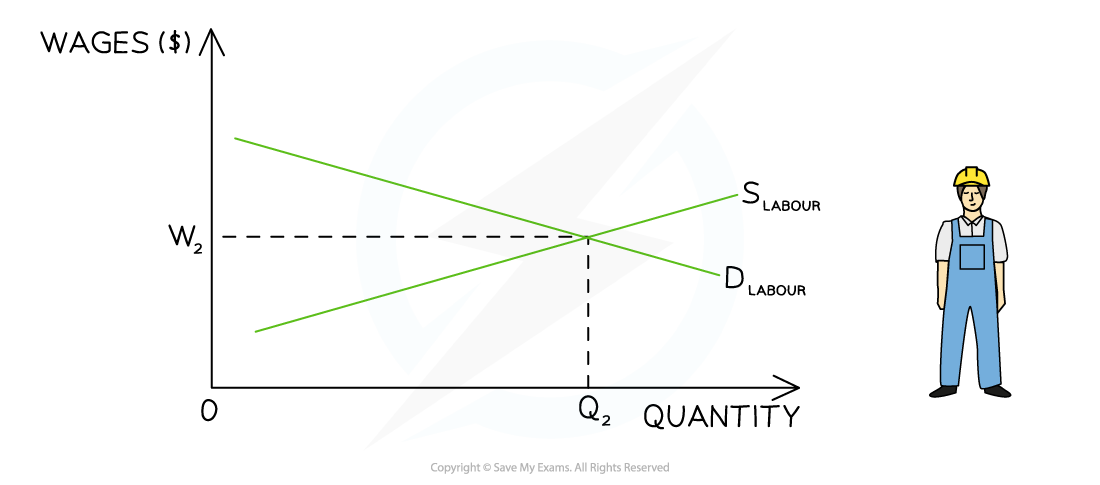
Diagram analysis
-
DL is the demand for labour from the building company for labourers
-
SL is the supply of labour by people willing to work on a building site
-
The demand for workers is very price elastic
- If wages dropped a little, then firms would respond quickly by employing more workers
-
The supply of workers is also very price elastic
- Due to it being an unskilled job, there would quickly be an increase in the supply of labour if wages were to increase
-
The market equilibrium is found at W1Q1 - a low price and relatively high quantity
Relative Bargaining Power
Spec point —
3.3.2· The influences of demand and supply, relative bargaining power and government policy, including minimum wage.
- Workers have different degrees of bargaining power when it comes to negotiating wage increases with their employers
- The following factors influence their bargaining power
- Membership of a trade union: trade unions represent the interests of the workers in negotiations with employers and members frequently enjoy higher wages than non-union members
- Age and experience: young, inexperienced workers have less bargaining power then older, more experienced workers. As workers grow older their age often begins to count against them and this reduces bargaining power
- Level of education: education provides higher levels of skill and specialisation to a worker. This increases their bargaining power relative to unskilled workers
- Current supply conditions: the supply of labour in many industries can change due to socio-political conditions e.g prior to Brexit, workers in the hotel industry had very little bargaining power. Brexit created a shortage of labour willing to work in hotels and so the bargaining power of workers has increased, resulting in higher wages in the industry
Government Policy: Minimum Wages
Spec point —
3.3.2· The influences of demand and supply, relative bargaining power and government policy, including minimum wage.
-
Government's often intervene in the labour market by setting a minimum wage
- They do this in order to improve equity and avoid the exploitation of worker
-
A minimum wage is a legally imposed wage level that employers must pay their workers
- It is set above the market rate
- The minimum wage/hour often varies based on age
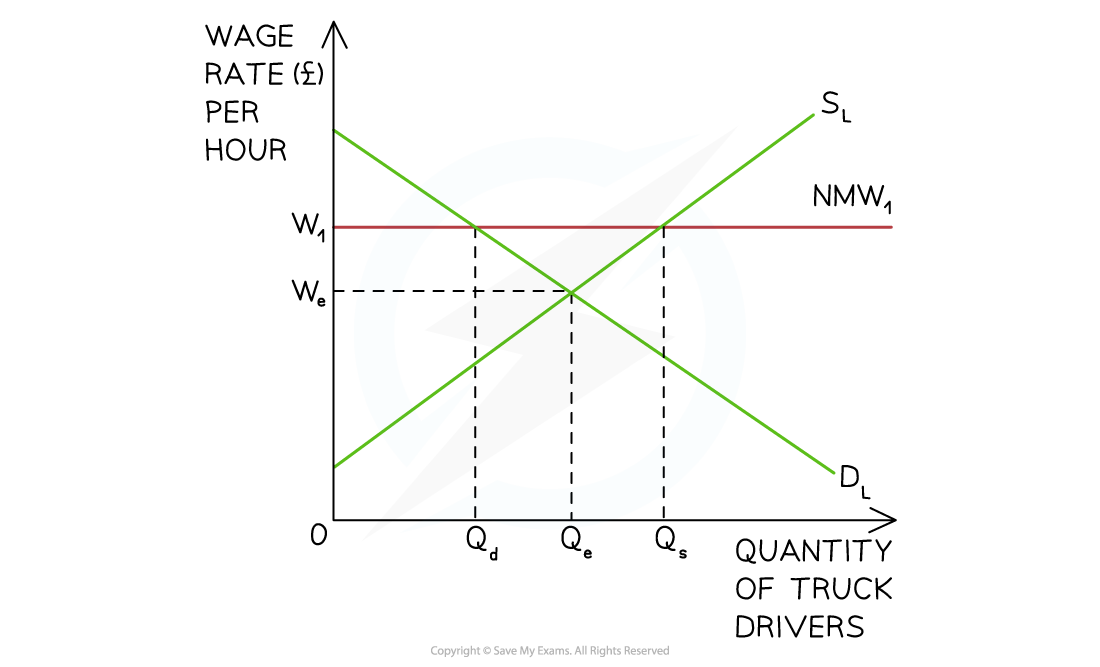
A national minimum wage (NMW1) is imposed above the market wage rate (We) at W1
Diagram analysis
- The market equilibrium wage and quantity for truck drivers in the UK is seen at WeQe
- The government imposes a national minimum wage (NMW) at W1
- Incentivised by higher wages, the supply of labour increases from Qe to Qs
- Facing higher production costs, the demand for labour by firms **decreases **from Qe to Qd
- This means that at a wage rate of W1 there is** excess supply of labour** and the potential for unemployment equal to QdQs
Exam Hint When evaluating national minimum wages, do not assume that they will automatically increase unemployment.
Many studies have shown that unemployment does not increase - and in some instances employment increases. This is likely due to the fact that workers are receiving higher wages and choose to consume more. This increases total demand in the economy which in turn increases the demand for labour by firms - thus reducing/eliminating any potential unemployment.
Was this revision note helpful?
Build on this topic