Taxation (Cambridge International IGCSE Economics)
The Classification of Taxes
Spec point — Examples of the different classifications of tax; progressive, regressive, proportional; and direct, indirect.
-
The main source of government revenue is taxation
-
Direct taxes are taxes imposed on income and profits
-
They are paid directly to the government by the individual or firm
- E.g. Income tax, corporation tax, capital gains tax, national insurance contributions, inheritance tax
-
-
Indirect taxes are imposed on spending
- The less a consumer spends the less indirect tax they pay
- Examples of indirect tax include Value Added Tax(19% VAT rate in the European Union in 2022), taxes on demerit goods, excise duties on fuel etc.
Progressive, regressive and proportional tax systems
- Tax systems can be classified as progressive, regressive or proportional
- Most countries have a mix of progressive (direct taxation) and regressive (indirect taxation) taxes in place
An Explanation of Tax Systems
| System | Explanation | Diagram |
|---|---|---|
| Progressive | - As income rises, a larger percentage of income is paid in tax - In the diagram, when personal income rises from Y1 to Y2, the tax rate rises from TR1 to TR2 | 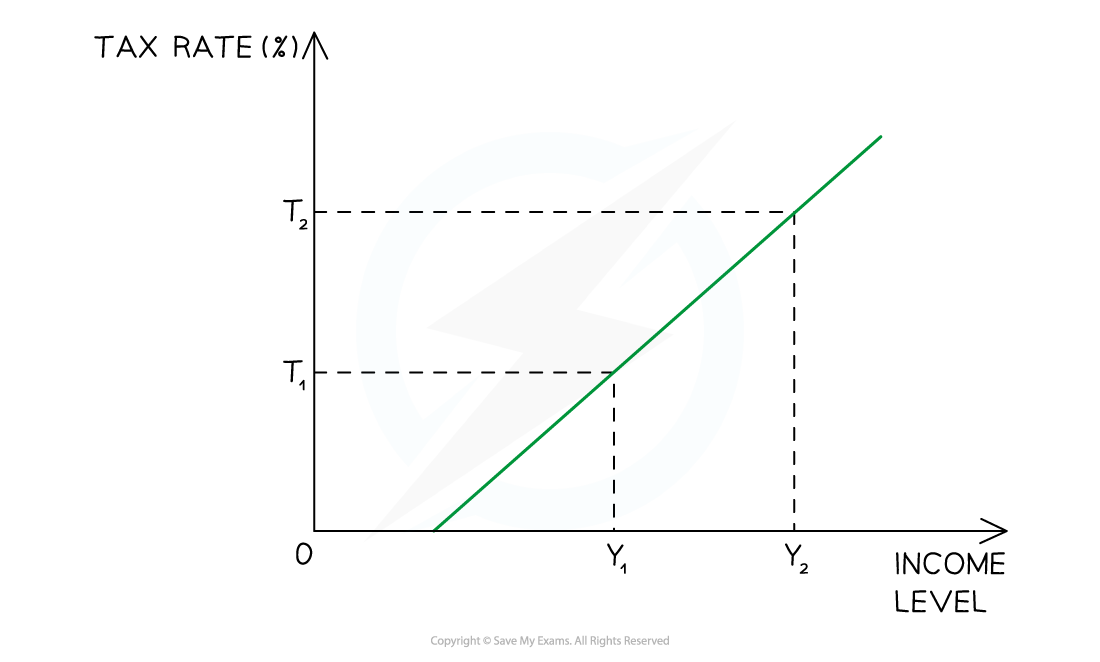 |
| Regressive | - As income rises, a smaller percentage of income is paid in tax - In the diagram, when personal income rises from Y1 to Y2, the tax rate falls from TR1 to TR2 - All indirect taxes are regressive - In the USA, Federal income tax is progressive but almost all State taxes are regressive (the bottom 20% of income earners pay as much as 6x the % of their income than the top 20%) | 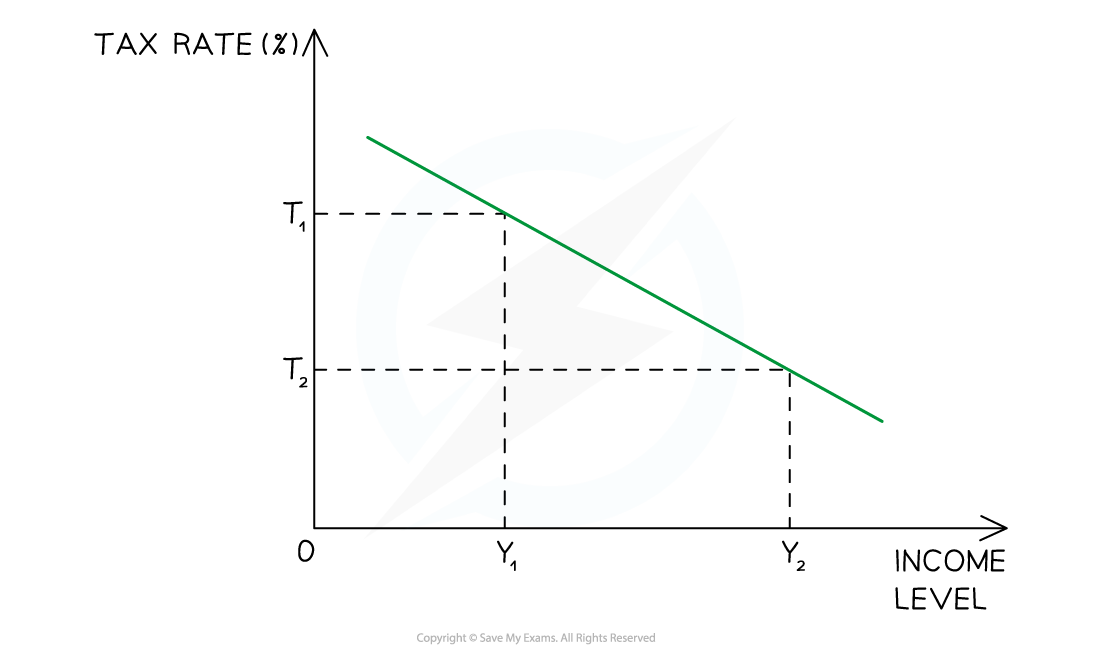 |
| Proportional | - As income rises, the same percentage of income is paid in tax - In the diagram, when personal income rises from Y1 to Y2, the tax rate remains constant at 20% - In 2022, Bolivia was using this system with a proportional tax rate of 13% | 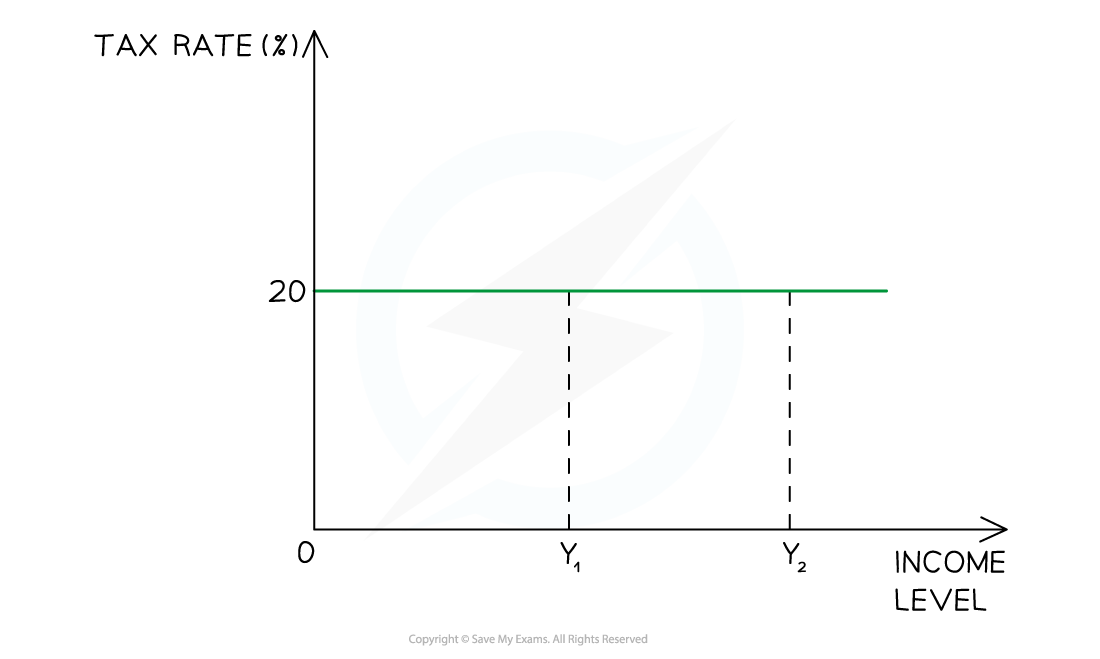 |
- Progressive tax systems are built around the idea of marginal tax rates
- The calculation of an individual's personal income tax requires several calculations
- Using this system, a salary of £60,000 would attract a tax bill of £11,499.80, calculated as follows:
Calculation Using UK Progressive Tax Rates – June 2022
| Tax Band | Taxable Income | Tax Rate | Tax Paid on £60,000 |
|---|---|---|---|
| Personal Allowance | Up to £12,500 | 0% | 0 |
| Basic Rate | £12,501 to £50,000 | 20% | £37, 499 at 20% = £7499.80 |
| Higher Rate | £50,001 to £150,000 | 40% | £10,001 at 40% = £4,000 |
| Additional Rate | Over £150,000 | 45% | 0 |
| Total Tax Paid on £60,000 | £7499.80 + £4,000 = £11,499.80 |
Exam Hint MCQ frequently test your knowledge of the different tax systems by presenting you with a table and asking you to identify the type of tax system illustrated
Identify the type of tax system illustrated below:
Weekly Income ($) 100 150 200 250 Weekly Tax ($) 20 30 40 50 It is a proportional tax system with a constant tax rate of 20%
Principles of Taxation
Spec point — The qualities of a good tax.
- In order for the population to accept a tax system and pay into it, the taxes imposed need to be considered to be 'good'
- There are several principles which should be applied when developing a 'good' tax system
- Simple: taxpayers should know what, when, where and how to pay the tax
- Fair (equity): taxes should reflect a taxpayer’s ability to pay - progressive taxation aims to achieve this as the wealthy can afford to pay more than the poor do
- Convenient: systems to collect payment should be easy and provide choice for taxpayers e.g. monthly payments spread over 12 months or tax collected by the employer each month before the salary is paid
- Efficient: the management of the tax system by the government should not be overly expensive or wasteful
- Fit for purpose: there should not be any unintended side effects of the system e.g. disincentivising workers from working
- Flexible: it should be easy to adjust/change as required by changes in the economy
The Impact of Taxation
Spec point — The impact of taxation on consumers, producers, government and economy as a whole.
-
Changes in direct and indirect tax rates influence a range of economic variables
- The greater the size of the change, the greater the ripple effects felt by households, firms and the economy
Effects of Tax Rate Changes
| Impact | Explanation |
|---|---|
| Incentive to work | - The higher the tax rate, the lower the incentive for the unemployed to seek work - or for existing workers to work overtime |
| Government tax revenues | - There is a relationship between increasing tax rates and the level of government revenues received - The broad idea is that as tax rates increase, a point will be reached where disincentivized workers work less, resulting in lower incomes and less government tax revenue - More people will actively seek to avoid paying tax (tax avoidance) or try to move their income elsewhere |
| Income distribution | - A **progressive tax system **redistributes from those with higher income to those with lower income and reduces income inequality - Sometimes the benefits of a good progressive tax system are lost by the penalties imposed through multiple regressive (indirect) taxes |
| Economic growth | - Tax rate increases will likely cause a reduction of total (aggregate) demand as firms and households have less disposable income - Tax rate decreases will have the opposite effect - As total demand slows down, fewer workers may be required for production and unemployment may increase |
| Inflation | - Increasing Indirect tax rates increase costs of production for firms possibly leading to cost-push inflation - An increase in indirect taxes reduces disposable income and so workers may petition their employer for a salary increase - If they receive the increase the economy may face a wage-price spiral |
| The trade balance (X-M) | - An increase in taxes can reduce disposable income which is likely to reduce the level of imports - This may** improve** the trade balance (exports - imports) |
| Business location | - If the rate of corporation tax increases relative to other countries, it may result in less inward foreign direct investment by multi-national corporations |
Was this revision note helpful?
Build on this topic