Business Cycle (Cambridge International IGCSE Business)
Stages of the business cycle
Spec point — growth, boom, recession, slump
- The business cycle describes the upturns and downturns in the level of a country’s economic activity (gross domestic product or GDP) over time
- Economies do not experience consistent levels of growth over time
The business cycle
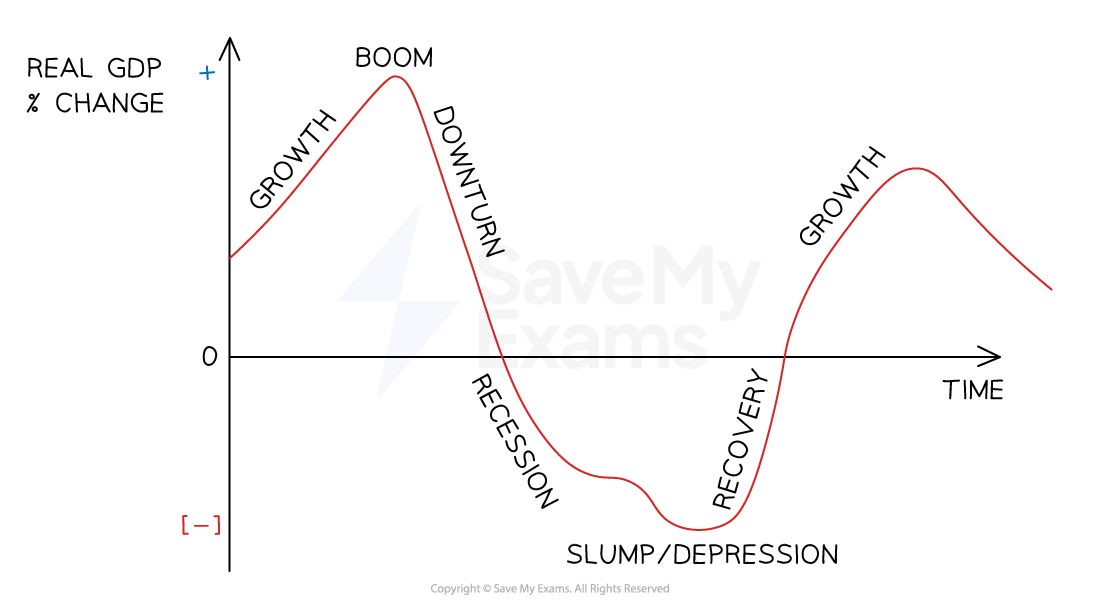
The business cycle diagram shows periods of growth, boom, recession and slump in an economy
Growth
-
The growth stage is a period of increasing rates of GDP growth
- Disposable income levels rise and lead to increased demand for products
- This drives an increase in production levels, which leads to a rise in employment levels
- Businesses look to expand and increase profit
Boom
-
A boom is a period of time when an economy experiences an extended period of increasing rates of GDP growth
- Consumer incomes and business profits are high
- Inflation is also high due to higher demand for goods and services
- Unemployment levels are low and wages are high due to a shortage of skilled workers
Recession
-
A recession occurs when an economy experiences two consecutive quarters (6 months) or more of negative GDP growth
- Incomes and consumer demand fall, leading to reduced output
- Consumer and business confidence tend to be low
- Business profits fall and unemployment rises
Slump
-
A slump is an extended period of negative GDP growth
- Unemployment is likely to be high as a result of high levels of business failure
- Significant declines in household incomes and business profits
- Increased government spending on welfare benefits and infrastructure projects to inject demand into the economy may benefit some businesses
The impact of the business cycle on business
-
Businesses must adapt their strategies at each stage of the cycle
- For example, cutting costs in a recession or investing in growth during a boom
Impacts at each stage of the business cycle
| Stage of business cycle | Impact on business | Example |
|---|---|---|
| Growth | - During the growth stage, businesses experience higher sales and profits as consumer demand increases - They are likely to invest more in new products, staff, and equipment | - After the 2008 financial crisis, Apple saw strong global demand for iPhones and expanded its operations worldwide |
| Boom | - In a boom, businesses often enjoy very high sales and profits. - However, they may also face rising costs due to increased wages, competition for skilled workers and the impact of inflation on materials | - Tesla benefited from a booming economy in the late 2010s, with high consumer demand and strong investor confidence helping it grow rapidly |
| Recession | - During a recession, businesses usually face falling sales and profits as consumer spending declines - Many businesses reduce costs by cutting jobs or delaying investment | - In the 2020 COVID-19 recession, Primark lost significant income due to store closures and reduced customer spending |
| Slump | - A slump is the most severe stage of the business cycle, where many businesses face major losses or closure due to very low demand - Investment falls, and unemployment rises sharply, reducing consumer spending | - In early 2020, many airlines faced a severe slump due to global travel restrictions - Passenger numbers dropped dramatically, leading to cancelled flights, redundancies, and government bailout requests |
Exam Hint Don’t just memorise the four stages of the business cycle – show how each one affects businesses differently. For example, a boom might raise sales but also costs (like wages), while a recession lowers demand but may reduce interest rates.
Effects of employment, inflation, and economic growth on a business
1. Employment Levels
-
Slump and recession (low employment/high unemployment)
- Many people out of work → consumer demand falls, especially for non-essential goods
- Easier and cheaper to recruit staff (wages lower, labour supply higher)
- Risk of low staff motivation and morale if job insecurity is high
-
Boom and growth (high employment/low unemployment)
- More people in work → consumer demand and sales rise
- Harder to recruit staff (skills shortages, competition)
- Wages may rise, increasing business costs
2. Inflation
-
Slump and recession (low inflation or even deflation)
- Falling prices may encourage consumers to delay spending, reducing sales
- Lower inflation = more stable costs, easier planning for businesses
- Risk of squeezed revenue if prices cannot be maintained
-
Boom and growth (higher inflation likely)
- Rising costs of raw materials and wages reduce profit margins
- Businesses may need to raise prices, but risk losing customers
- Uncertainty in pricing makes planning and forecasting difficult
3. Economic Growth
-
Slump and recession (low/negative growth)
- Consumer incomes fall → lower demand, especially for luxury or non-essential goods
- Businesses may cut investment, delay expansion, or make redundancies
- Some opportunities for “inferior goods” (low-cost options) as consumers switch to cheaper products
-
Boom and growth (high/positive growth)
- Rising incomes → strong demand for goods and services
- More opportunities to expand, innovate, and increase profits
- Risk of higher costs (wages, rent, raw materials) as demand outstrips supply
Was this revision note helpful?
Build on this topic