Choosing a Suitable Type of Business Organisation (Cambridge International IGCSE Business)
Determining a suitable ownership type
- An entrepreneur must choose the ownership structure that suits the business needs, circumstances and the level of personal liability involved
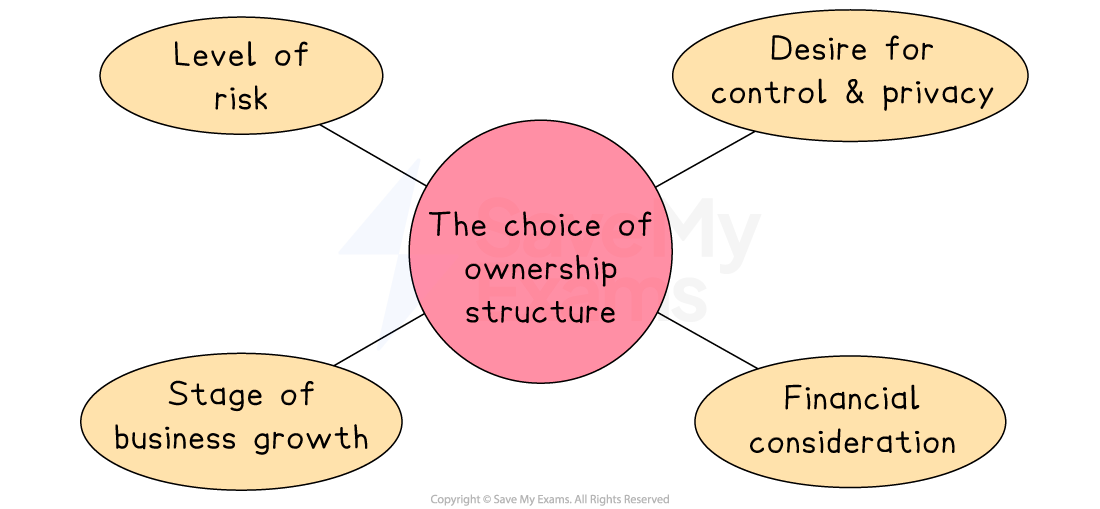
The choice of business ownership depends on a range of factors, including the level of personal risk owners are willing to accept and their desire for control and privacy
Factors affecting the choice of ownership structure
Level of risk
-
Entrepreneurs who want to protect their personal assets may choose a company structure with limited liability
-
If the business is small and the owner is willing to take personal financial risk, a sole trader structure may be enough.
- For example, a builder setting up alone may accept the risk of unlimited liability, but a software company seeking funding might choose the security of limited liability
Desire for control and privacy
-
Sole traders have full control and can make quick decisions
-
Partnerships share decision-making but may have disagreements
-
Companies are run by directors, decisions may be slower or involve more people and accounts need to be published
- For example, a freelance designer may prefer to be a sole trader for full independence
Financial considerations
-
Larger businesses often need more capital, which may not be possible as a sole trader or partnership
-
Companies can raise money by selling shares
- For example, a technology start-up needing finance may choose to become a private limited company to attract investors
Stage of business growth
-
Businesses planning to grow quickly or expand internationally may choose a company structure to attract shareholders and funding
-
Those aiming to stay small and local might prefer a simpler ownership type.
- EFor example, a café wanting to open branches across the country may change from a partnership to a private limited company
Business organisation for small firms
Spec point — "recommend and justify a suitable type of business organisation to owners/management for a given situation"
Business organisation for small firms
- When starting a business, entrepreneurs often choose simple and flexible ownership structures that match their goals, resources and attitude to risk
Comparison of ownership types for small firms
| Ownership type | Why it’s a good choice | Best for |
|---|---|---|
| Sole trader | - Easy and cheap to set up (minimal paperwork) - Full control over decisions - Keeps all profits - No need to publish accounts | - Freelancers, tradespeople, tutors, small shop owners |
| Partnership | - More capital from multiple owners - Shared skills and responsibilities - Simple to set up - Flexible division of profits and work | - Professionals (e.g. accountants, lawyers), family or joint start-ups |
| Private limited company | - Limited liability protects personal assets - Can raise finance by selling shares - More professional image - Separate legal identity (company owns assets and signs contracts) | - Technology start-ups, online businesses, growth-focused enterprises |
Case Study Pizzazz Pizzeria
Sarah is considering setting up a new pizza restaurant called Pizzazz. She has 3 different options
- Start small as a sole trader
- Seek a partner willing to invest in the business
- Start small but register as a private limited company
Key considerations
- Sarah does not have much money
- Her sister, a chef, is looking to invest in a business
- The business plan identifies significant start-up costs, including fitting out a pizza restaurant premises
Recommendation
- A private limited company may be a good option, as it is relatively inexpensive to set up, provides Sarah with legal protection and may be more attractive for lenders such as banks
- However, the partnership option is also attractive, as Sarah knows her sister well and relevant skills could be brought into the business as well as finance
- As the business plan has identified significant costs, setting up as a sole trader is the least suitable option, as it involves personal financial risk for Sarah
Business organisation for growing firms
- As a business grows, its needs become more complex, and choosing the right ownership structure becomes even more important
- Growing businesses often require more finance, better risk management, and stronger organisational structures to support expansion
Comparison of ownership types for growing firms
| Ownership type | Why it’s a good choice | Example |
|---|---|---|
| Partnership | - Brings in new skills or capital by adding partners - Growth is shared, reducing pressure on one person - Still flexible and less complex than a company | - A successful accounting firm adds new partners to open offices in other cities |
| Private limited company | - Limited liability encourages investors and protects owners - Can raise finance by selling shares privately - Separate legal identity supports long-term growth | - A fashion brand expands into national retail by attracting private investment through share sales |
| Public limited company | - Can raise large amounts of capital by selling shares to the public - Shares can be traded on a stock exchange - Suitable for large-scale expansion and global operations | - A supermarket chain becomes a PLC to raise funds for global expansion and opening new branches |
Case Study AMF Cleaning and Maintenance Ltd
AMF is a large, fast-growing private limited company that specialises in commercial cleaning and maintenance services
AMF is seeking to raise finance to continue their expansion. They can either
- Become a public limited company
- Seek venture capital investment but remain as a private limited company
Key considerations
- If AMF sells shares to the public, its current owners lose some control of the company but gain access to a large pool of capital
- Money raised through share sales does not need to be repaid, unlike loans
- New shareholders will have high expectations and may pressure the business for strong short-term performance
- Becoming a PLC involves legal and administrative costs, including publishing financial accounts and meeting stock exchange requirements
Recommendation
If AMF aims for rapid national or international expansion and needs substantial long-term funding, becoming a public limited company may be the most suitable option
- This would allow them to raise large amounts of capital by selling shares to the public
However, if AMF prefers to keep tighter control over decision-making and avoid the pressures of public shareholders, seeking venture capital while remaining a private limited company could be a better solution
- This would still provide significant funding but from fewer, more specialised investors
Exam Hint Don’t simply describe each business type – exam questions expect you to recommend and justify the most appropriate option for the scenario, considering factors like liability, finance, and control
Was this revision note helpful?
Build on this topic