Business Growth (Cambridge International IGCSE Business)
Why grow a business
Why grow a business?
-
Many firms start small and will grow into large companies or even multi-national corporations
- For example, Amazon and Dell both started in entrepreneurs' garages
Reasons why businesses grow
- The owner's or manager's desire to run a large business & continually seek to grow it
- The owner's desire for higher levels of market share and profitability
- The desire for stronger market power (monopoly) over its customers and suppliers
- The desire to reduce costs by benefiting from lower unit costs as output increases
- Growth provides opportunities for product diversification
- Larger firms often have easier access to finance
Internal business growth
Spec point — how and why businesses can grow internally, e.g. develop new products, develop new markets
-
Internal growth that is driven by organic expansion using reinvested profits or loans
-
It is usually achieved by:
- Gaining a greater market share
- Product or market diversification
- Opening new outlets
- International expansion (new markets)
- Investing in new technology or production machinery
Examples of internal growth
| Business | Explanation |
|---|---|
| Apple | - International expansion (new markets): Apple expanded into new markets by opening its stores in new countries, such as China and India, and by partnering with telecom providers to sell its products. |
| - Product innovation: Google introduced new products, such as Google Drive and Google Maps, to complement its search engine and advertising businesses | |
| Disney | - Product diversification: Disney has diversified into several areas, such as theme parks, cruise lines, television networks and movie studios. |
-
Product diversification opens up new revenue streams for a business
- Firms may spend money on research and development or innovation *to existing products to help create a new revenue stream
-
Firms often grow internally to the point where they are in a financial position to integrate(merge or buy) with others
Evaluating internal growth
| Advantages | Disadvantages |
|---|---|
| - The pace of growth is manageable - Less risky, as growth is financed by profits and there is existing business expertise in the industry - The management knows and understands every part of the business | - The pace of growth can be slow and frustrating - Not necessarily able to benefit from lower unit costs (e.g. bulk purchasing discounts from suppliers) as larger firms would be able to - Access to finance may be limited |
External business growth
Spec point — how and why businesses can grow internally, e.g. develop new products, develop new markets
-
External business growth is when a business expands by joining with or buying other businesses rather than growing on its own
-
A merger occurs when two or more companies combine to form a new company
- The original companies cease to exist and their assets and liabilities are transferred to the newly created entity
-
A takeover occurs when one company purchases another company, often against its will
- The acquiring company buys a controlling stake in the target company's shares (>50%) and gains control of its operations
-
Vertical integration
-
Vertical integration refers to the merger or takeover of another firm in the supply chain or different stage of the production process
-
Forward vertical integration involves a merger with or takeover of a firm further forward in the supply chain
- For example, a dairy farmer merges with an ice cream manufacturer
-
Backward vertical integration involves a merger with or takeover of a firm further backwards in the supply chain
- For example, an ice cream retailer takes over an ice cream manufacturer
-
A firm can grow through forward or backward vertical integration, merging with or taking over another business in the supply chain
Evaluating vertical integration
| Advantages | Disadvantages |
|---|---|
| - Cuts production costs by removing middlemen - Lower costs increase competitiveness - Greater supply chain control and more reliable access to raw materials - Better control over raw material quality - Forward integration increases profit and brand visibility | - Diseconomies of scale (e.g. duplicate management roles) - Culture clash between merged firms - Lack of experience in new business area may reduce efficiency - High acquisition cost may take time to recover |
Horizontal integration
-
Horizontal integration is the merger or takeover of a firm at the same stage of the production process
- For example, an ice cream manufacturer merges with another ice cream manufacturer
Evaluating horizontal integration
| Advantages | Disadvantages |
|---|---|
| - Rapid market share growth - Lower unit costs from economies of scale - Less competition - Shared industry knowledge improves success chances - May gain new expertise | - Diseconomies of scale (e.g. duplicate roles) - Culture clash between merged firms |
Exam Hint Don’t just state methods of growth (internal or external) – make sure you can explain their advantages and disadvantages, as questions often test your ability to judge which method is most suitable in a given situation
Problems of business growth
- In some cases, growing the size of a business can fail to improve its profitability and can lead to cash flow and coordination problems
Problems and solutions of business growth
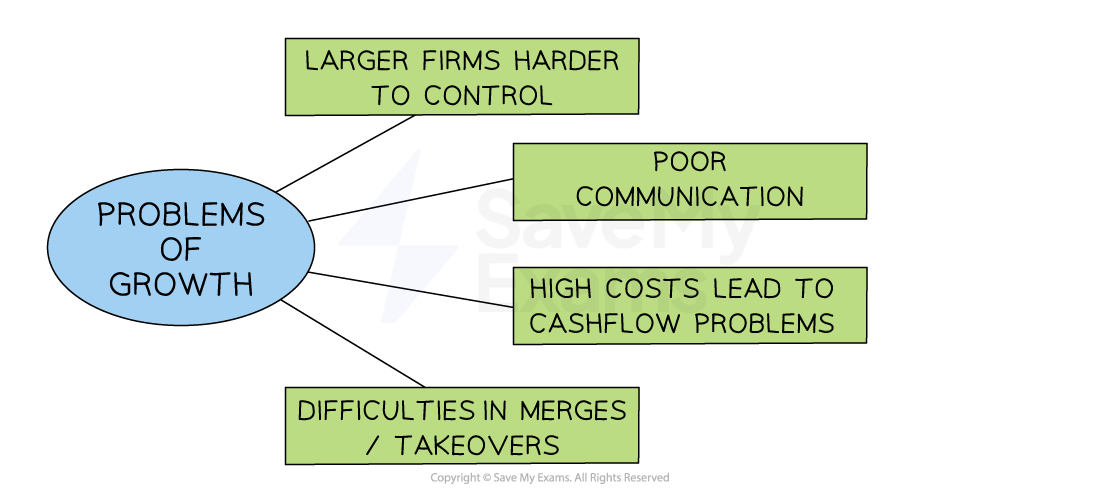
Businesses are often faced with a range of challenges when they grow
Poor communication
- Longer chains of command and wider spans of control for managers may lead to slower decision-making times and inefficiency
Solution
- Use the latest communication technologies, such as instant video calls, to improve communication between managers and workers
- Decentralisation may help to delegate decision-making
Larger firms are often harder to control
- As a business grows in size, it can experience diseconomies of scale such as poor co-ordination of resources
Solution
- Operate as a series of smaller units which allows local or functional area managers to have more control
- Increase delegation in order to empower workers and get jobs done more quickly
High costs and cashflow problems
-
Expansion can be very expensive as it may involve developing a new product range or buying a new factory
- High costs in the short/medium term means the business may need additional finance to avoid cashflow problems
Solution
- Grow slowly using profits rather than loans to fund gradual and less risky expansion
- Manage cash flow carefully, making use of retained profits and short-term borrowing to counter cash flow shortfalls
Difficulties of mergers and acquisitions
- A culture clash may occur if a merger or acquisition takes place between two different firms due to different management styles
Solution
- Ensure good communication so employees are less likely to be resistant to change
- Take time to carefully negotiate and plan mergers/acquisitions to reduce 'teething problems'
Was this revision note helpful?
Build on this topic