The Concept of Lean Production (Cambridge International IGCSE Business)
Lean Production
Spec point — • The concept of lean production: how to achieve it, e.g. just-in-time inventory control and Kaizen; benefits of lean production
-
Lean production involves the minimisation of the resources used in production
- Less time is required as the production process is organised in the most efficient way
- Fewer materials are used as there is a focus on waste reduction
- Less labour is used as lean production is typically capital intensive
- The space required for production is reduced as a result of just in time stock management
- A small number of trusted suppliers work closely with the business
-
The use of lean production is likely to lead to a competitive advantage
- Lower unit costs are achieved due to minimal wastage so prices may be lower than those offered by competitors
- Better quality of output is likely as a result of supplier reliability and carefully managed production processes
-
Lean production uses strategies such as Just in Time stock control and Kaizen
Just in time stock control
-
Just in Time (JIT) stock management is a process in which raw materials are not stored onsite but ordered as required and delivered by suppliers 'just in time' for production
-
Careful coordination is required to ensure that raw materials and components are delivered by suppliers at the moment that they are to be used
- Close relationships with suppliers need to be developed
- Suppliers may need to be in close proximity
Evaluating the use of just in time stock management
| Advantages | Disadvantages |
|---|---|
| - Stockholding costs, including storage costs are minimised - Close working relationships are developed with a small number of trusted suppliers - Cash flow is improved as money is not tied up in stocks - Unused storage space is available for productive use - Teamwork is encouraged so employee motivation is likely to be improved | - Bulk buying economies of scale are not generally possible - The ability to respond to unexpected increases in demand is reduced - Administrative costs related to frequent ordering are increased - Unreliable suppliers (e.g. late or poor quality deliveries) can quickly halt production - Significant changes to organisational structure and production controls are required |
Continuous improvement (Kaizen)
-
Kaizen involves taking continuous steps to improve productivity through the elimination of all types of waste in the production process
- Changes are small and ongoing rather than significant one-off’s
- They are constantly reviewed to ensure that they achieve the desired positive impact on productivity
- Kaizen requires a long-term management commitment to change
Kaizen (continuous improvement)
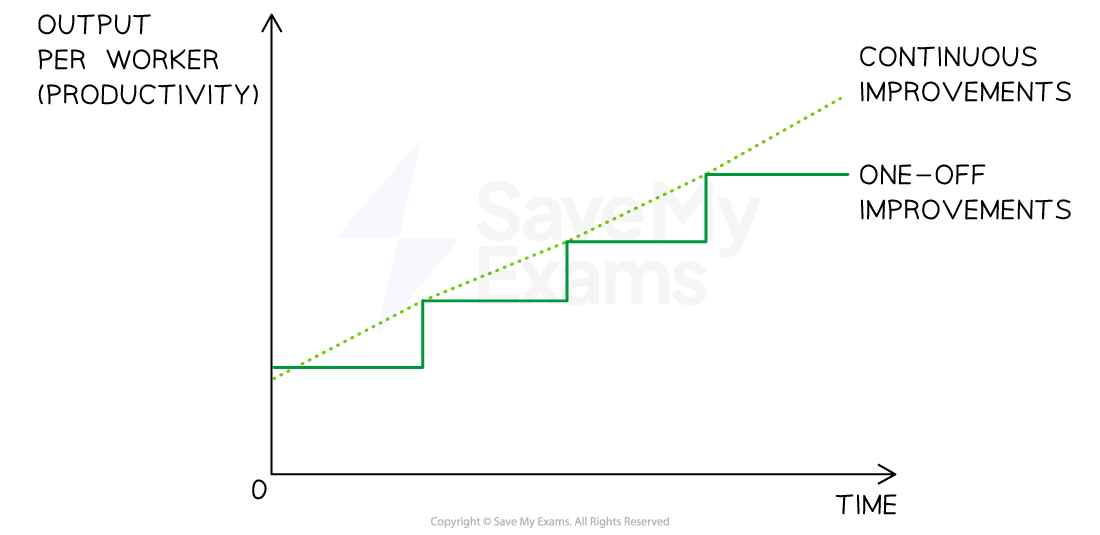
Kaizen Versus One-off Improvements
-
Elements of Kaizen commonly include
- Zero defects in manufacturing
- High levels of automation
- High levels of cooperation between workers and management
-
Staff training and computer inventory management systems may also reduce wastage as fewer errors are likely to be made
The Benefits of Lean Production
-
Lean production leads to the following benefits for a business:
- Right first time approach
- Aims for zero defects in output
- Identifies and solves problems as they arise
- Prevent rather than corrects errors
- Flexibility
- Multiskilled staff and team working
- Flexible management styles
- Waste Minimisation
- Removes processes that do not contribute to added value
- Consumes as little as is necessary
- Effective supply chain management
- Develop excellent relationships with suppliers
- Minimal number of suppliers
- Continuous improvement
- Ongoing, small steps
- All staff involved in improvement
The seven wastes eliminated in lean production
- Waste refers to anything that prevents a business from being efficient
- Seven key types of waste are minimised in lean production:
- Transportation: Unnecessary movement of materials or products
- Inventory: Excess raw materials, work-in-progress, or finished goods
- Motion: Unnecessary movement of people or equipment
- Waiting: Delays or idle time in the production process
- Overproduction: Producing more than what is required by the customer
- Overprocessing: Using more resources than necessary to produce a product
- Defects: Products or services that do not meet customer requirements
Was this revision note helpful?