The Business Cycle (Cambridge International IGCSE Business)
The main stages of the business cycle
Spec point — "• Main stages of the business cycle, e.g. growth, boom, recession, slump • Impact on businesses of changes in employment levels, inflation and Gross Domestic Product (GDP)"
The main stages of the business cycle
- The business cycle describes the upturns and downturns in the level of a country’s economic activity (Gross Domestic Product or GDP) over time
- Economies do not experience consistent levels of growth over time
The business cycle
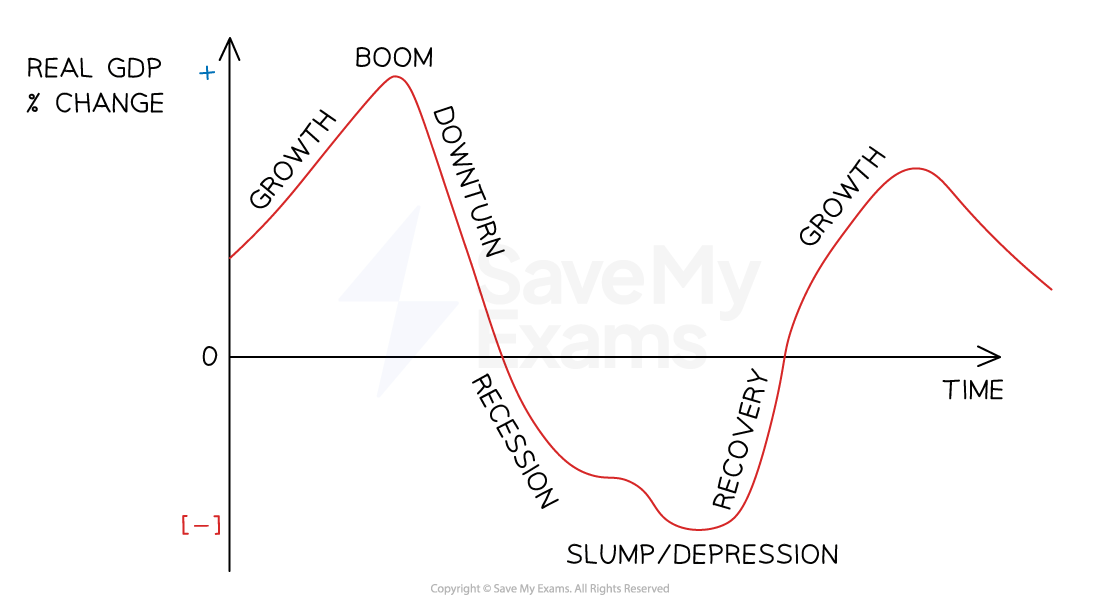
The business cycle diagram shows periods of growth, boom, recession and slump in an economy
-
A recession occurs when an economy experiences two consecutive quarters (6 months) or more of negative GDP growth
- Incomes and consumer demand fall, leading to reduced output
- Consumer and business confidence tend to be low
- Business profits fall and unemployment rises
-
A slump is an extended period of negative GDP growth
- Unemployment is likely to be high as a result of high levels of business failure
- Significant declines in household incomes and business profits
- Increased government spending on welfare benefits and infrastructure projects to inject demand into the economy may benefit some businesses
-
The growth stage is a period of increasing rates of GDP growth
- Disposable income levels rise and lead to increased demand for products
- This drives an increase in production levels, which leads to a rise in employment levels
- Businesses look to expand and increase profit
-
A boom is a period of time when an economy experiences an extended period of increasing rates of GDP growth
- Consumer incomes and business profits are high
- Inflation is also high due to higher demand for goods and services
- Unemployment levels are low and wages are high due to a shortage of skilled workers
The impact on business of changes in employment levels
- Levels of unemployment are closely linked to the business cycle
Unemployment and the business cycle
| Recession and slump | Growth and boom |
|---|---|
| Unemployment is likely to be rising | Unemployment is likely to be falling |
| - Businesses will find it relatively easy to recruit and retain workers - Workers are unlikely to make demands for large pay increases as inflation is low and job security may be more important to them than pay - Household incomes are reduced so some may choose to defer or cancel purchases - Luxury brands may suffer large falls in revenue, whilst budget brands may increase their discounts - Businesses that sell necessities are unlikely to be significantly affected | - Businesses need to compete for skilled labour, and wages will increase due to rising inflation and low labour supply - Employees may have greater power in the workplace leading to greater demands for improved terms and conditions of employment - Household incomes and consumer confidence rise - There is increased demand, particularly for luxury goods |
The impact on business of changes in inflation
-
Inflation is the sustained rise in prices in an economy over time
- In most countries, a **price index **measures monthly changes in the prices of a range of goods and services and compares these changes to earlier periods
-
After several decades of relatively low levels of inflation,** much of Europe has recently experienced rapidly increasing inflation**
- In the UK, inflation reached a peak of more than 11% in 2022, driven largely by increased fuel costs
- By late 2023, Eurozone inflation had returned to a relatively low level of 2.9%
-
High or fluctuating levels of inflation can be problematic for businesses
Problems caused by rising or fluctuating inflation
| Problem | Explanation |
|---|---|
| Increased costs | - Workers often demand higher wages to compensate for the increase in the cost of living - Suppliers increase the cost of raw materials and components - Utilities such as electricity become more expensive |
| Higher repayments on loans | - Interest rates usually rise as central banks use the base rate as a tool to control inflation, making new and variable rate borrowing more expensive |
| Changing consumer spending habits | - Rising inflation **deters consumers from making significant purchases **and they may reduce demand for lower-priced items too, e.g cinema tickets - Purchasing on credit becomes more expensive |
| Reduced international competitiveness | - Where domestic inflation rates are higher than those in other countries - UK businesses are likely to be less competitive and lose sales - Imports of overseas competitors are likely to be cheaper than domestic goods |
| Uncertainty | - It occurs when businesses cannot predict prices, even in the short term - Survival may need to become the key business objective until stability returns - Spending and contract decisions are likely to be** delayed** |
The impact on business of changes in gross domestic product (GDP)
-
Increases in GDP are associated with growth and boom periods
- Although inflation is likely to rise, increases in household incomes may cancel out higher costs
- Recruiting and retaining workers may be challenging so businesses may seek to import labour from other countries
- Interest rates are likely to be high but increased consumer confidence may mean that spending on expensive items remains buoyant
-
A fall in GDP is associated with recession and slump periods
- Despite low inflation, household incomes will be squeezed and **discretionary spending will be closely monitored or reduced **
- Governments may take steps to stimulate the economy, which could lead to better public services, infrastructure or tax benefits for businesses
- Businesses could take advantage of** low-cost borrowing due to low interest rates** and invest for future business growth
Was this revision note helpful?
Build on this topic