Diseconomies of Scale (Cambridge International IGCSE Business)
Exam board Cambridge International · IGCSEUpdated 2025-06-06
Spec point —
4.2.2· • The concept of diseconomies of scale with examples, e.g. poor ommunication, lack of commitment from employees, weak coordination
Diseconomies of scale
-
As a firm continues increasing its scale of output, it will reach a point where its average costs (AC) will start to increase
- The reasons for the increase in the average costs are called diseconomies of scale
Explaining diseconomies of scale
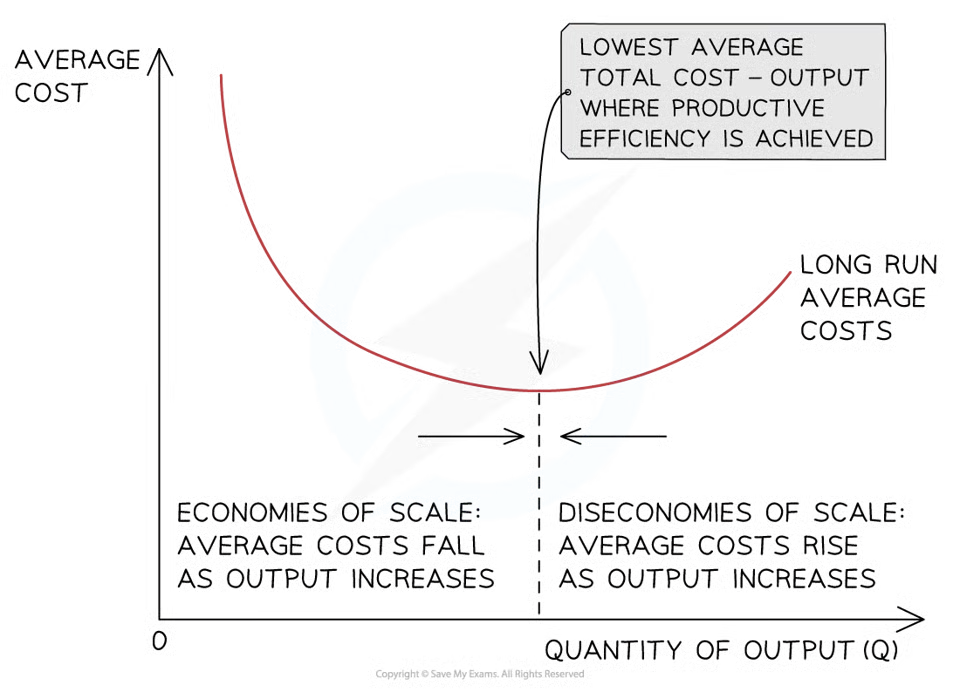
* Diseconomies of scale occur when average costs increase with increasing output*
Diagram analysis
- At some level of output, a firm will not be able to reduce costs any further. This point is called productive efficiency
- Beyond this level of output, the average cost will begin to rise as a result of diseconomies of scale
- This indicates that there is an optimal level of output that exists when the state of technology and capital (machinery) is fixed
Different types of diseconomies of scale
-
Diseconomies of scale highlight that it is possible for a business to become so large that it becomes less and less efficient
-
A business experiencing diseconomies of scale may reconsider its organisational structure to improve communication and coordination problems
- Many very large businesses often break themselves up into autonomous smaller units, which can communicate more effectively
The causes of diseconomies of scale
| Type of diseconomy of scale | Explanation |
|---|---|
| Poor communication | - As a business increases in size, more managers and employees will join the business - Communication becomes slower and mistakes may be made, leading to worsening efficiency |
| Weak coordination | - Time-consuming decision-making may make it harder to coordinate workers and physical resources - The chain of command is likely to lengthen, limiting interaction with employees |
| Lack of commitment from employees | - As the business grows workers may feel less valued as their interaction with management is limited - Workers may become demotivated, leading to a fall in output which can increase average costs |
Was this revision note helpful?