Benefits & Drawbacks To Countries of Hosting MNCs (Cambridge International IGCSE Business)
Benefits to a country of hosting an MNC
Spec point — "• Potential benefits to a country and/or economy where a MNC is located, e.g. jobs, exports, increased choice, investment • Potential drawbacks to a country and/or economy where a MNC is located, e.g. reduced sales of local businesses, repatriation of profits"
Benefits to a country of hosting an MNC
- Many governments are in favour of MNCs establishing in their country as there are benefits to the wider economy, but their presence can also have negative consequences
- The extent to which their activities are regulated and the behaviour of individual companies determine the overall effect
The impact of MNCs on the national economy
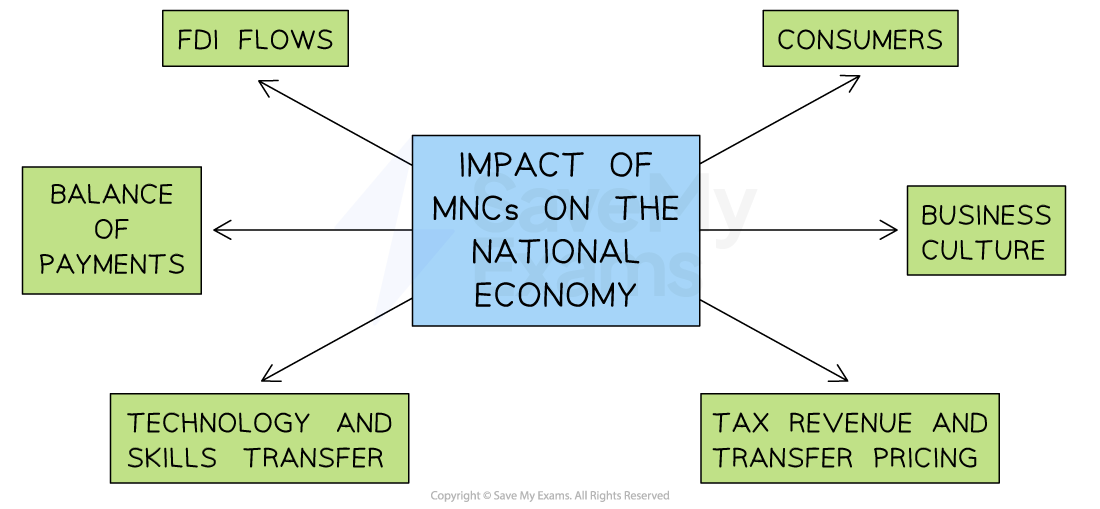
MNCs impact several business metrics in the national economy
Foreign direct investment (FDI)
-
There will be an inflow of money into a country if a MNC decides to invest into a country through foreign direct investment
- This money enriches local firms or citizens, who now have more money available to spend in the economy
- If this money is reinvested back into the local economy, it may help to generate new jobs and boost economic growth
Balance of payments
-
MNCs can help improve the balance of payments of a country as FDI flows into the country
- Any goods and services exported for sale by the MNC will generate further inflows to the country’s balance of payments
- This is especially beneficial to a country when the MNC is exporting a rare and valuable raw material, e.g cobalt
Technology and skill transfer
-
MNCs can bring new technologies and skills to local businesses
- This will help to improve efficiency and productivity, helping domestic businesses become more competitive in national and international markets
Consumers
-
Customers in countries which host MNCs often benefit from
- Better quality, a wider choice of goods and services and lower prices if MNCs pass their cost advantages on in the form of lower prices
- Improved living standards as people may have higher incomes due to job creation and the resulting reduction in unemployment
Business culture
-
Domestic businesses may be influenced by the business culture of MNCs
- E.g. In the 1990s, European businesses adopted the working practices of Japanese businesses such as Nissan
- Workplaces became more open and employers started to copy ideas such as Kaizen and continuous improvement
-
MNCs may also encourage a culture of entrepreneurship
- This can help boost overall economic growth
Tax revenue
- There is the potential for the host country to gain significant tax revenue
- Governments can use tax revenue paid by MNCs to invest in improving public services and infrastructure
Limitations for a country of hosting an MNC
- Multinational companies can also present some challenges, which governments sometimes struggle to mitigate
Loss of assets
- Assets from the home country are now owned (or partly owned) by foreign businesses
- Local firms or individuals who have sold the asset may not reinvest the money into the local economy but may move it abroad or offshore
Balance of payments
-
MNCs can have a negative impact on the balance of payments
- If the MNC buys raw materials or equipment abroad (imports), there is a flow of money out of the country
- If the MNC send profits back to their home country, it will also represent a flow of money out of the country
Consumers
-
In the long run, MNCs can push domestic businesses out of the market, leaving customers with less choice
- This may lead to MNCs exploiting customers with higher prices and low-quality products as they have limited choice
Business culture
-
MNCs may demonstrate unethical behaviour and have a company culture of exploitation
- E.g. Bangladesh is used by many clothing brands to produce cheap clothes and many turn a blind eye to poor working conditions
- This encourages local firms to also ignore the working conditions
Transfer pricing
-
MNCs often seek to maximise profits and try to reduce their tax liabilities
- Transfer pricing is a method used by MNCs to shift profits from where they are generated to countries with lower tax rates
- This is a method of tax avoidance and means that the businesses will deprive the host country of tax revenue
Was this revision note helpful?