Organisational Charts & Roles (Cambridge International IGCSE Business)
Organisational Structures
Spec point — "• Simple hierarchical structures: levels of hierarchy, span of control, chain of command e.g. tall/short • Roles and responsibilities of directors, managers, supervisors, other employees in an organisation and inter-relationships between them"
Organisational structures
-
An organisational structure outlines the reporting relationships, roles, and responsibilities of employees in the organisation
-
Businesses must determine what the best structure is for them so as to effectively implement ideas and achieve their objectives
- They should consider how the structure may affect the management and effectiveness of operations and communications
- A well-designed organisational structure helps to promote clarity, efficiency and accountability
-
An organisational chart
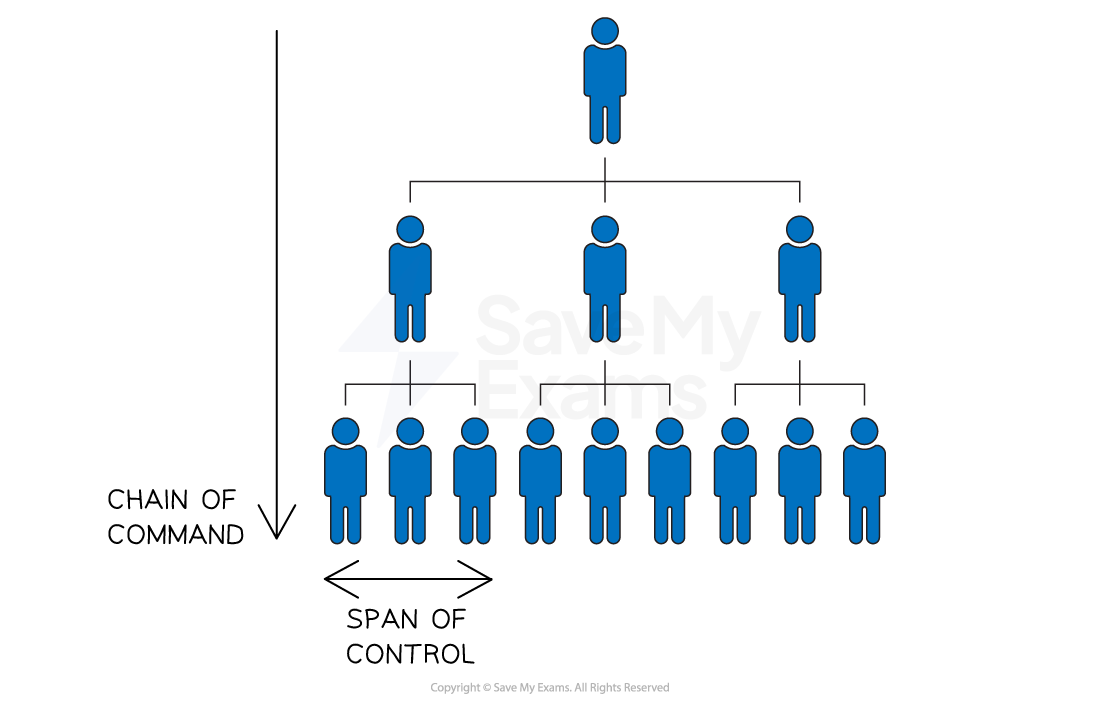
This organisation chart shows a traditional hierarchy where workers are answerable to the supervisor or manager who has authority over them in the structure
1. Hierarchy
-
A hierarchy refers to the levels of authority within an organisation
- It describes the ranking of positions from top to bottom
- The higher the position in the hierarchy, the more authority and power it holds
- The hierarchy usually includes top-level management, middle-level management, and lower-level employees
2. Chain of command
-
The chain of command is the formal line of authority that flows downward from the top management to lower-level employees
- It defines who reports to whom and who is responsible for making decisions
- The chain of command helps to establish a clear communication channel and helps to maintain accountability within the organisation
3. Span of control
-
Span of control refers to the number of employees that a manager or supervisor can effectively manage
-
It is based on the principle that a manager can only effectively manage a limited number of employees
- A narrower span of control means that there are more layers of management
- A wider span of control means that there are fewer layers of management
Tall & Short Organisational Structures
Tall and short structures
-
The chain of command and span of control are closely linked
-
A long chain of command usually results in a narrow span of control
- This is known as a tall organisational structure
-
A short chain of command usually results in a wide span of control
- This is known as a flat organisational structure
-
Characteristics of tall structures
-
**Multiple levels of management **
-
A long chain of command and narrow span of control
-
Common in large organisations with complex operations
- E.g. government agencies and universities
A tall structure
Evaluating tall structures
| Advantages | Disadvantages |
|---|---|
| - Provides a clear hierarchy of authority and defined roles and responsibilities - Promotes specialisation and expertise within each department or function | - Can create communication barriers between upper and lower levels of the hierarchy - Decision-making can be slow as information must pass through multiple layers of management |
Characteristics of flat structures
-
Fewer levels of management
-
A short chain of command and wide span of control
-
Common in small organisations or start-ups
- E.g. tech start-ups and small businesses
A flat structure
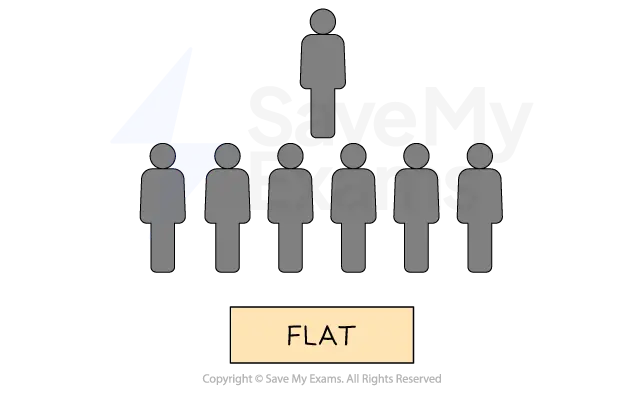
A flat structure has few layers in it
Evaluating flat structures
| Advantages | Disadvantages |
|---|---|
| - Promotes a culture of collaboration and open communication - Decision-making can be faster and more efficient | - Can lead to a lack of clear hierarchy - May require employees to take on multiple roles and responsibilities leading to burnout and overwhelm |
-
Some businesses may choose to remove layers from their hierarchy which shorten the chain of command
- This is known as delayering
Exam Hint Remember the following distinctions:
- The longer the chain of command, the ‘taller’ the organisational structure and the ‘narrower’ the span of control
- The shorter the chain of command, the 'wider' the span of control
In exam questions, you may be asked to define a specific key term in this section or explain a type of organisational structure
Was this revision note helpful?