Choosing the Right Employee (Cambridge International IGCSE Business)
The Employee Recruitment Process
-
The recruitment and selection process details the steps a business takes when bringing new employees into a business
-
A manager or HR employee is usually nominated to manage the application process
- This person (possibly together with others) will draw up a **shortlist **of candidates from the applications received
- The shortlist is a list of candidates who are** invited to interview** or asked to complete an assessment tas
Stages in the recruitment process
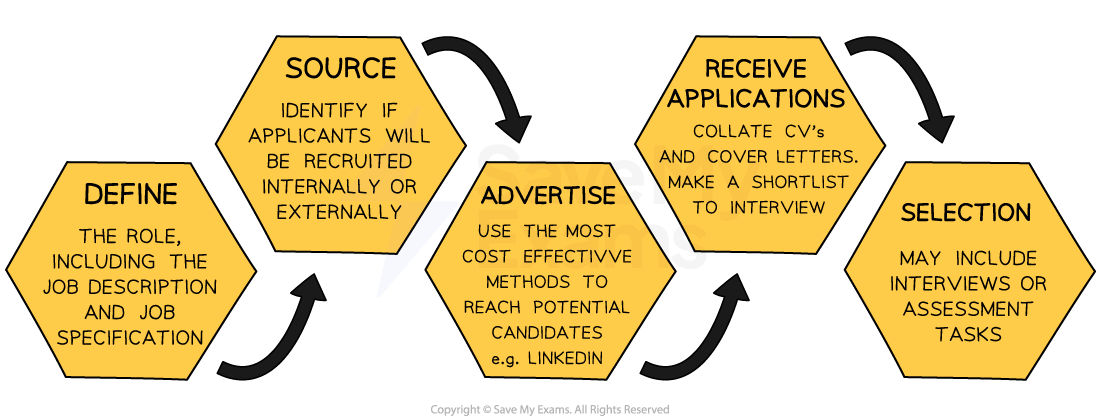
The recruitment process starts by defining the role the business wants applicants to apply for
Step 1: Defining the role
-
Businesses should determine exactly what is required and part of that is developing a job description and a person/job specification
- A job specification (sometimes known as a person specification) outlines the qualifications, skills, experience, and personal qualities required from a candidate for a specific job e.g. problem solver, good communicator, able to code in Java etc.
- A job description outlines the duties, responsibilities, and requirements of a particular job
Comparing a person specification with a job description
| Job Specification | Job Description |
|---|---|
| - Details the essential and desirable characteristics of the person suitable for the job including - Qualifications - Experience - Skills such as the ability to drive or IT capabilities - Personal characteristics and attributes | - Details the features of the job including - Duties - Hours and location of the job - Managerial or supervisory responsibilities - Pay and conditions |
Step 2: Identifying the source of required employees
-
Internal recruitment involves a business promoting or redeploying workers that already work for them
- Internal recruitment can be beneficial as it encourages employee development, builds morale and can save time and money on training
-
External recruitment involves bringing in new workers from outside of the business
- External recruitment can bring fresh ideas, experiences and perspectives to the organization
Step 3: Advertising the role
-
Roles may be advertised internally or externally
-
If the business is seeking an internal candidate business newsletters, staff noticeboards or internal email can be used to display job advertisements
- Line managers may be asked to recommend suitable candidates following appraisals
-
External candidates can be targeted with advertisements in newspapers, industry magazines, specialist recruitment websites, agencies and government-run agencies
-
Existing employees may be asked to nominate people they know for roles - sometimes they receive a reward of their nominee is successfully recruited
-
Headhunting can be used to fill high level roles
-
Businesses with a strong social media presence can use these platforms to advertise cost effectively e.g. Facebook, LinkedIn, TikTok
-
Specialist recruitment portals may be used to advertise
- These tend to be expensive but target specific groups of potential applicants
- E.g. The Times Educational Supplement is one of the main publications in the UK used to recruit teaching staff
-
-
Step 4: Receiving applications
-
The business may accept applications from candidates via Curriculum Vitae (CV) and covering letter or application form
-
A curriculum vitae should be well laid out and clear and usually contains the following details:
- Name and contact details
- Qualifications and work experience
- Positions of responsibility
- Interests
- The names and addresses of referees
-
The accompanying letter of application should outline
- Why the applicant wants the job
- Why they would be suitable for the advertised role
-
Application forms are often preferred in place of a CV
- They usually ask for the same information as the CV
- Sometimes further information that is specific to the job is requested
- Applications from a selection of candidates can be easily compared
- Many application forms are now completed online
Comparing application methods
| Application form | Curriculum vitae (CV) | Covering letter |
|---|---|---|
| - A standardised form designed by the recruiter to collect the same details from each candidate - Responses are collected in a consistent formatand comparison is straightforward - A large volume of candidates can be narrowed down for interview | - A professional document compiled by the applicant - Details career experience, key skillsand strengths - Includes qualificationsand character/professional referees - Provides contact details for the recruiter to get in touch with the applicant | - A letter that accompanies the candidate's application form or CV - Gives reasons for submitting an application - Draws attention to the applicant's particular suitability for the role - Allows recruiters to sift applications without having to compare detailed application forms/CVs |
The Employee Selection Process
Step 5: Selection
- Once candidates have submitted their applications and the business has shortlisted suitable candidates, a variety of methods can be used to select the right worker for the role
Interviews
-
Interviews are commonly used to meet with candidates
-
They usually include a face to face, telephone or online discussion between a manager and the candidate about their suitability for the role
-
It is important to prepare a set of relevant questions to ask all candidates and to ensure that the interview is conducted in a fair and consistent manner
-
Interview questions may focus on
- Skills and experiences that are relevant to the job
- Successes and failures - and how these were overcome
- Personal interests and experiences
-
Selection tests
-
Candidates may be asked to undergo a test to demonstrate their skills and suitability for the job
-
Candidates may be asked to complete tests individually or within groups to assess how they may work as part of a team
-
The different types of tests may include:
- Skills tests (e.g. numeracy) show the ability of candidates to carry out certain tasks
- Aptitude tests show the candidate’s potential to improve or increase their skills
- Intelligence tests are used to assess the candidate’s ability to work at a desired level
- Personality tests are used to identify desired characteristics or traits such as the ability to work effectively in a team
Recommending Which Applicant to Employ
Spec point — • Recommend and justify who to employ in given circumstances
-
The final decision of which applicant to employ depends on several factors
-
Even when a suitable candidate is identified the business will need to think about whether it can finalise their appointment
- Can the business fulfil the applicant's pay and conditions demands?
- Can appropriate fringe benefits be offered?
- Are attractive development opportunities available to the applicant?
Factors used to select the best applicant
| Factor | Explanation |
|---|---|
| Experience | - Which applicant has the most relevant work experience? - How might broader experiences help an applicant succeed in a specific role? |
| Qualifications | - Are formal qualifications essential for filling the post? - E.g. A teacher may require a degree in their specialist subject, whilst a retail store manager's experience is likely to be more relevant than formal qualifications |
| Internal or external candidate | - How important is it that the applicant already has a good understanding of how the business operates? - Time may be saved on induction training and productivity may reach expected levels sooner than with an external candidate - How important is it that the new worker has experience and skills gained from outside the business? - New ideas, insights into competitor activities and different ways of working could contribute towards a businesses competitive advantage |
| Gut feeling | - Will the worker 'fit' in with the business's culture and values? |
Case Study
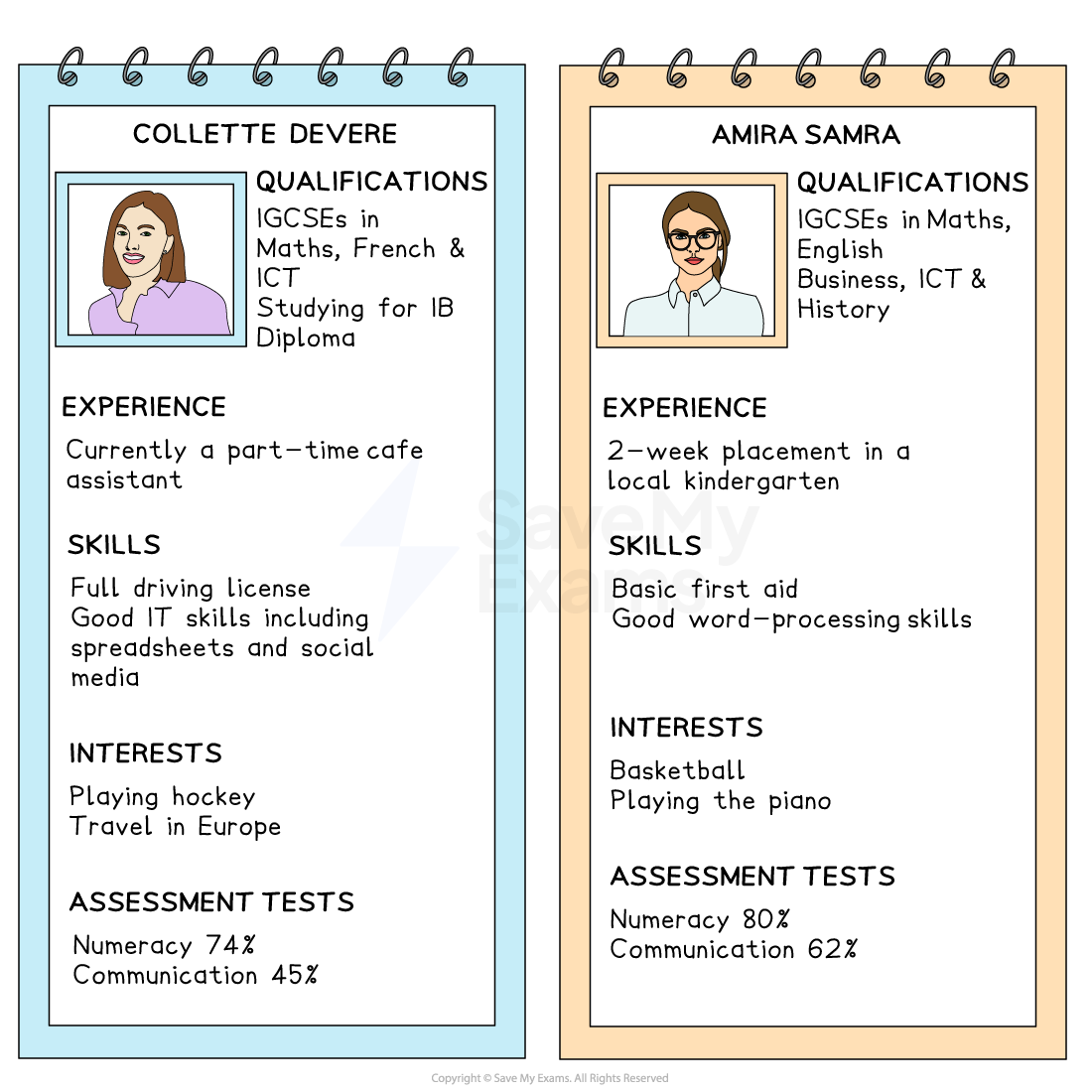
- A small children's bookshop business has received two applications for its advertised sales assistant role
- The shop owner is keen to select a knowledgeable candidate who is capable of delivering good customer service, communicating effectively with its (often young) customers and being willing to support administrative tasks such as banking cash
- Which of these two applicants would likely be appointed?
Applicant analysis
- Amira scored better in the assessment tests. She was nearly 20% better in communication
- Amira has had two weeks experience of working with kids, which will suit this role nicely
- Amira also has a first aid qualification, which is a useful skill when working with kids
- Overall, Amira is a better fit for the role advertised
Was this revision note helpful?